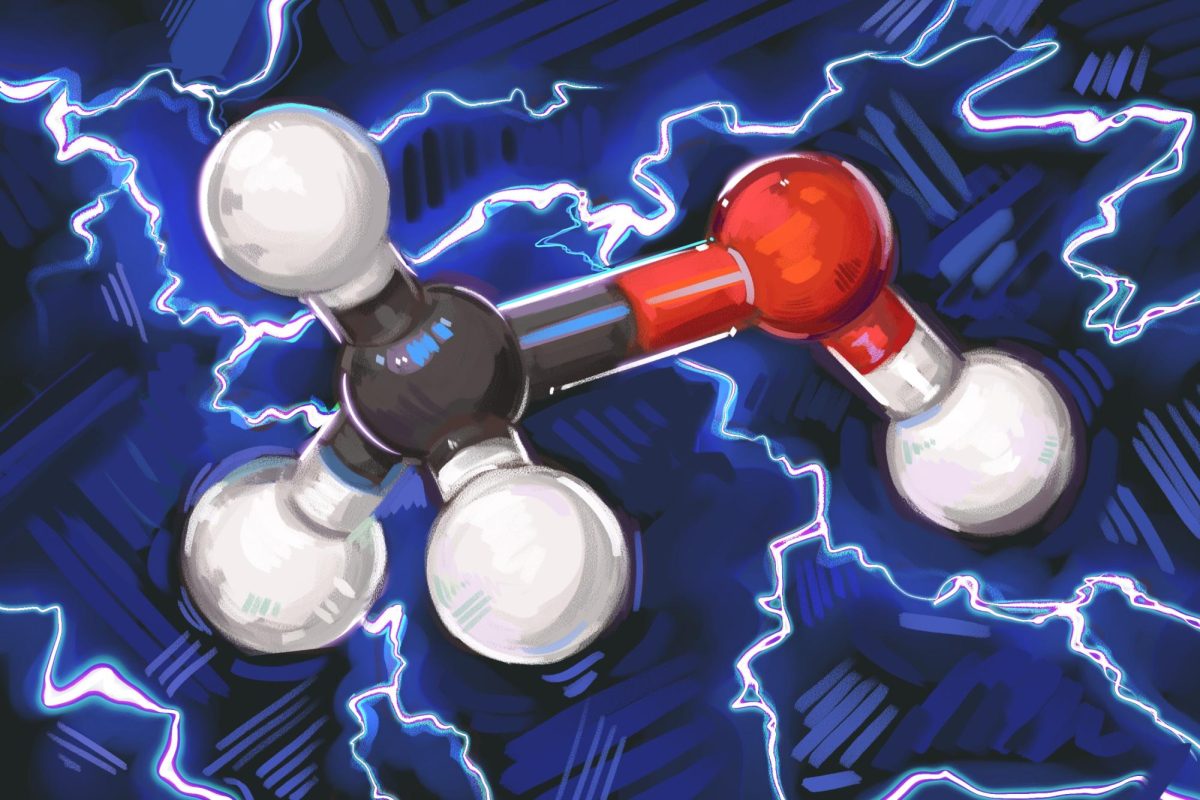
Six Northwestern researchers published a paper April 15 detailing how plasma can be used in a reaction to convert methane to methanol, a fuel and chemical that is the foundation of certain industrial chemical reactions.
Around 110 million metric tons of methanol are produced each year, according to the paper, which was published in the Journal of the American Chemical Society.
The common conversion process is carbon-intensive and occurs in two steps, said third-year chemical and biological engineering graduate student James Ho, one of the paper’s authors.
The method described in the study occurs in one step and doesn’t produce any carbon dioxide byproduct. The process could also be used in reaction technology installed on leaking wellheads, a surface component of gas wells, Ho said. He added that this would turn unused natural gases, which currently accelerate climate change, into fuel.
“(The paper) gives a lot of design principles for a way to engineer additional systems that can utilize electrified processes based on plasma technology for chemical conversion with higher degrees of selectivity and energy efficiency,” said chemistry and McCormick Prof. Dayne Swearer, the study’s corresponding author.
The flask containing the reaction lights up as the reaction is taking place due to the plasma involved, Swearer said. He said the project took about two to three years.
While the researchers knew before starting the project that plasma creates a highly reactive environment, Swearer said most time was spent optimizing the reaction.
Much of Ho’s work in the lab involved testing different conditions to optimize the reaction, both in output and energy efficiency, he said. Ho added that the plasma helps facilitate the reaction.
“The electrons in the plasma are really, really energetic, and they can essentially collide with a methane molecule at high enough energies to break it apart into more reactive radicals,” Ho said. “We can do this, again, only using electricity without needing any external temperature input. So, we have the reactive radicals in the methane, and these react with water since we are bubbling methane plasma into water.”
Second-year McCormick Ph.D. student and study author Stephanie Pecaut said she built computer models for the heat transfer and electrical components of the reaction.
Pecaut said the Swearer Research Group, which Pecaut and Ho are part of, is “actively investigating” what other catalysts and chemicals the system could be used with.
Pecaut said while previous research has involved plasma and controlled systems, this paper introduced water and the copper-oxide catalyst.
“It’s additional complexity, but we’re able to get really, really exciting results,” Pecaut said. “I think this will encourage other people in the field as well to really push their systems and then see what products they can make.”
Email: [email protected]
Related Stories:
— Trienens Institute seeks solutions amid renewable energy transition
— Chemistry Prof. Chad Mirkin wins Harvey Prize for pioneering work on spherical nucleic acids