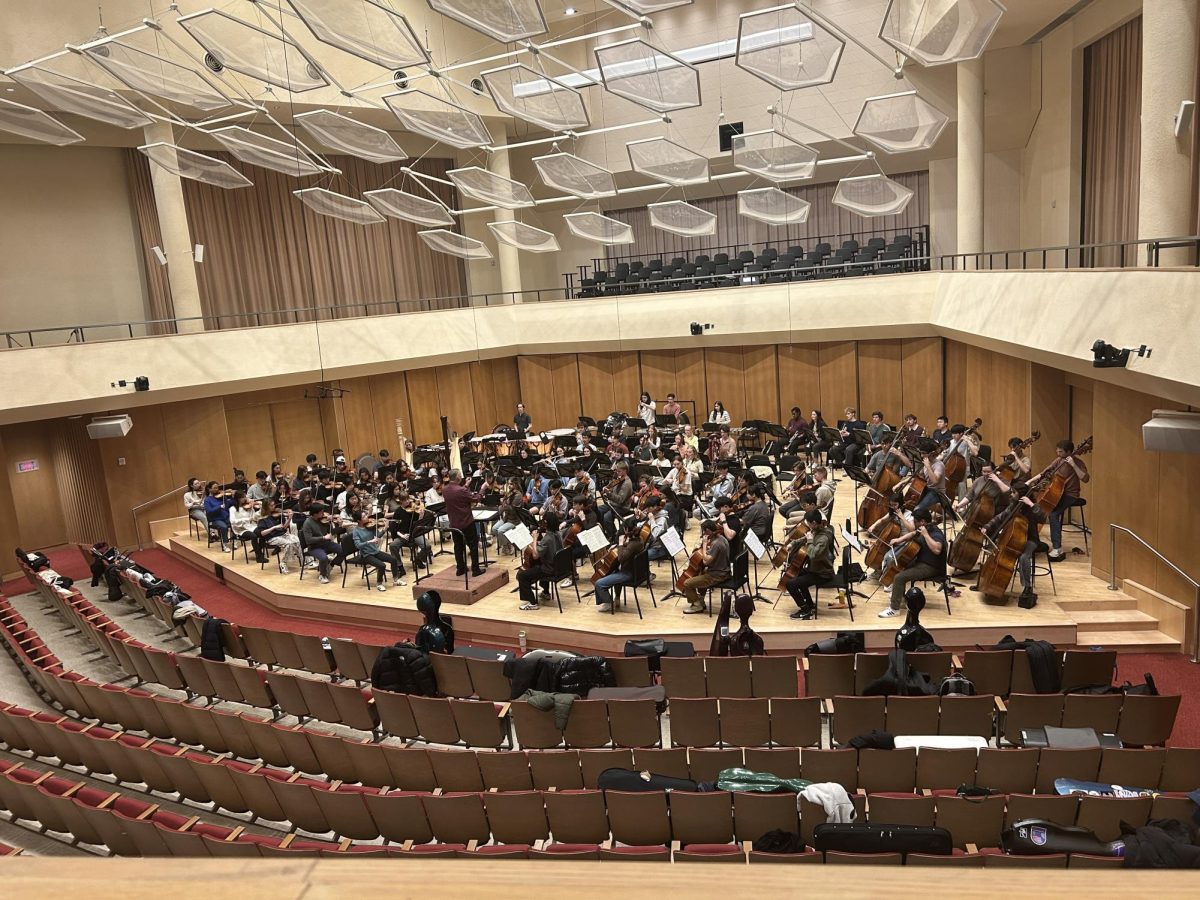
Northwestern University Symphony Orchestra will perform the music to legendary composer Igor Stravinsky’s “The Rite of Spring” on Friday at 7:30 p.m. in Pick-Staiger Concert Hall.
The ballet’s 1913 Paris premiere caused a riot, with choreographer Vaslav Nijinsky having to shout to tell the dancers where to go.
“We go to the ballet to see beauty, then suddenly we hear a sound that can’t be described as beautiful. Then we see all the costumes; we don’t see the beautiful display of ‘Swan Lake’ or ‘The Nutcracker,’ said Luis Aguilar, first-year Bienen doctoral student and director of the Northwestern University Philharmonia. “Instead, we see these primitive human beings. Can I describe that as being beautiful?”
The piece depicts prehistoric tribes coming together to celebrate the arrival of spring by performing a sacred ritual where a chosen girl dances herself to death.
The curtain opens with the first dance, “Augurs of Spring,” a celebration of the Earth. The dancers jump up and down, accentuating irregular beats. The violins and horns accompany them with repeated bitonal chords.
“In the ‘Augurs of Spring,’ (the music) has bitonality — E flat major seven and F flat major at the same time. I can’t imagine what that sounded like,” Donald Schleicher, NU’s director of orchestras, said.
Amid the celebration, a sage comes in and reminds the dancers of the ritual: a chosen girl must perform a sacrificial dance. In Nijinsky’s choreography, the chosen one spins and jumps irregularly, then pounds the ground as she tries to keep dancing. The orchestra plays dissonant percussive chords in quickly changing meters. One last chord is pounded out, and she collapses.
“It’s very pagan, and boy, it’s hard because the patterns are irregular patterns,” Schleicher said. “It’s not something to memorize easily. It’s not organic, and I think that’s probably what a sacrificial dance is.”
Stravinsky once said, “There is music wherever there is rhythm.” The score of “The Rite of Spring” is full of meter changes and conflicting rhythms layered on top of each other. The dancers stomp to irregular beats and make sudden jerking movements. Aguilar said these elements influenced modern forms of dance.
“The way Nijinsky did the choreography inspired modern dance and even hip-hop,” Aguilar said. “The angular movements and the stomping comes out of ‘The Rite of Spring.’”
Second-year orchestral conducting graduate student Eli Zelman said the debut of “The Rite of Spring” was the most cataclysmic event in ballet history.
In Russia, where Zelman is from, Pyotr Ilyich Tchaikovsky’s melodies are beloved, and his ballet speaks to the “melancholic and beautiful side of the Russian soul,” Zelman said. With Stravinsky, the dances are chaotic, leaving the audience on the edge of their seats, he said.
“The rhythms, the meter changes, the orchestration, the colossal size of the orchestra, the dances, they all shock you to the core,” Zelman said.
Tickets for the production are $5 for students and $8 for general admission. The program also includes Richard Strauss’s “Don Juan” and Lili Boulanger’s “Of a Spring Morning.”
Email: [email protected]
Related Stories:
— Jazz ʼCats: Local restaurants and venues featuring live jazz