Content warning: This review contains mentions of sexual assault.
This review contains spoilers.
Five months after Guillermo del Toro’s adaptation of “Frankenstein,” Maggie Gyllenhaal responded with her own —focusing not on the signature monster, but his companion.
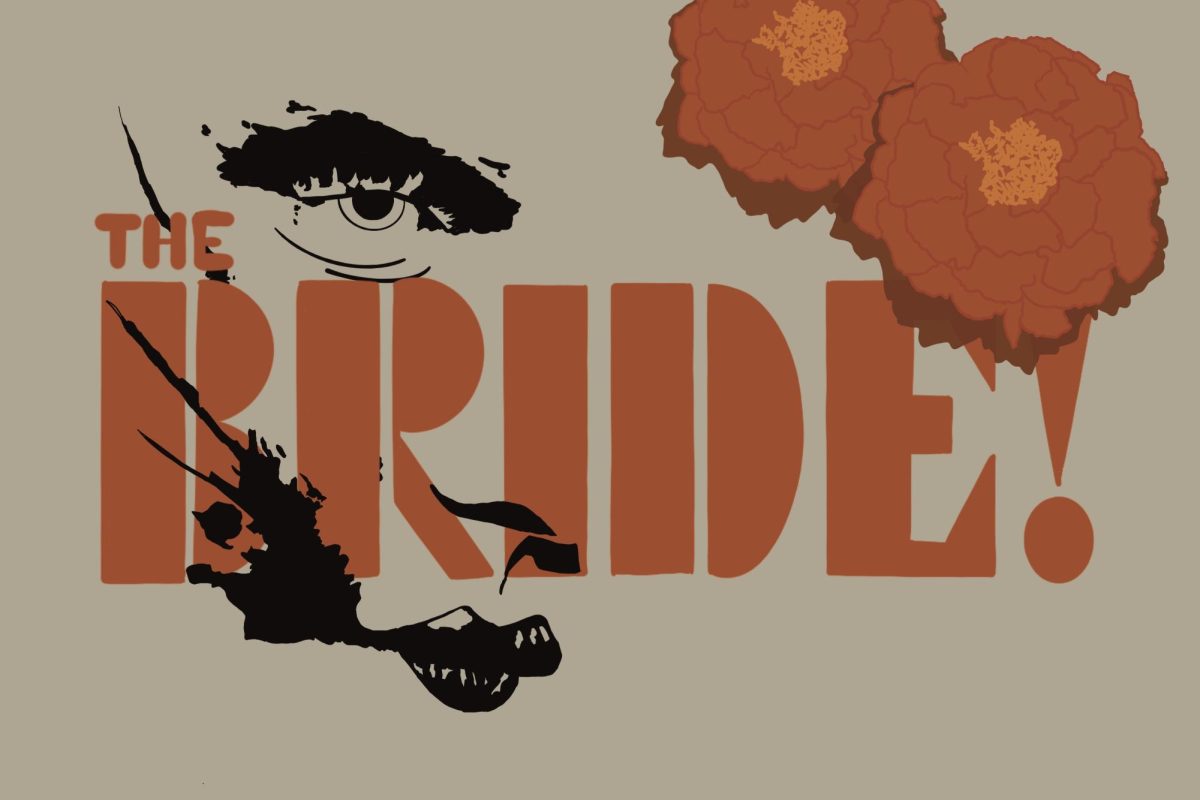
Directed by Gyllenhaal, “The Bride!” follows Frankenstein (Christian Bale), affectionately referred to as Frank, and Ida (Jessie Buckley), who comes to be known as the Bride after her death. The two travel across America as a monstrous Bonnie and Clyde, attacking those who threaten to separate them.
Throughout their journey, they embark on adventures varying in intensity, from crashing elite galas with deranged, monster-like dancing to simple movie dates.
Gyllenhaal’s Frankenstein is not portrayed as scary and monstrous like many other adaptations, but as single and looking for a companion. Frank’s woes end when he and Dr. Cornelia Euphronius (Annette Bening) dig up a grave and find Ida, who was murdered after being pushed down a flight of stairs. Euphronius brings Ida back to life a la Victor Frankenstein, and for Frank, it’s love at first sight. For Ida, not so much.
Bale and Buckley are the acting duo of my dreams. Having watched many of their films, I knew the great lengths they go to to fully embody their roles. The way they depict the evolution of the Bride and Frank’s relationship from cautionary to passionate and codependent is masterful.
Bale’s portrayal of Frank’s violence is most interesting. As opposed to other adaptations where the monster seems consumed by violence, Bale only lashes out when the Bride is threatened.
The catalyst that sets off the duo’s killing spree is when two men attempt to sexually assault the Bride, and Frank kills them in her defense. Violence is carefully implemented in the film almost as a love language. Through the use of violence as defense, their relationship deepens. It is hard not to root for them and much of this can be credited to Bale and Buckley’s exceptional performances.
Buckley, in particular, is the standout of the two, having to balance her portrayal of the Bride with her portrayal of “Frankenstein” author Mary Shelley, who possesses Ida moments before her murder. The inclusion of Shelley as a character in the film, a nod to the 1935 film “Bride of Frankenstein,” was compositionally jarring and distracted from the plot. However, it was captivating to see Buckley transition between the two contradictory roles.
Buckley’s Bride, like Bale’s Frankenstein, also deviates from traditional depictions. In the 1935 film, the Bride of Frankenstein does not speak. In “The Bride!,” this could not be further from the truth.
During the film’s press junket, Gyllenhaal stated that she wanted the theme of consent to be central to the film, encouraging the audience to ask “What about her?” Gyllenhaal’s sentiment was translated perfectly on-screen.
The Bride is headstrong and unabashedly opinionated. From the moment of her creation, she embodies the importance of autonomy, stemming from her life experience of being sexually exploited and manipulated by powerful men. While alive, she had worked undercover as an escort to unveil the seedy misdoings of the mob boss Lupino. When the investigation is closed without resolution, Ida is upset and avows herself to personally reveal the truth, a task cut short by her death.
Yet, when she is reborn, she rededicates herself to this and after giving a rousing speech, inspires an uprising of women, who advocate for autonomy and against the patriarchy whilst bearing The Bride’s signature ink splatter-esque look.
Throughout the film, The Bride repeats the phrase “I would prefer not to,” perfectly summarizing the agency she exercises over her own body. Even as she is presented to Frank as his bride, their relationship does not begin to blossom until she decides she wants it to. Frank is completely enraptured by her, and as the film is set in the 1930s, it is powerful to see a woman wielding the reins.
It is also worth noting that she goes by simply the Bride, nixing the Frankenstein that typically accompanies her name and exercising her autonomy.
The Bride is not the only powerful woman in the film. Penélope Cruz plays aspiring detective Myrna Malloy, a woman working to make her voice heard in the male-dominanted investigative industry. Unfortunately, Malloy was a relatively one-note character and paled in comparison to the three-dimensional Bride.
While the film is on track to being a box office failure, to me, it is a massive success. Bale and Buckley give unforgettable performances and the feminist theme integrated throughout the film is as timely now as it was in the 1930s. While some characters fall flat and some elements feel disjointed, the combination of derangement with delight ultimately made the film unlike anything I have seen before.
Email: [email protected]
Related Stories:
— Reel Thoughts: Guillermo del Toro’s ‘Frankenstein’ is a monstrous success
— Reel Thoughts: Pixar’s ‘Hoppers’ turns an animated adventure into an environmental lesson
— Reel Thoughts: ‘Dreams’ attempts societal commentary but fails in execution