Content warning: This story contains mentions of gun violence.
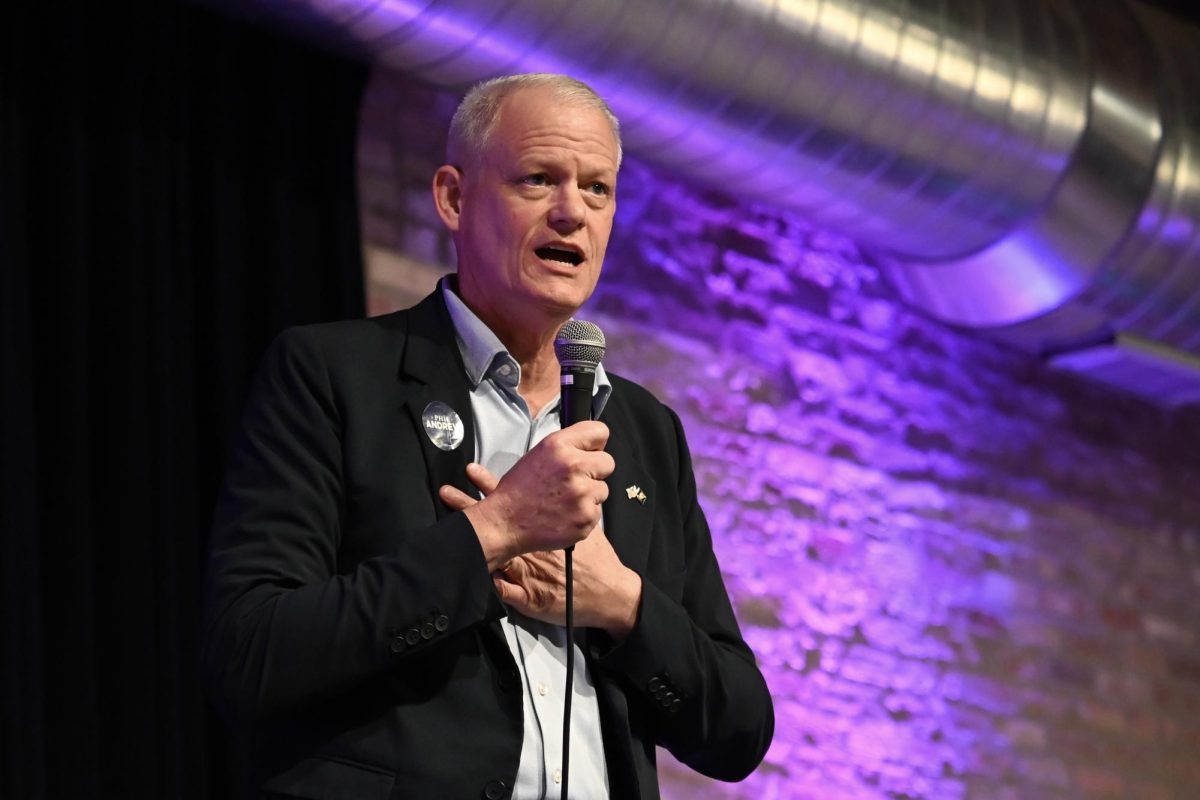
Before Phil Andrew was a hostage negotiator for the Federal Bureau of Investigation, a gun violence prevention advocate or a congressional candidate, he was a 20-year-old college swimmer trying to protect his parents.
In 1988, Andrew was home in Winnetka for the summer from the University of Illinois Urbana-Champaign, where he captained the men’s swimming team. After a school shooting that left one child dead and six others wounded, shooter Laurie Dann fled the scene, drove to Andrew’s childhood home and took him and his parents hostage.
He managed to talk Dann into letting his parents go, but when Andrew tried to disarm her, he was shot in the chest and critically wounded.
Andrew survived. When he returned to UIUC, he juggled class, the swim team and gun control lobbying — beginning a lifelong commitment to justice and public safety.
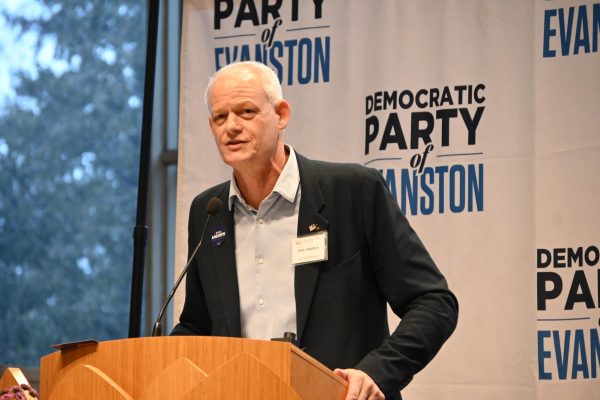
Andrew grew up on the North Shore in a “big Catholic family” as one of seven kids. He spent his summers lifeguarding at Lake Michigan beaches, where he said he made multiple rescues, including saving people trapped beneath an overturned sailboat.
He credited his upbringing in a service-oriented family raised by parents he described as “Kennedy Democrats, Kennedy Catholics,” as well as his time at Loyola Academy in Wilmette, for instilling “that sense of justice and commitment to social good” in him.
After attending law school and spending several years as a practicing attorney while volunteering with violence prevention groups, Andrew joined the FBI in the mid-1990s. He began at a Topeka, Kansas field office, working on counterterrorism, counterintelligence and public corruption cases.
Over a 21-year career with the Bureau, he served stints at its Washington, D.C. headquarters as well as its field office in New York. Andrew said he was deployed to international kidnapping and terrorism cases, including the 2008 Mumbai attacks, and was involved with negotiations tied to the release of kidnapped journalist David Rohde.
Andrew and his wife, Michelle, moved back to the North Shore in 2011, hoping to raise their four children in the same environment in which they had grown up.
Recent empty-nesters, Andrew said three of their four children have pursued naval service. All four are also either current or former collegiate swimmers — three at the U.S. Naval Academy and one at UCLA.
“Our youngest just left,” Andrew said, “(It was) a little badass that she was willing to sign up and go to the Naval Academy at a time when this administration was saying, and this defense secretary is saying, that women don’t belong.”
Andrew spent his final eight years with the FBI working out of its Chicago field office before retiring in 2018 and launching PAX Group, a crisis management and public safety consulting firm.
Among its projects, the firm recently conducted a safety review at University of Arizona following the 2022 murder of a professor by a former graduate student. The review outlined recommendations to improve the school’s public safety. Additionally, the firm has developed a hate crimes training curriculum in partnership with the Illinois Holocaust Museum & Education Center.
PAX Group partner Steve Knipstein has known Andrew for over three decades, from the time Andrew was in law school to when he was running a violence prevention nonprofit.
Knipstein said he has worked with Andrew at PAX Group for three years and is now managing more of the company as Andrew focuses on his campaign.
“Phil doesn’t need to make a name for himself,” Knipstein said. “He wants to serve people.”
From 2018 to 2020, Andrew was the director of the Archdiocese of Chicago’s Violence Prevention Initiatives, which heeds Pope Francis’ call for the Church to become a “field hospital.”
There, Andrew’s mission was twofold: to build safety and resilience programs for the 225 schools and 300 parishes in the region while organizing Catholic assets, including food pantries, homeless shelters, hospitals and social service agencies. He met with a range of people, from interreligious organizations to police departments, trying to understand their needs.
Andrew called this work a “turning point” for the city, emphasizing that this plan helped significantly reduce gun violence in Chicago.
“To solve real problems with people in crisis, you have to actually be close to them, which says a lot about the way that we are running this campaign,” Andrew said.
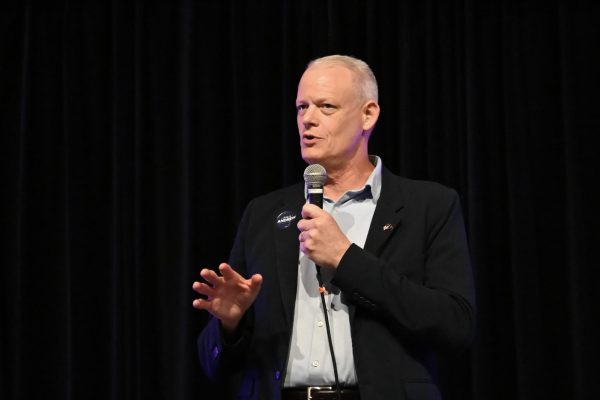
“One of the things that is very important to me is that our communities are still at great risk of gun violence,” Andrew said.
Since the 1988 shooting, Andrew said he has been involved in advancing gun violence prevention efforts at both the state and federal levels. He lobbied for the passage of the Brady Bill, one of the first pieces of legislation to restrict handgun ownership by mandating federal background checks.
Andrew added he has also advocated for gun dealer licensing, firearm restraining orders, assault weapon bans and safe storage laws in Illinois. Now, he is working with activists to pass the Responsibility in Firearm Legislation Act in Illinois, which, among other requirements, would mandate firearms manufacturers to obtain licenses, according to Andrew.
While gun violence remains a critical issue, Andrew said danger can also take other forms, including limited healthcare access and economic uncertainty.
“We have a lot of business leaders here,” Andrew said. “Small business leaders, like myself, they feel that the chaos and the instability has made it very difficult to plan.”
Pointing to the 9th District’s large Jewish community, from its Jewish schools and synagogues to the Illinois Holocaust Museum, Andrew added that community members “constantly feel the threat of terror and hate crimes.”
For example, Andrew noted the antisemitic hate symbols recently painted throughout Evanston and on Northwestern’s campus.
“The threats to safety in our community — as diverse as it is from North Chicago, Uptown, Rogers Park — still exists. But now it’s unique to each community,” Andrew said. “Some communities are being targeted now by threats, intimidation and violence, by the federal government, by the use of ICE.”
Former congressional candidate and Chicago 50th Ward Committeeperson Bruce Leon endorsed Andrew after withdrawing from the race in January.
Leon recalled visiting a factory with Andrew on the campaign trail.
He said Andrew walked around, looked each employee in the eye, asked them their name and what issues were important to them — an experience that Leon said reminded him of the presidential campaigns of former Presidents Bill Clinton and Barack Obama.
During candidate forums, Leon said it was already obvious to him that Andrew was different from other congressional contenders.
“He’s not a yeller, he’s not a screamer, he’s not a panicker,” Leon said. “He actually likes to talk about solutions and solving problems and crisis management. I often say to people, ‘Sometimes, I feel like he’s the only adult in the room.’”
What struck Leon about Andrew was that when he doesn’t know an answer, he asks questions to learn.
When Leon withdrew from the race, he joked that Andrew was such a strong second choice it made him question his first choice, too.
“Then I realized maybe I had to drop out of the race,” Leon said.
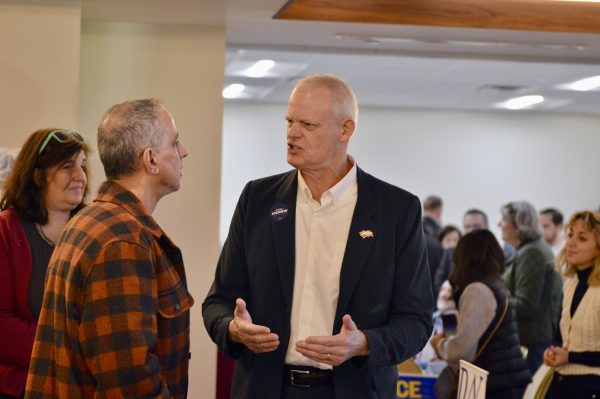
Just days away from the March 17 primary election, Andrew said he was confident in his “surging” campaign, as voters turn away from those who have played “political games to finance their campaigns.”
He condemned “career politicians like Dan Biss and Laura Fine,” who he said have become “part of a political class” that take dark money contributions.
“They grew up in that system,” Andrew said, referencing former Illinois House Speaker Michael Madigan’s legacy of corruption and financial mismanagement. “And now they’re using the same playbook.”
Additionally, he criticized both Biss and Fine for running simultaneously for Congress and state Democratic Party leadership positions, accusing them of using money from the committee races to promote their congressional campaigns.
To Andrew, this is an issue of public trust and accountability, arguing others lack the “high ethics” this moment demands.
“When you’re battling the most corrupt administration, you have to come in with clean hands,” Andrew said.
Email: [email protected]
Bluesky: @yongyuhuang.bsky.social
Related Stories:
— Mayor Daniel Biss isn’t afraid to make waves. Now, he’s aiming for Washington.
— ‘I didn’t want to wait’: Kat Abughazaleh looks to upset congressional status quo
— Laura Fine looks to ‘get things done,’ emphasizes legislative record in congressional bid