At 28 years old, this isn’t Bushra Amiwala’s first election cycle. It’s not her second, either.
As a 19-year-old student at DePaul University, she ran for Cook County commissioner, attempting to unseat 16-year incumbent Larry Suffredin. Though she lost that race, Amiwala said Suffredin encouraged her to stay involved.
More than that, Amiwala added, she walked away with 5,400 new voters.
In 2019, Amiwala was elected to the Skokie School District 73.5 Board of Education, becoming the first Gen Z woman and the youngest Muslim to become a U.S. elected official. She is currently serving her second term, having won reelection uncontested in 2023.
Now, Amiwala’s aiming for a congressional seat.
“I don’t have an independently wealthy family at all. I do not have a Rolodex of donors. I don’t have an affluent partner or community that I can rely on,” Amiwala said. “I’m really proud to have paved this with dedicated people that want to see someone like me representing them.”
Niles West High School social studies teacher and debate coach Eric Oddo has known Amiwala since she was a student at Niles North High School. He later grew to know her better when she worked as an assistant debate coach at her alma mater.
“Even in times when she’s already experienced losses politically, she bounces back — which is a huge, important thing for the youth to see,” Oddo said.
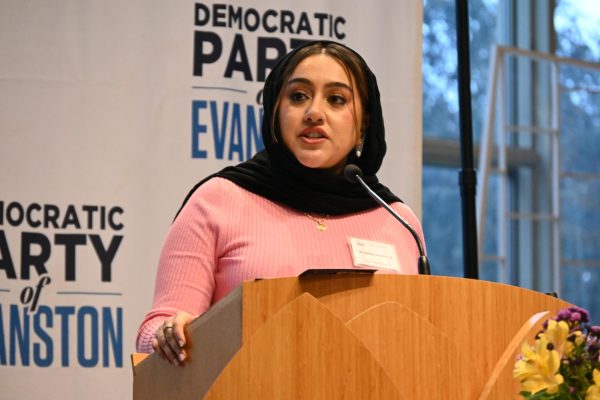
Born and raised in the 9th Congressional District, Amiwala has emphasized her knowledge of the area’s character and its communities.
“When I announced my candidacy, I did not have to spend copious amounts of time trying to recruit volunteers or find where people are and learn what’s important to them through polls,” Amiwala said. “I was already ingrained in that fabric of society.”
Amiwala pointed out that the U.S. census previously designated the district’s significant Middle Eastern and North African population as white — which she said obscures its true diversity. At least 90 languages are spoken across the district, she explained. According to Data USA, 35.1% of households report speaking a non-English language at home as a primary shared language.
She said the district is also “home to the sandwich generation,” which she described as those with aging parents and young children. The community also claims some of the region’s highest and lowest earners, Amiwala said.
Growing up, Amiwala said her family was reliant on the Supplemental Nutrition Assistance Program.
“That means the first of the month was our snack of choice,” she said. “That meant when the Trump administration was cutting SNAP benefits, this was deeply personal work.”
She said reductions in food assistance programs are the kinds of issues that harm communities of color and non-native English speakers. If elected, Amiwala added, her office will “at the minimum” provide support in the district’s three most commonly spoken languages other than English.
Amiwala acted as “the literal translator” for her family, she explained. And that outreach didn’t stop there. She said that in June, when the first community member was taken by Immigration and Customs Enforcement in Skokie, she interpreted for the impacted family in Spanish.
The most vulnerable community members are not the ones “raising their hands asking for help,” she said.
“They’re drowning and trying to survive,” Amiwala said. “It’s being a proactive legislator that doesn’t need to wait to be told what their struggle is.”
According to Oddo, Amiwala is an inspiration for students who don’t come from elite schools, as a candidate with immigrant parents and an alumna from a high school “full of diversity.”
Oddo said it’s important to have diverse representation in today’s political climate.
He added he strongly identifies with Amiwala’s policies about increasing federal funding for public education.
“You can see such drastically different schools based upon the funding that goes to them. And in Illinois, it’s very local,” Oddo said.
Amiwala said her legislative goals include providing Medicare for All, paving paths to citizenship while abolishing ICE and increasing federal funding for public education.
Although threats to democracy are something that “deeply plague” her personally, Amiwala added, “the average community of color is not thinking about that.”
“Bring back the things that materially can benefit and improve someone’s life first before we try to zoom 50,000 feet outward,” Amiwala said. “Because even though this is a federal office, it is a hyper-local election.”

Amiwala’s calendar features an additional layer compared to her primary opponents. She’s campaigning during the month of Ramadan, and Eid, the holiday marking the end of the Islamic holy month, falls two days after the March primary.
Come election day, Amiwala will still be fasting from sunrise to sunset.
“It actually poses a unique opportunity to normalize my faith in a way that is traditionally constantly being outcasted and misrepresented,” she said.
Amiwala said the district is home to one of the largest concentrations of Muslim Americans in the state, and she has also watched non-Muslim neighbors to her faith respond warmly.
The host of a campaign meet-and-greet set out dates so that she could break her fast during the event, and Amiwala added that attendees of a recent candidate forum wished her a happy Ramadan.
As a part-time MBA student at Kellogg School of Management at the time, Amiwala participated in Northwestern’s April 2024 pro-Palestinian encampment. There, she attended a Friday prayer led by Imam Omar Suleiman and brought umbrellas to hand out to protestors in the rain.
“I’m proud to have been a student at Northwestern that contributed in the small way I did,” Amiwala said.
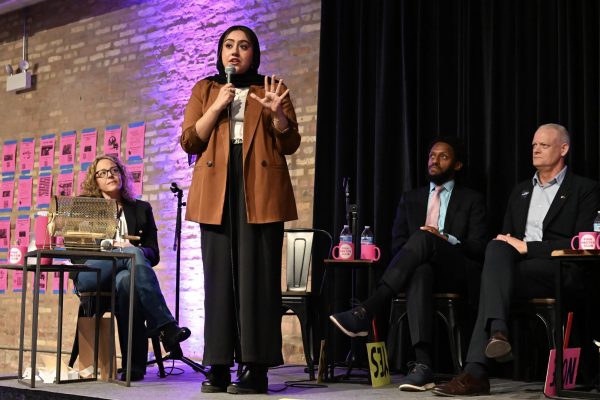
Before her campaign, Amiwala spent several years working full-time at Google, while also serving on the school board. She left her job in September to campaign full-time.
Former Skokie school board secretary pro-tem and Winnetka teacher Maureen Jacob, who served alongside Amiwala from 2021 to 2025, said she initially had doubts about the young school board member, worrying that she would be “another flashy social media politician.”
Jacob witnessed Amiwala lose the commissioner’s race and expected her to try again somewhere else. But instead, she explained, Amiwala “learned from the loss” and “took notes.”
Amiwala soon disproved Jacob’s doubts. According to Jacob, Amiwala consistently represented “the adult in the room,” despite being the youngest person on the board.
What struck her most was how process-oriented Amiwala proved to be, Jacob added. Although Amiwala didn’t come to the board with an educational background, Jacob, a teacher by trade, was impressed by how she handled gaps in her knowledge.
“That’s another thing that I was always impressed with is her ability to stop and ask really good questions and try to figure out a system if she didn’t understand it, rather than becoming entrenched in a position,” Jacob said.
She said that Amiwala gravitated toward negotiations, where she was focused on “reorienting people” to common goals and then examining options “pragmatically.”
According to Amiwala’s website, some of her accomplishments include making the district livestream public board meetings, offer more diverse food options for students and provide free after-school programming.
“She’s not somebody who is constantly talking,” Jacob said. “She’s very much a doer.”
Amiwala notes that she’s the only candidate in the race with experience across the public, private and nonprofit sectors.
Former U.S. Rep. Marie Newman, who has known Amiwala for roughly a decade and is now volunteering for her campaign, said that combination is rare and valuable.
“The most successful members of Congress are those that have worked in non-profit, in for-profit businesses and in government,” Newman said. “You get off the ground really quickly in Congress when you understand how all those models work.”
Newman added that although Amiwala has been “an amazing fundraiser,” it’s hard to go up against the millions that the American Israel Public Affairs Committee has reportedly funneled into the race.
As concerns about outside spending have grown, Amiwala has criticized candidates who run “on a platform of taxing billionaires and getting big money out of politics” but accept dark money contributions.
Amiwala accused her competitors who sport redboxes on their websites of “actively inviting” external spending on their behalf because they are “unable to earn people’s votes without millions of dollars being spent in TV ads and mail.”
“That’s a sign of a mediocre candidate and a mediocre message at best,” Amiwala said.
She also denounced her opponents who have “flip-flopped” on their issues, depending on the time and place, and stressed that consistency, along with “everyday donors,” is one of the tenets of her campaign — which also includes credibility, lived experience and relationships.
To her, these are things that “money can’t buy.”
Email: [email protected]
Bluesky: @yongyuhuang.bsky.social
Related Stories:
— Mayor Daniel Biss isn’t afraid to make waves. Now, he’s aiming for Washington.
— Laura Fine looks to ‘get things done,’ emphasizes legislative record in congressional bid
— ‘I didn’t want to wait’: Kat Abughazaleh looks to upset congressional status quo