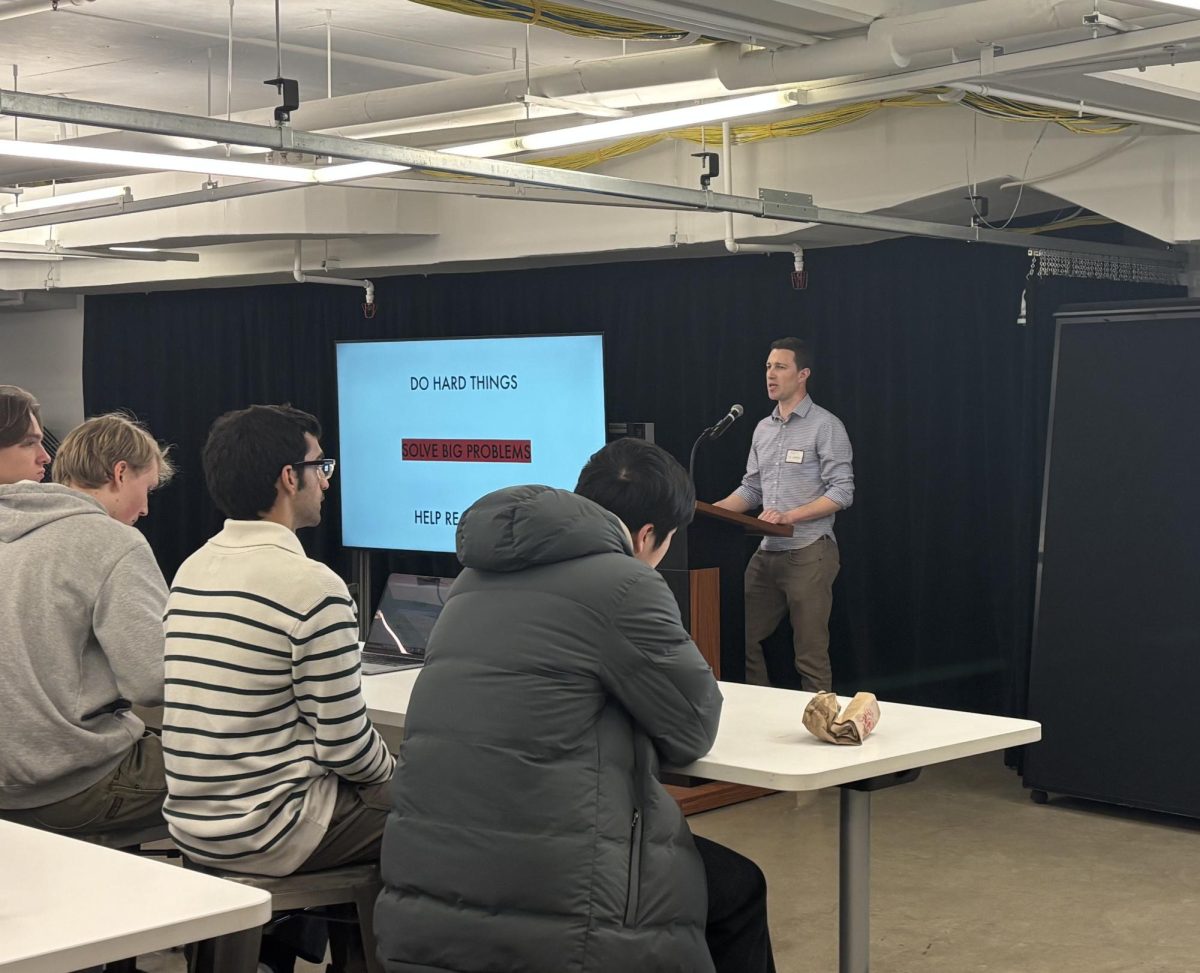
The Garage at Northwestern hosted four speakers Saturday to explore problems in their respective fields in the first-ever Problem Summit for students interested in brainstorming startups.
The summit featured faculty and staff from different fields of study such as communication, global health and medicine. They proposed problems in their field for students to brainstorm in collaborative groups, Mike Raab (Communication ’12, Kellogg ’22), executive director of The Garage, said.
“Great startups do not come from ideas,” Raab said. “Great startups come from solving big problems.”
Feinberg Prof. Keith Summa presented the first problem, which focused on the circadian clock system in humans.
Summa said society works against our circadian systems due to consistent exposure to city lights, the screens of mobile devices and the presence of jobs that require individuals to be awake at night. Summa said these factors cause disruptions in the circadian system that can lead to many health concerns, such as diabetes and depression.
Medill Prof. Patti Wolter presented her problem in the context of science’s representation in the media.
“But I am wondering, ‘Is there a different answer, is there a different product or mechanism or tool?,’” Wolter said. “These are all problems that need to be overcome.”
Wolter prompted students to explore ways to educate readers on the difference between factually supported science and false claims.
Curriculum Director for The Litowitz Center for Enlightened Disagreement, Brad Zakarin, asked attendees for a way to teach disagreement to grade school students through activities or games.
“One thing that I found that was super helpful in getting to agreements or having some sort of common understanding even if you disagree fundamentally with somebody else was writing it out,” first-year business master’s student Eliza Doll said.
Anthropology and global health Prof. Sera Young ended the Summit by asking students to brainstorm how they could bring awareness to the available resources combatting water insecurity.
Young said the water sector only measured insecurity through physical indications such as the volume of a body of water. However, she said the sector failed to consider the social obstacles individuals face in obtaining the water.
“A lot of those problems are going unseen because of the way we have been measuring water insecurity,” Young said.
The event concluded with students speaking to one another about the ideas for startups they now have inspired by the problems presented.
“They might not have obvious solutions at this time, but that is the challenge and the opportunity,” Raab said.
Email: [email protected]
Related Stories:
— 3 of 8 Chicago Inno’s 2025 Under 25 honorees developed their startups at Northwestern’s The Garage
— Creating in The Garage: A guide to NU’s entrepreneurial hub
— Garage startup Vouchd bridges the gap between nonprofits and high school volunteers