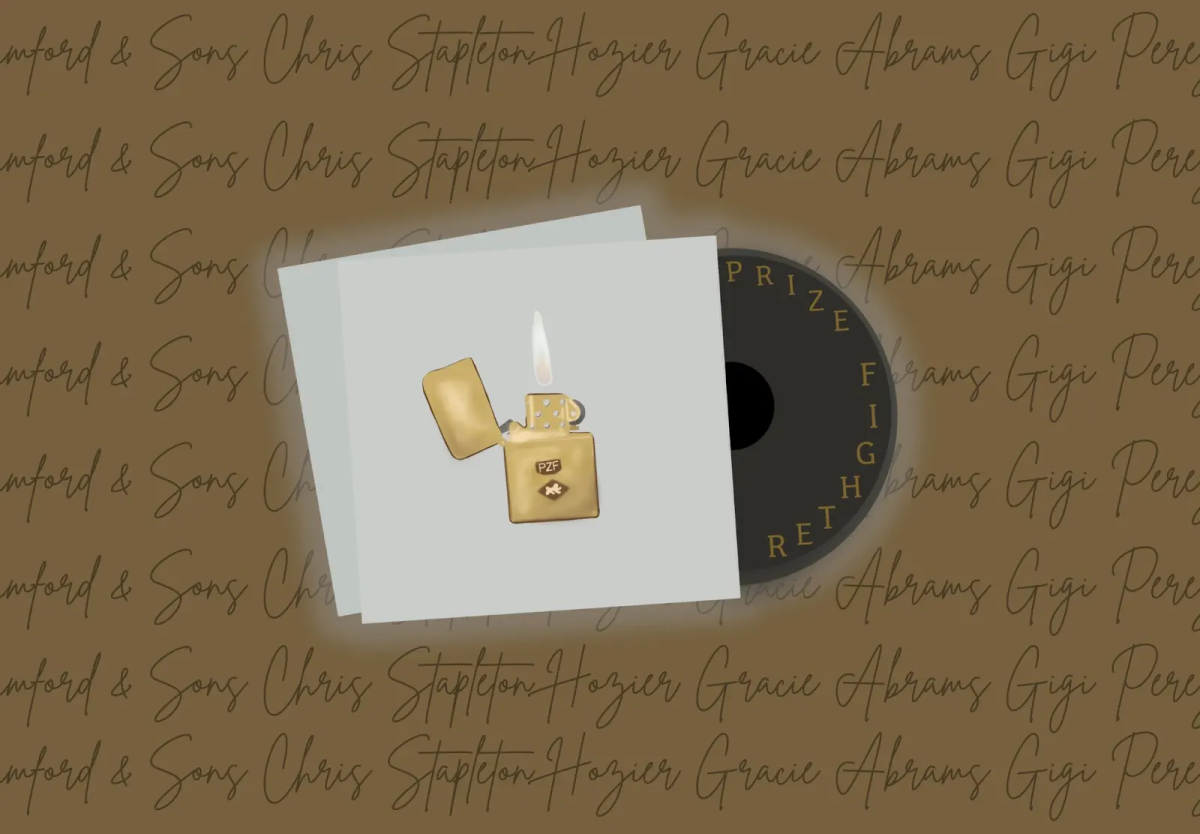
Given that English folk-rock band Mumford & Sons once sang the lyric “I will wait” 20 times in the same song, I’m not sure why I’m so surprised that their new album, “Prizefighter,” relies so heavily on melodic and lyrical repetition.
This monotony is ultimately what prevents “Prizefighter” from being more than mindless department store background music. But the album does have a few standouts, primarily in the songs where the band takes risks through unique guest features or intriguing melodies and tempos.
Released Feb. 20, “Prizefighter” is the sixth studio album for the three-man band, who released their first studio album, “Sigh No More,” almost 17 years ago. Given their longevity, it’s no surprise the band has the industry clout to collaborate with so many other popular artists, whose features are the highlights of the album.
The project opens on a strong note with “Here (with Chris Stapleton),” a track that examines themes of vulnerability and is backed by the addictive, muted but upbeat folky tempo that made Mumford & Sons famous. The lyrics read almost as a confessional: “And here’s my pride, and here’s my shame … Here’s all the mistakes that I made / For too long.”
The song exemplifies the Achilles’ heel of “Prizefighter” early on, with the utterance of “here” in almost every line in the song, making it lyrically unengaging.
The track is followed by another strong piece: “Rubber Band Man (with Hozier).” The song allows Hozier to show off the full strength of his voice, which fantastically complements that of frontman Marcus Mumford. The track may be the highlight of the album — it excels musically with smooth crescendos and beautiful guitar strumming. The song’s message is encapsulated in the refrain, “You’re a world away / But you’re still the same / I know you by your heart / I will call you by your name,” which conveys the emotional tumult of an unsteady, push-and-pull relationship.
Unfortunately, the following songs fall flat. “The Banjo Song” and “Run Together” sound almost identical, and their respective choruses are so repetitive that I have to fight the urge to skip the songs after hearing their first refrains.
While the next two songs, “Conversation with my Son (Gangsters & Angels)” and “Alleycat,” were two of my initial favorites for their sweet, soothing melodies, the lyrics were disappointing. “Conversation with my Son (Gangsters & Angels)” addresses an existential conversation about the meaning of life and the existence of heaven, which would theoretically give songwriters plenty of material to work with lyrically.
Incorrect.
The outro repeats the same lyrics for over two minutes, which was absolutely not needed. “Alleycat” addresses themes of exploration and discovery, framed partially through the metaphor of an alleycat, but unnecessarily asks the question “Is this all there is?” of the listener 10 times.
The titular track “Prizefighter” and “Badlands (with Gracie Abrams)” have almost haunting qualities to their openings. But the eponymous song doesn’t build anything memorable out of this attention-grabbing start.
However, “Badlands (with Gracie Abrams)” stands out in terms of production and melodies, especially because Abrams’ voice is such a stark contrast to Mumford’s. Disappointingly, though, the song only offers cookie-cutter lyrics as it attempts to detail the life of a risk-taking protagonist.
“Icarus (with Gigi Perez)” and “Begin Again” are also particularly satisfying due to their crescendos into high-energy songs. While both songs are predictably repetitive, “Icarus (with Gigi Perez)” is buoyed by the storytelling that accompanies the retelling of the classic Greek myth. Perez’s voice complements Mumford’s well, and the balance of lyrical ingenuity and musical production makes it stand out on the album.
“Begin Again” feels like a callback to the folk-pop-rock smash hits of the 2010s, and while it doesn’t really have anything substantial to say, it is an earworm.
Unfortunately, the last three songs on the album are barely distinguishable to me, despite listening to the album over five times. “Shadow of a Man,” “I’ll Tell You Everything” and “Clover” are so generic that I can’t even come up with anything insightful to say about them.
“Prizefighter” is like watching toddlers get on a seesaw: When one side — the lyrics — is successful, the other side — the musical components — often fails. While they’re always trying to strike a balance, they are rarely successful.
Email: [email protected]
Related Stories:
— Liner Notes: Megan Moroney’s ‘Cloud Nine’ reaps what it sows
— Liner Notes: Baby Keem’s ‘Ca$ino’ is moving yet brief
— Liner Notes: Hilary Duff’s ‘luck… or something’ is riddled with cringeworthy lyrics, nostalgia