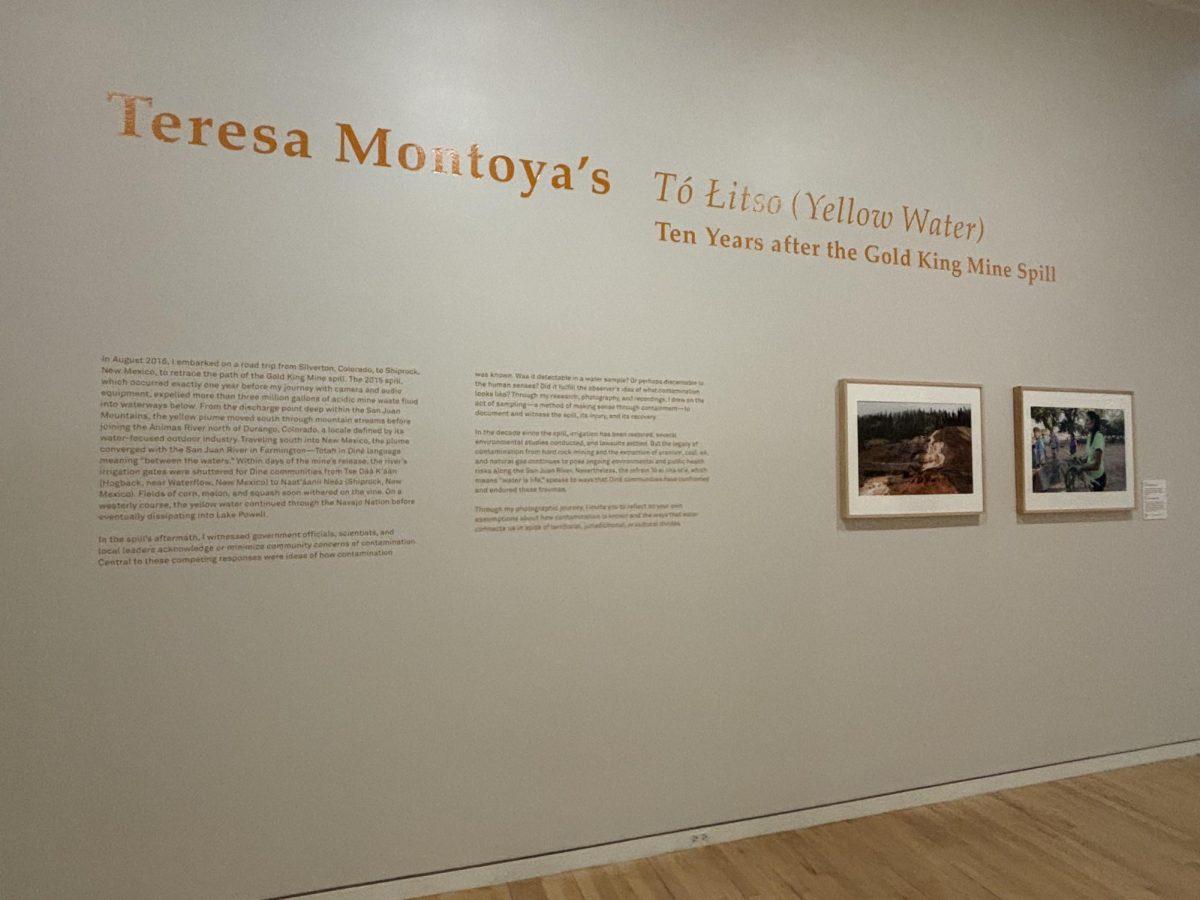
ALLEGRA LIEF: From The Daily Northwestern, I’m Allegra Lief. Today, The Daily speaks with artist and Assistant Professor of Anthropology at UChicago Teresa Montoya, whose exhibit “Tó Łitso (Yellow Water)” is being featured at the Block Museum from February 4th to the end of spring quarter.
ALLEGRA LIEF: Will you just start by talking about the genesis of your exhibit, what drew you to retracing the path of the Gold King mine spill through photography and other media, and what drew you to the project initially?
TERESA MONTOYA: This project began in August of 2016, so exactly one year after the spill. But in many ways, my knowledge of the spill started with the origination of the spill itself, which was in August 2015, and I had just moved back home to the Navajo Nation to start my graduate research. So it just happened to be … there was a confluence of multiple environmental crises happening at the same time, and the Gold King mine spill was the most visible, arguably because of the yellow water of the mine discharge.
ALLEGRA LIEF: I know your exhibition combines a lot of media, photography, sound recordings, water samples and mapping. How did you approach weaving those all together to tell a unified story?
TERESA MOMYOUA: This project initially began as a film project. So I studied filmmaking through my graduate program at New York University, and so I collected, actually, dozens of hours of footage, and the photographs were meant to help me storyboard what would be a film. But making a film, it takes a lot of time. But, I think I got wrapped up in trying to figure out how to end the film. There was just, like, some final footage that I wasn’t able to get. And in the meantime, I had been approached by a colleague at Anthropology Now, which is a journal, and they were seeking submissions for photo essays, and they were already familiar with some of my work, so that became the impetus for me to take what I had and make a photo essay. I’ve been taking photographs since I was like 13, when I got my first camera. So I’ve always loved photojournalism. I mean, I wanted to be a National Geographic photographer when I was young. I worked as a wedding photographer all through college. I took several portraiture classes in college. Photography has always been a natural medium for me. Translating the terms of my research into the visual medium was a way for me to help reach a broader audience.
ALLEGRA LIEF: How do you balance multiple intentions when you’re trying to get a photo?
TERESA MONTOYA: I guess I see photography similar to, maybe a way that a writer sees a pen or a keyboard. You know, it’s just it’s a medium for translating thoughts and ideas. And there’s something very potent, I think about photography that, yeah I think has the capacity to reach more people, because you don’t need, like, a background in anthropology or reading a certain sort of theory in order to just see a photograph. So I think that was initially my intention, was just trying to document the aftermath of what had happened, and also to kind of understand how communities were reacting very differently to this spill. But also, I was thinking about, “Oh, this is a way for the visitor to also imagine themselves in this space,” you know by listening to the water samples within the gallery. And even though I started out with photographs, it wasn’t until, you know, after all these components were brought together, that I thought, “Oh, the photograph itself is also a sample. It’s a slice of time.
ALLEGRA LIEF: I know you mentioned briefly how your work centers water. I know it’s a resource sample, kind of an example that carries history, and one that can simultaneously also fail certain communities profoundly. How does this conceptualization influence your practice?
TERESA MONTOYA: Well, a lot of my broader research looks at a environmental governance and issues of tribal sovereignty and jurisdiction, and I think water contamination, especially with spill events like this, unsettle our assumptions that we even have about the fixity of geopolitical boundaries, about a nation’s able to respond to the spill event to protect, you know, the people, the citizens that live within its boundaries. Water does not respect boundaries. So that’s, that’s kind of what I was trying to get at with the selection of these images. I took hundreds of images for the project itself, but I had to narrow it down to a set of 24, which actually was kind of a challenge, like, what is the story that I’m trying to tell.
ALLEGRA LIEF: You referenced your indigenous identity and how it clearly plays a big role in the project. How did it influence your storytelling, and how you felt personally connected to the works?
TERESA MONTOYA: So I’m Diné, which means the people. And so I’m a member of the Navajo Nation. So, you know, I was doing my research on a Navajo Nation. And there was a lot of coverage on a national media scale, so I was interested in also helping document that same story, but from a Diné-centered perspective.
ALLEGRA LIEF How does your Diné identity shape how you like to broadly explore work and how you tell stories through art, not just within your own project?
TERESA MONTOYA: I think it’s just an attention to the broader politics of representation that have disadvantaged or obscured Indigenous stories. And you know, what does it mean to have, you know, a Diné or an indigenous understanding of things that should be shown, but also the things that we prefer not show or tell. And I also say this in terms of, I have like curatorial experience. So I think, you know, having an understanding of the culture, and I don’t speak Diné bizaad, the Navajo language fluently. So also, I’m not trying to be a stand-in for Navajo Nation or Diné communities at large. But you know, as someone who has kind of always lived in and between the reservation and other places, I guess I kind of view my position as, as a translator of different stories and mediums.
ALLEGRA LIEF: Going back to the exhibition itself, what is one photograph or piece of data or sound recording that has a particularly strong meaning to you or was an immediate yes during the creative process?
TERESA MONTOYA: There’s two framing images to the exhibition itself. So there’s that iconic view of the, the acid mine discharge that’s running down the mountainside. And I think that’s iconic of what we imagine the aftermath of a spill to look like. And I think it’s a very alluring image, like people are drawn to it. It’s what you could call sublime, right? It’s kind of haunting and beautiful, and it has all of that mixed together in one image. And then I paired that with an image of my friend and collaborator, Janene Yazzie, who, in the photograph, she’s holding ears of corn. And this is, this was taken during a food sovereignty gathering that she helped organize on a Navajo Nation, and this was one year after the spill. So kind of, in juxtaposing those two images, I mean, you see the violence of mining extraction in that first image. But then in the second image of Janene, it’s like, there’s still healing. I’ve heard this from many people in other indigenous contexts. You know, living through colonial violence and genocide over millennia. You know, this has been one catastrophic event, but indigenous people have endured. So I think that image kind of points to that enduring relationship and resilience that, like, we’re gonna plant crops again.
ALLEGRA LIEF You reference your academic work as well, and how has that research shaped or evolved alongside your artistic practice? How does one inform the other?
TERESA MONTOYA: As I said, I think both of them are mediums to convey, yeah my interest in how contamination impacts human relationships, in the broadest terms. So photographs can help do that right, like no documentary storytelling. I can do that with writing, I interview people, and they tell oral histories, and then I’m helping contextualize that through historical events. But those are both just two ways of storytelling.
ALLEGRA LIEF: How do you hope communities and audiences, both in and outside the indigenous community, respond to your work?
TERESA MONTOYA: Well, as an educator, obviously, I hope my work spurns people to want to educate themselves. I know a lot of people with the Midwest audience did not know about the Gold King mine spill. But there’s a lot of other similar events that have happened in the Midwest. Actually, the Flint water crisis was happening around the same time as the aftermath of the Gold King mine spill. No matter where you are, there’s, I think, the threat or history of some form of contamination. So it’s, in that sense, sadly, is a universal experience. But I do think it’s, you know, an obligation for people to understand their place in broader environmental systems and ecologies. You know, how can we be better stewards of the places that we live? And how can we also, like, honor and respect those places by understanding the history also of other land relations?
ALLEGRA LIEF: Is there anything else you feel like is important to get across about your creative process and your hopes for the exhibit in general?
TERESA MONTOYA: I, it was very intentional in the gallery space, like, even the map, for instance, it prioritized Diné place names. And these are like, maybe they’re small things that a viewer wouldn’t recognize right away. But I consulted with folks back home about the names of Diné waterways, of course, the highlighting of our four sacred mountains. The map that’s showing the Four Corners region doesn’t even name the states. And so, there’s little things like that that, once again, is trying to push visitors to unpack their own assumptions about, I mean, even, like a map, right?
ALLEGRA LIEF: Well, thank you so much for speaking with me.
TERESA MONTOYA: Aww, thanks.
ALLEGRA LIEF: From The Daily Northwestern, I’m Allegra Lief. This episode was reported and produced by Allegra Lief.
The Audio Editor is Ruby Dowling. The Multimedia Managing Editors are Femi Horrall, Yong-Yu Huang and Jonah McClure. The Editor in Chief is Emily Lichty.
Our theme music is “Grand Panda” by Modern Monster, used under a Creative Commons Non-commercial International license and provided by the Free Music Archive.
Follow us on X and Instagram @thedailynu.
Email: [email protected]
Related Stories:
—Sound Source: Northwestern a cappella groups find harmony in traditions
—What’s New at NU: Hear the voices of NU students protesting against ICE