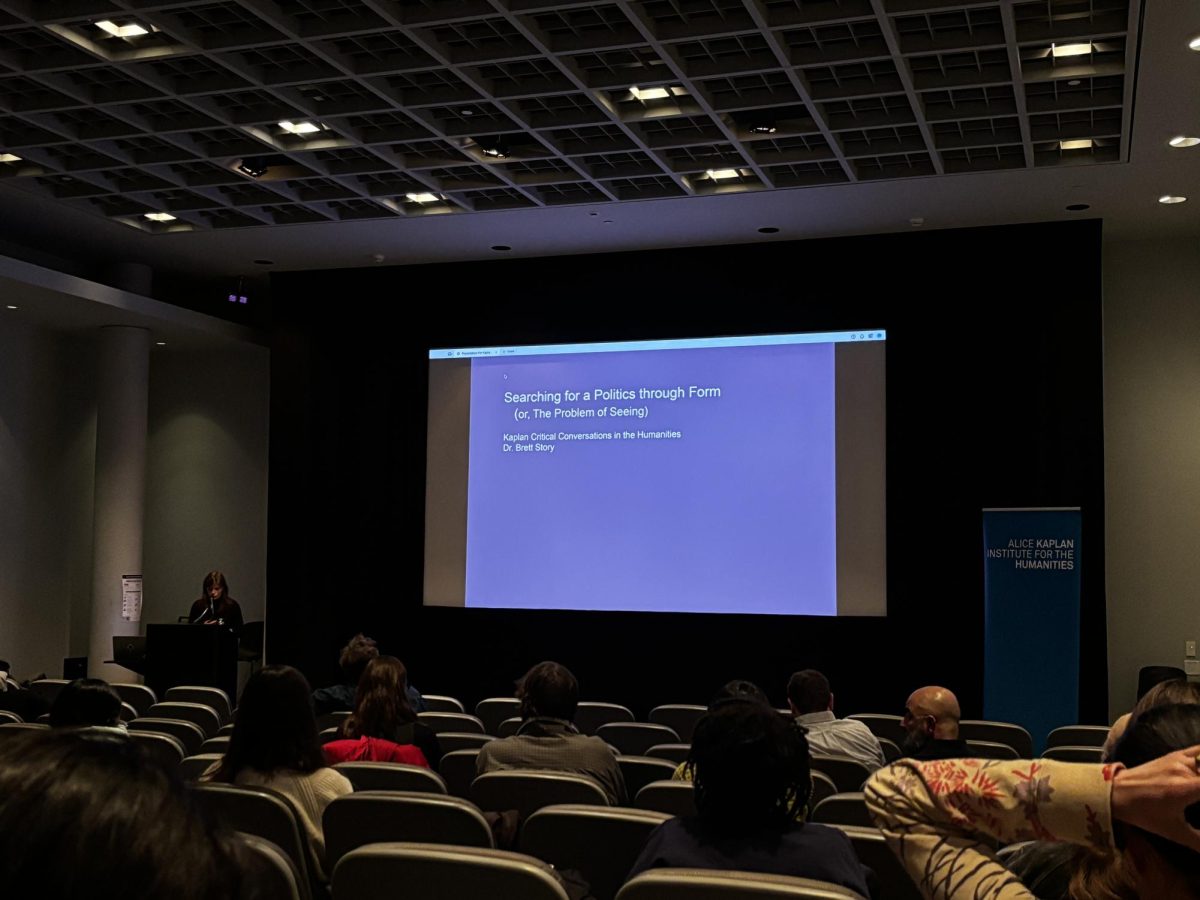
Brett Story, an award-winning filmmaker, writer and geographer, described the inspiration behind her most recent feature film documentary, “Union,” at the Alice Kaplan Institute for the Humanities’s keynote Thursday.
The event was held in collaboration with the Block Museum of Art as part of the institute’s Critical Conversations in the Humanities series. It included an introductory talk, a screening of “Union” and a post-screening discussion with Story.
“Union,” which she co-directed, chronicles a grassroots union campaign that took place at an Amazon fulfillment center in Staten Island, New York.
The documentary won the Sundance Film Festival’s Special Jury Prize in 2024, as well as the New York Time’s Critic’s Pick.
Story said “this particular moment of history” makes her think about how much she owes to the community of filmmakers she works with.
“In this moment of renewed struggle, it feels crucial to those of us that work in the realm of images to actively participate in and contribute to the questions of how images relate to reality,” Story said.
Despite their experimental nature, Story said her films are always simultaneously highlighting urgent political questions.
Michael Metzger, the Pick-Laudati Academic Curator for Cinema and Media Arts at the Block, said Story is a particularly captivating director in showing what it means to be human.
“This really is an ingenious film in trying to address what it means to tell labor struggles in the 21st century,” Metzger said. “Brett’s storytelling allows us to reimagine otherwise to these structures of labor violations and incarceration.”
Regarding her film about mass incarceration, “The Prison in Twelve Landscapes,” Story said her research has been interdisciplinary between her film and geography interests.
“I’m trying to untie the ways in which we were constantly being trained to think about prisons as having this direct indexable relation to so-called crime, and instead, think about prisons as a labor issue, a development issue, as an issue of space and economic geography,” Story said.
As a filmmaker with a focus on politics, Story said she feels an imperative to both trust her audience and take her audience seriously. Thus, she said her projects’ film medium becomes important when tackling complex socio-political issues.
“My current film, which is a film called ‘The Production of the World,’ is a continuation of my interest in form,” Story said. “It’s in the inclusion of art and politics and in the problem and possibilities of seeing.”
Jayme Collins, the Public Humanities Teaching Fellow at the Institute, said Story’s work makes her think about the role of research-informed storytelling in amplifying community concerns.
“I hope that there can be new connections between researchers, community members and storytellers and kind of trying to work together to bridge the gaps that we have in our society to really address the problems that we’re facing,” Collins said.
Collins added that she admires how Story centers the role of research in her storytelling, both without making it inaccessible and in amplifying community concerns on the topic.
Story said “Union” focuses on the complex dynamics of a union campaign, both in building out an organizational committee and in dealing with aggressive union busting. She said the most important thing was highlighting how a group of workers could win over a company with over $470 billion in sales.
“It’s a classic David and Goliath story,” Story said. “Moral divides are drawn between the righteous worker and the greedy corporation and the action is mined for strategic insight and hopeful feeling and that one or two heroes are plucked and lionized.”
While she didn’t want to fall victim to this type of narrative, Story said that it was crucial in representing people and their struggles against injustice.
“What mattered was the question of who has the kind of courage to bring themselves to the kind of space to take on this kind of fight,” Story said.
Email: [email protected]
Related Stories:
— Hamdia Traoré documents the marabouts of Djenné in new Block Museum exhibit