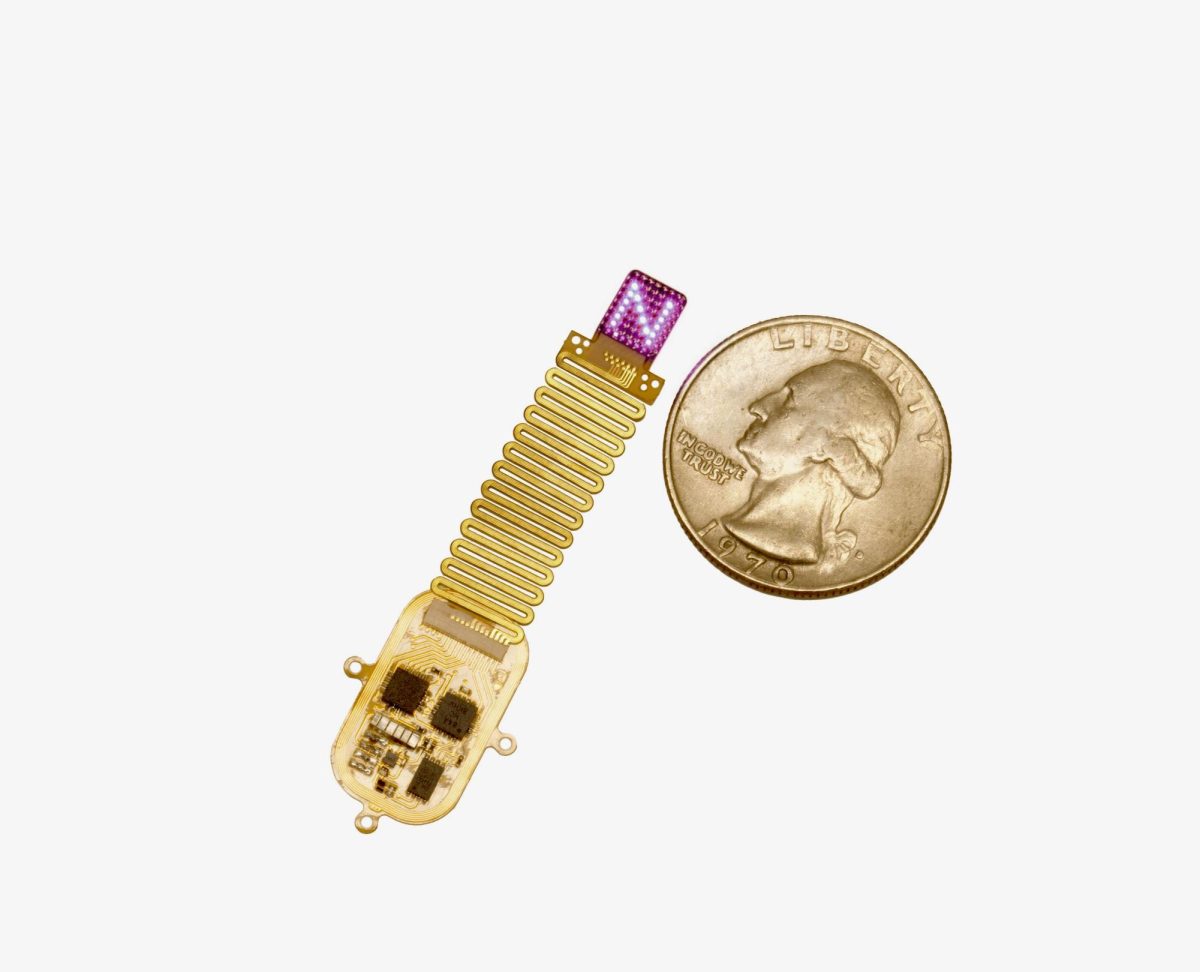
Northwestern researchers have developed a wireless device that uses patterns of light to send information directly to the brain in mice, according to a study published in the Nature Neuroscience journal Dec. 8.
The technology was primarily designed as a research tool for basic neuroscience studies in small animals like mice. However, McCormick Prof. John Rogers, who led the device’s technology development, said its potential future applications include addressing brain disorders and other neurological conditions in humans.
Through optogenetics, a technique that genetically modifies specific neurons to respond to light, Rogers said researchers can directly link patterns of neural activity to behavior.
“You can light up this certain region of the brain, you can stimulate it in this way, and you see how the animal behaves,” Rogers said. “If you do enough of those kinds of experiments, you can begin to disentangle how brain function is controlling animal behavior.”
The device consists of a flexible patch embedded with 64 microscopic LEDs, positioned in an eight-by-eight array. Implanted beneath the skin and resting on the skull, the patch wirelessly projects patterns of light through the bone and into targeted areas of the brain.
Neurobiology Prof. Yevgenia Kozorovitskiy, who led the neuroscience side of the project, said the array-based design allows researchers to essentially “play the piano externally to the brain.”
Specifically, she said the array allows them to move beyond stimulating one isolated brain region at a time and instead study how activity across multiple areas works together to drive behavior.
“The opportunities are endless because the spatial-temporal structure of patterns that can be attained, even with a relatively small number of units in the device, becomes essentially near infinite,” Kozorovitskiy said.
Center for Bio-Integrated Electronics postdoctoral scholar Mingzheng Wu was the study’s first author, who worked in both the Kozorovitskiy and Rogers laboratories. He said the device’s wireless design is essential because it allows animals to move freely during experiments.
By controlling the LEDs remotely, Wu said the device breaks from the “conventional approach” in neuroscience research.
“People still use a head-fixed setup and put a giant microscope on top of the animal’s skull and then deliver light through the microscope to regulate their neuronal activities and study behaviors,” Wu said. “It’s not ideal, because if you fix an animal to a stage, you cause a lot of stress, and their behaviors won’t be the same as their naturalistic behaviors.”
Rogers said the device also operates without a battery to avoid interfering with mice’s natural behavior. Instead, he said it uses wireless power similar to the technology used in contactless payment systems.
Alongside engineering wireless, battery-free control, he said another technological hurdle was managing the device’s thermal load.
“If you heat up brain tissue by more than one or two degrees Celsius, you’ll do irreversible damage,” Rogers said. “We really had to think about how to manage heat flow in this display to make sure that it operates sufficiently, dually at low enough temperatures not to have any kind of adverse effect on the brain tissue.”
To assess the device’s capabilities, the researchers tested whether mice could learn and respond to different light patterns delivered directly to their brains. Wu said the patterns functioned as information, training the mice to recognize specific sequences and make decisions in exchange for a reward.
Kozorovitskiy said the technology could eventually inform new approaches to treating neurological conditions such as stroke or Parkinson’s disease, though she said clinical applications remain distant.
“We’re not quite in ‘Inception’ territory,” Kozorovitskiy said. “But it is telling that the capabilities of neuroscience have now increased to the point where these kinds of experiments become possible, and you can ask important questions about how coordinated activity across brain regions participates in cognition and behavior.”
Email: [email protected]
Related Stories:
— Northwestern researchers map human genome over time
— ‘Stuck in limbo’: NU researchers with terminated NSF grants unable to continue work
— Northwestern launches new biomedical institute with $29 million gift from trustee Kimberly Querrey