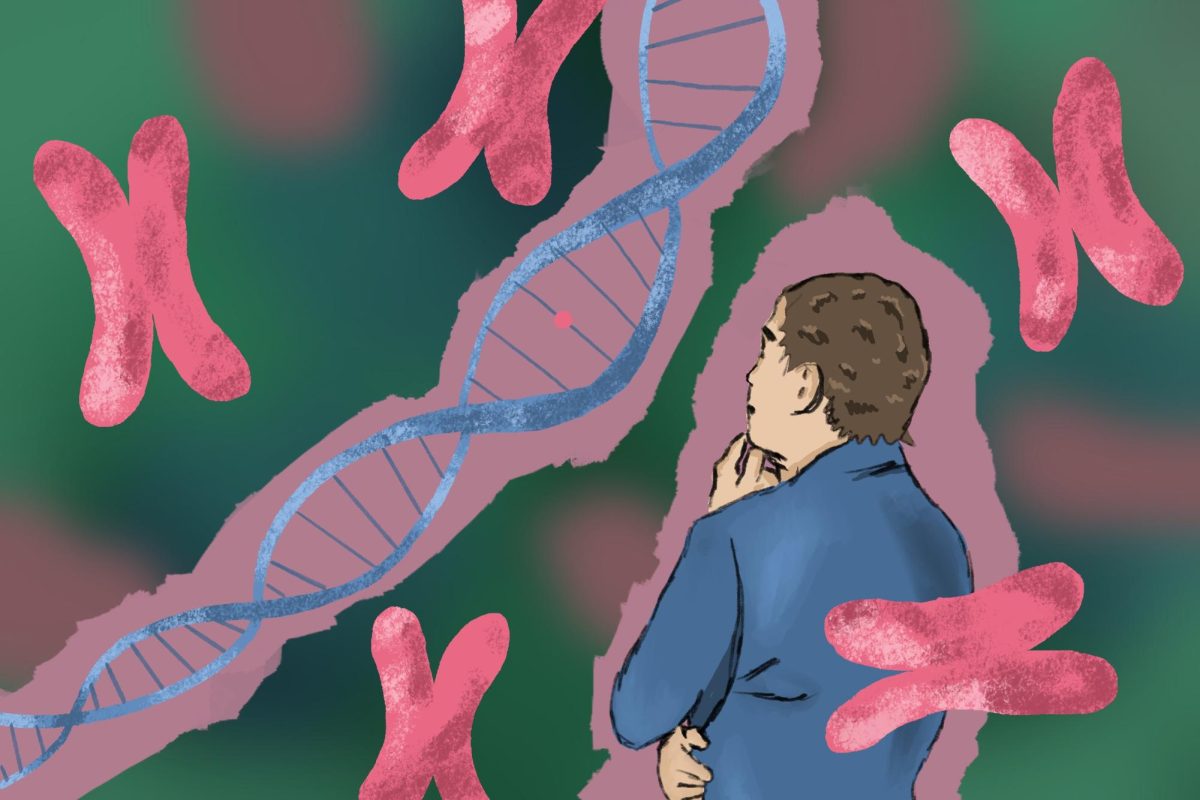
Four Northwestern scientists published a study in December as part of the 4D Nucleome Project, which maps the genome in 3D and illustrates how its structure changes over time.
According to the study, the goal of the 4D Nucleome Project is to understand how the folding of chromosomes relates to DNA function. The project started ten years ago and is a collaboration between labs and scientists across the globe, with the study having a total of 90 authors.
“(DNA is) a very, very, very skinny but long, long fiber,” Katie Pollard, a principal investigator for the 4D Nucleome Project and director of the Gladstone Institute of Data Science and Biotechnology, said. “To fit it inside of a microscopic little nucleus, it needs to fold up.”
She said that improper folding could lead to cell death or the wrong cell type, among other things.
Researchers Ping Wang, Xiaotao Wang, Jie Xu and Feng Yue contributed to the project through the Feinberg School of Medicine, with funding provided by grants from the National Institutes of Health Common Fund.
The structure of the genome is key to the cell’s purpose. Cells differentiate to serve different roles in the body, such as brain or heart cells. Once differentiated, the structure of the genome changes to activate and use the portion of the DNA specific to its cell. The 4D nucleome is the 3D organization of DNA in the nucleus and how that organization changes over time.
“The 4D nucleome is an extremely dynamic structure,” Dave Gilbert, a principal investigator for the project and professor at San Diego Biomedical Research Institute, said. “Each cell type has its own 4D nucleome, and that 4D nucleome is dynamic over the course of the life of the cell.”
Feinberg Prof. Feng Yue, researcher and co-chair of the project’s integrative analysis, said the study used both imaging and genomic approaches. Imaging techniques use microscopes to see the structure, while genomic methods rely on Hi-C, a genomic analysis technique that reveals genome-wide interactions.
Yue said distal elements in the cell act as switches for protein-coding genes, turning genes on or off. He explained that misfolding the genome can lead to incorrect connections between the two, sometimes leading to diseases such as cancer.
“That’s why we need to find things like this,” Yue said. “Then, potentially in the future, we can do something about it.”
Email: [email protected]
Related Stories:
— Northwestern researchers make breakthrough discovery in genetic factors of small-cell lung cancer
— Northwestern’s Lurie Cancer Center focuses on integrating patient care within scientific research
— Evanston residents participate in state-funded DNA project to learn their ancestry