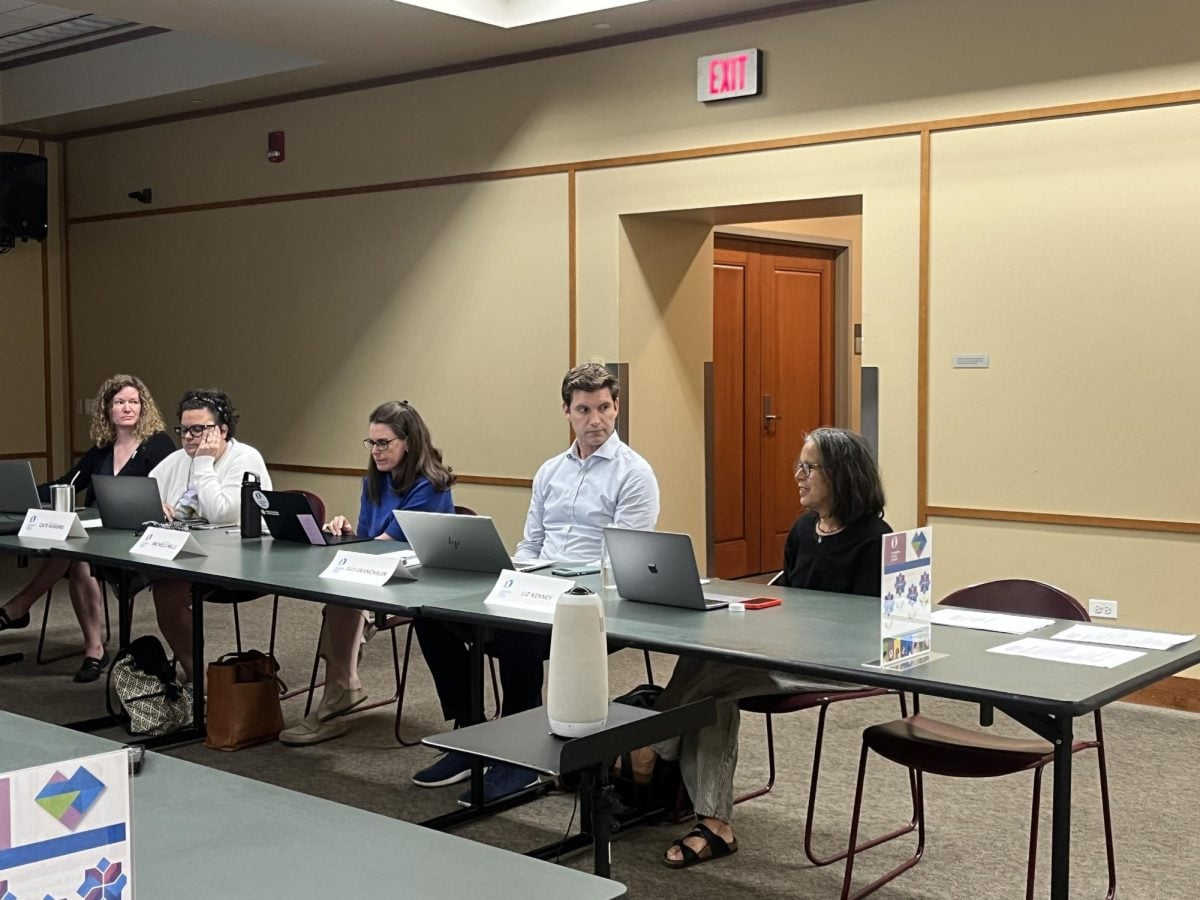
The Climate Action and Resilience Plan Implementation Task Force discussed releasing a progress report and welcomed a new member at a Wednesday night meeting at Lorraine H. Morton City Hall.
Members expressed a desire to present a 2025 CARP progress report, which will outline the task force’s achievements and areas of improvement, to City Council upon the report’s completion in June.
Major goals, including a 50% reduction in Evanston’s greenhouse gas emissions and a 25% reduction in the city’s building energy consumption, were set to be accomplished by 2025, according to the plan.
Renewable energy certificates enabled Evanston to make significant progress on reducing greenhouse gas emissions last year, meeting the United Nations’ Paris Agreement’s threshold of a 50% reduction by 2030, according to a presentation by Sustainability and Resilience Manager Cara Pratt.
But Task Force members celebrated their achievements with cautious optimism.
“We made good progress because good decisions were made, so we need to keep making good decisions if we’re going to continue this,” said CARP Task Force member Hank Neuberger.
Fellow Task Force member Hal Sprague echoed that sentiment, adding that the sub-committee cannot “relax” now.
In an effort to garner more support from council members, Pratt suggested framing Evanston’s climate achievements as a trailblazing model for other municipalities.
Task force members also discussed making graphs more digestible for the public and emphasizing the City’s role in reaching sustainability goals.
Pratt said she believes the progress report will not only raise “awareness” but act as “an accountability mechanism” for City Council.
She recalled a disappointing reaction from members during an Oct. 27 council meeting after she announced the City was on track to meet their 50% reduction in greenhouse gas emissions goal earlier than originally expected.
“I thought there would be a little bit more fanfare that we had actually reached our 50% reduction goal in 2023. And it was not a clap, not a question,” Pratt said. “The amount of work that’s gone into this and nobody even reacted was like we could have just not met at all.”
Describing the reaction as “alarming,” Pratt said the task force’s approach to presenting the news “was not right because it did not hit in any way.”
Neuberger emphasized telling a story that is “public-facing” is key to winning the council’s support.
“That’s where the rubber meets the road,” he said.
In an interview with The Daily after the meeting, Task Force member and Environmental Board Co-Chair Katarina Topalov added that CARP is “definitely up for revision” in the next “two, maybe, three years.” She added that releasing a progress report will give task force members “a really good idea of what else needs to be updated.”
Also during Wednesday’s meeting, Rachel Fleishman (Kellogg ’98) became the tenth task force member. Bringing climate change-related consulting experience, Fleishman said in an interview with The Daily that her combination of “business acumen” and knowledge of “stakeholder engagement” will enable her to contribute to its work.
In the long term, Task Force members argued that Evanston’s innovation in environmental policy has made the city a positive example for other communities.
“It might stimulate us, the city, to project this out, so that people can learn from our example, and we can help other cities,” Sprague said.
Email: [email protected]
X: @Summer_Huu
Related Stories:
— CARP Implementation Task Force prioritizes council outreach, national environmental efforts for 2025
— CARP Implementation Task Force prepares to issue recommendations on city’s comprehensive plan