Fifteen years ago, after spending seven years on a waitlist and sharing a one-bedroom Melrose Park apartment with her three young children, now-5th Ward resident Theresa Kaufman received four affordable housing options from the Housing Authority of Cook County. From them, she chose to move to Evanston because of its schools.
The 5th Ward, largely bordered by the North Shore Channel to the north and west and stretching east to Sherman Avenue, has been shaped by housing policies like redlining that concentrated Evanston’s Black residents in the neighborhood.
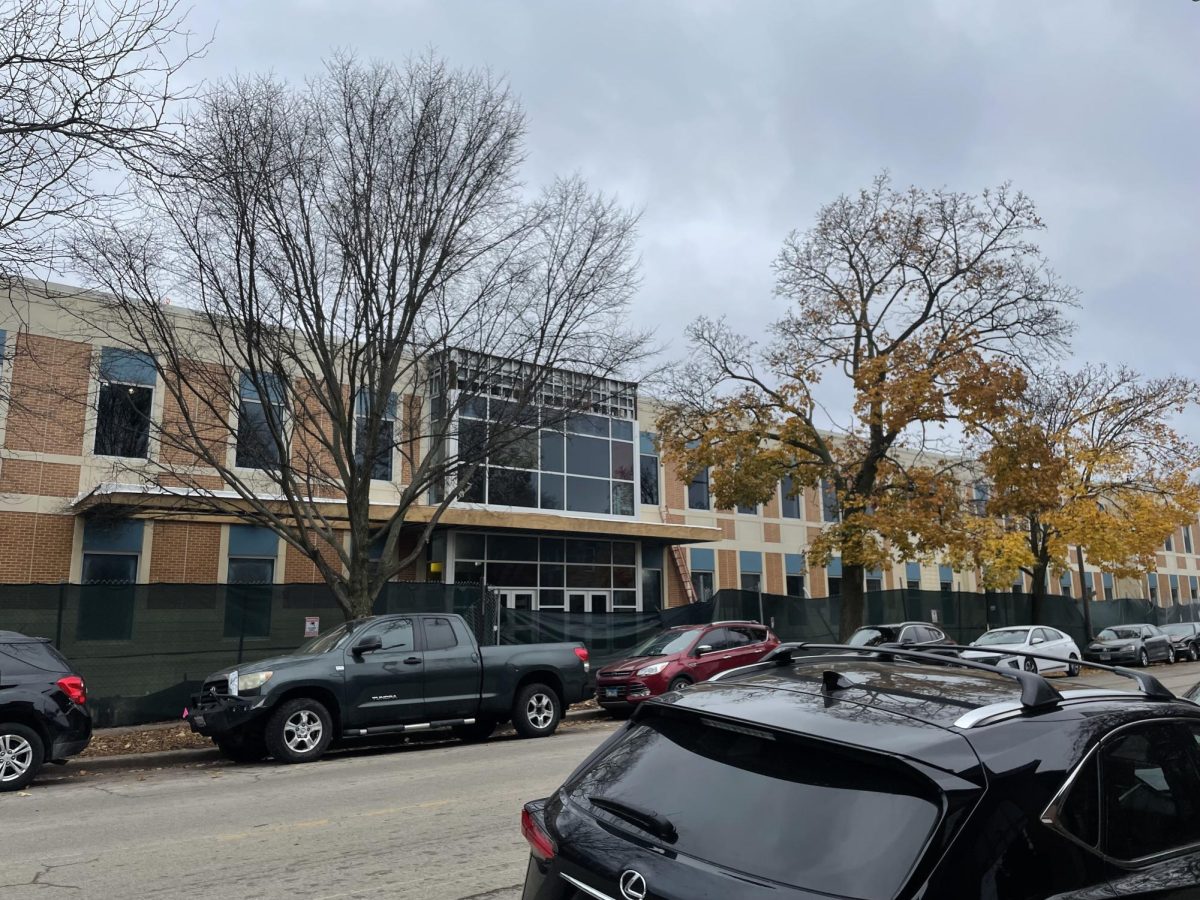
Reflecting on changes in the neighborhood, Kaufman pointed to the new Foster School nearing completion — the culmination of a decadeslong push by 5th Ward residents to restore a neighborhood school that originally closed in 1979 — and a large housing complex under construction nearby.
“It’s going to be huge — a lot of (units). I hope there’s parking in the back because if there isn’t, the streets are going to get more congested with cars,” Kaufman said. “But other than that, there’s no problem.”
She noted that under HACC rules, her rent is tied to her income, easing concerns some residents have about being priced out of the neighborhood.
Those concerns have been a central focus of Ald. Bobby Burns (5th), who explained that as a young African American “trying to form a cultural and racial identity” in north Evanston, he naturally gravitated to the 5th Ward’s Black community.
“The biggest change is just people that I grew up with not being able to afford to stay here, wanting to stay here and not being able to stay here like past generations have,” Burns said.
While the ward was once as much as 70% Black, according to Burns, that proportion has declined over the last few decades, a change he attributed to both gentrification and greater housing options for Black residents.
But he contrasted his experience with that of previous generations, who saw many prominent institutions close, including the old Foster School, Emerson Street Branch YMCA and many Black-owned businesses.
During his lifetime, the new Foster School was approved, and institutions like Family Focus, Fleetwood-Jourdain Community Center, Shorefront Legacy Center and the area’s many Black churches have “sustained themselves,” Burns explained.
“It’s been really important to me to figure out how we can return these institutions to serve the community while not expediting or accelerating gentrification or displacement,” Burns said. “I truly believe that we have to figure out how to do both.”
He added that a thriving neighborhood must offer residents access to such institutions while remaining financially accessible.
Burns emphasized that affordable housing policies must address both rental units and homeownership, highlighting Black homeownership as a key strategy to help the community “reestablish its roots.”
“The reason why affordable housing has always been and will continue to be my top priority is that if you no longer live in Evanston, none of the other stuff matters,” Burns said. “If you’ve relocated to Waukegan, you’re probably not going to Fleetwood. Your children are no longer within the school boundaries to go to Foster School.”
He added that while his job as a councilmember is to continue improving residents’ experiences, many young Black families are already “thriving” in the neighborhood.
Burns highlighted local businesses that support the community, including Ebony Barber Shop, which has hosted free haircut days for school children. Heather Bublick, CEO and sommelier of Soul & Smoke, said the ward’s challenges present a unique opportunity for businesses like hers to give back.
“When we talk about Evanston being so diverse, it’s diverse socioeconomically as it is racially, and that need is often found in this neighborhood,” Bublick told The Daily in November.
As for Kaufman, Evanston might not be a forever home. With her son now applying to graduate school, she said she hopes to move away from Illinois to “somewhere warmer” with lower taxes and more affordable homes.
While Kaufman said she typically skips events like block parties due to her busy schedule, she hopes another family will soon benefit from all that the 5th Ward has to offer.
“There’s nothing wrong with making friends. I just didn’t move out here for that — I moved out here for my children. And now my children are happy and content,” Kaufman said. “I feel like it’s almost time to move on and get something I want and maybe give someone else this great opportunity that was given to me.”
Clara B. Freeth contributed reporting.
Email: [email protected]
X: @jdowb2005