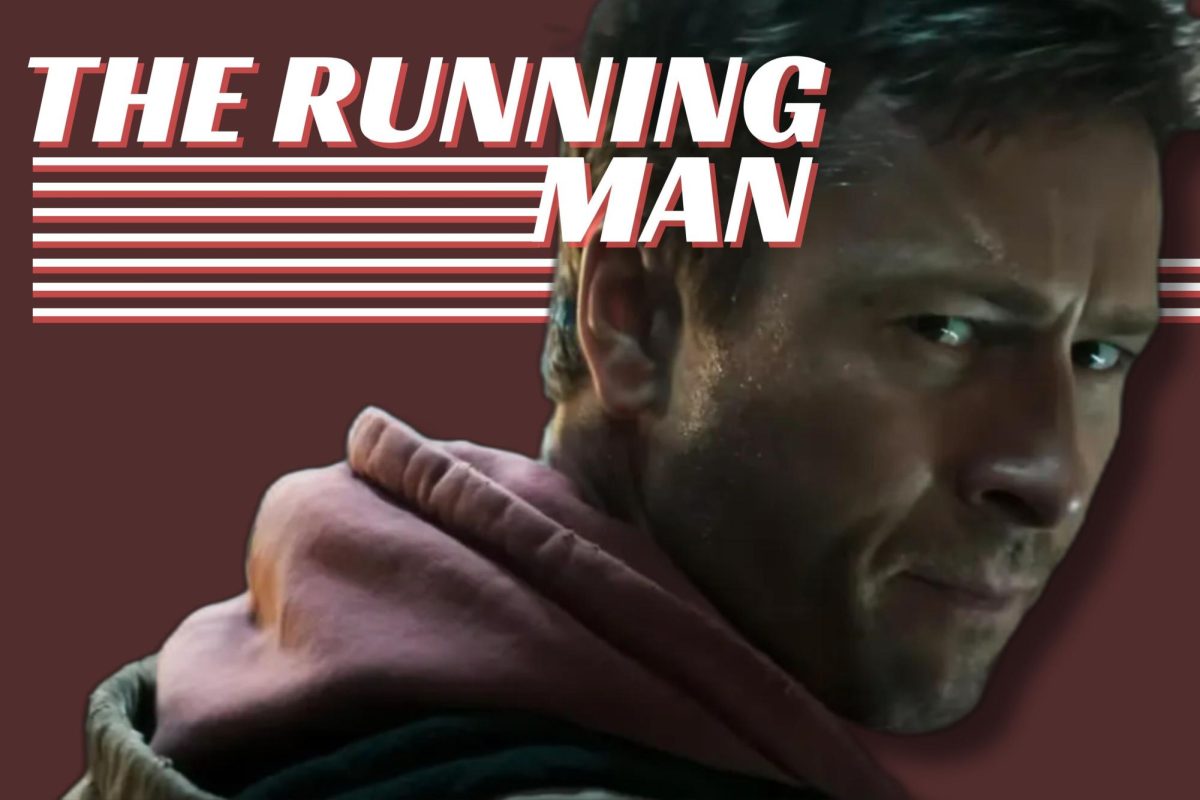
Dystopian movies have always been favorites of mine. From “The Hunger Games” to “Interstellar,” I have rarely watched a dystopian movie that I have not enjoyed. “The Running Man” continued this trend. However, it did not live up to the same greatness as others in its category.
Directed by Edgar Wright and based on a novel by Stephen King, “The Running Man” follows protagonist Ben Richards (Glen Powell) as he competes in a game show of the film’s same name to win $1 billion — hoping to move his family out of their dilapidated home and purchase medicine for his dying 2-year-old daughter. To win the game show, he must survive for 30 days. However, while competing, Richards and the two other contestants are chased by a group of hunters, led by the bloodthirsty Evan McCone (Lee Pace).
Once the game begins, the action starts and never slows down. Richards finds himself victim to ambush attacks in hotels, car chases and, at the film’s climax, a face-off with McCone on a jet. The action scenes intensify the direness of Richards’ situation. Whenever it seems as if Richards is taking the game too seriously, the movie chimes in with a perfectly-timed reminder that it is all in the name of saving his family.
Counteracting the seriousness of the fight scenes are the two other contestants who serve as comedic relief. Each contestant fits into a pre-determined archetype: The Hopeless Dude, the Negative Dude and the Final Dude. The Hopeless and Negative Dudes, played by Martin Herlihy and Katy O’Brian, respectively, are a welcome reprieve from the bloodshed and violence the Final Dude Richards was experiencing. While Richards is often seen fighting to survive, the other two contestants are barely skating by, opting to partake in flirtatious conversations with store clerks and gambling in casinos.
Like most dystopian films, “The Running Man” conveys an important message relevant to current political conversations. The tipping point for Richards’ visit to the ruling corporation’s headquarters is his daughter’s sickness, the result of a health care affordability crisis. The movie features scenes of lines wrapping around pharmacies and families struggling to pay for cancer medicine while highlighting the stark difference between the richest people of the city and ordinary citizens. It is very easy to see the similarities between the fictional situation in the film and the reality many Americans face.
While powerful, the movie tries to tackle many themes at once, which makes its plotline more garbled. It also comments on the concept of surveillance, led by a media group aptly named the Network, and entertainment as a weapon of distraction. Juggling these three themes at once resulted in an unsatisfactory ending and left me wanting more as a viewer.
Adding to my overall dissatisfaction with the movie were the performances. The film features some acting powerhouses like Colman Domingo and Josh Brolin — as well as some less-than-strong performances, like Powell’s.
Although I have never been Powell’s biggest fan, I went into this film with an open mind. Unfortunately, his performance as the leading man fell flat and at times felt as if he were reading directly from the script. This might have gone unnoticed had they not cast him alongside some of the industry’s most well-seasoned actors, but here, he was simply lackluster.
“The Running Man” is a decent dystopian film and has all the good qualities of the genre. Where it fails is its overambition to tackle many of the world’s largest problems in two hours and 13 minutes, a task that is not aided by the mediocre performance of its leading man. Still, “The Running Man” is a fun watch, and I would recommend it based on the action alone.
Email: [email protected]
Related Stories:
— Reel Thoughts: ‘Wicked: For Good’ pales in comparison to its source material
— Reel Thoughts: ‘Now You See Me: Now You Don’t’ serves up familiar tricks
— Reel Thoughts: Psychological thriller ‘Die My Love’ relies on big names, descends into a fever dream