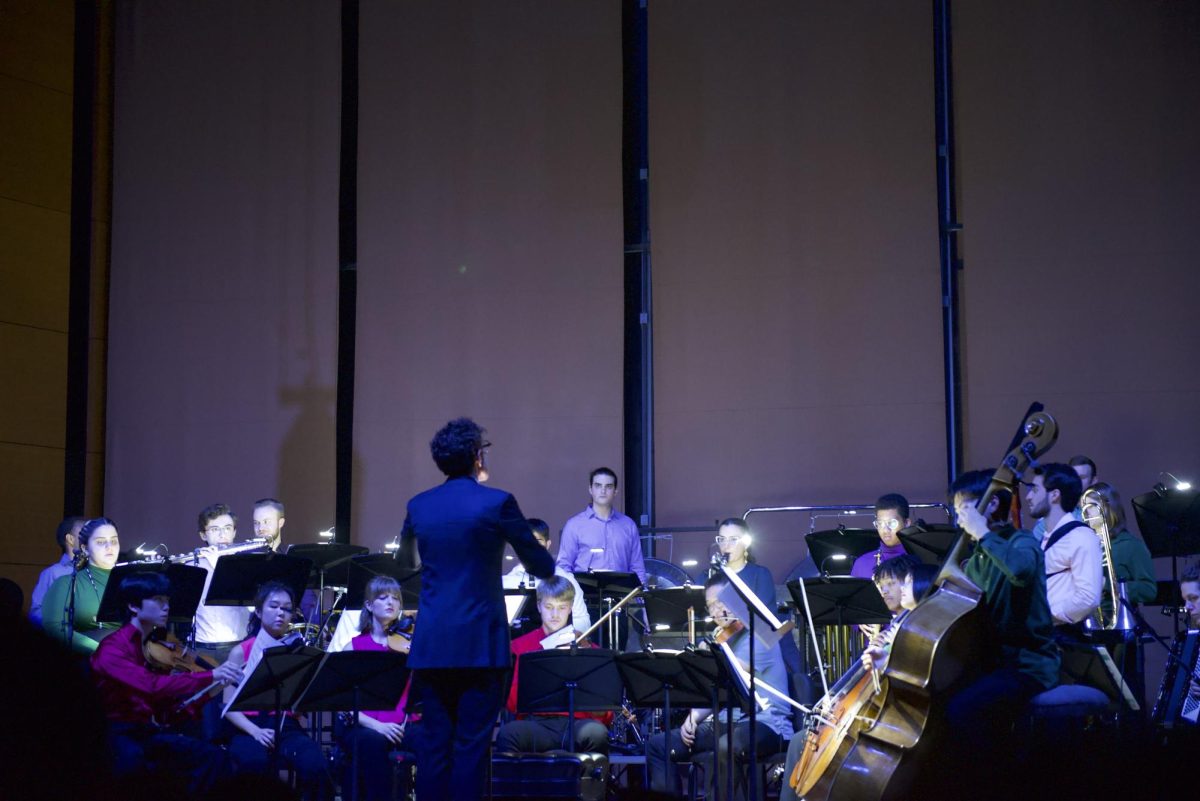
The Contemporary Music Ensemble performed two captivating pieces Saturday evening in the Mary B. Galvin Recital Hall, pairing chaotic sound and fluctuating light for a concert that was both visually and musically striking.
After just nine rehearsals, the ensemble opened with “Unseen Presence” by Cecelia Olszewski. The song was conducted by Ben Bolter and accompanied by lights that glowed and dimmed in sync with musical crescendos.
Inspired by painter Andrew Wyeth’s ideas of omission, Olszewski translated themes of absence and memory into layers of fleeting instrumental voices mirrored by the shifting lights: a fitting prelude to “in vain,” a work designed to be played in the dark.
“This idea of (loved ones’) spirits or their essence emerging through these objects became really immersed in the project,” Olszewski said.
As “Unseen Presence” finished, blinds descended over floor-to-ceiling windows. Bolter ceded the podium to conductor Alan Pierson, and composer Georg Friedrich Haas took the stage.
Having been raised under Nazi ideology, Haas broke away from fascist beliefs when he was 21. In defiance against his unsympathetic childhood teachings, he invested great emotion into his music, channeling his familial guilt into more empathetic compositions as mentioned in the program distributed before the show. At the concert, Haas introduced “in vain” as a reflection on the inevitability of authoritarian cycles and collective resistance.
“Musicians who just are used to (following) orders are not able to play it,” Haas said. “Only musicians who feel responsible, who feel (solidarity) in their partners. And this playing in the darkness is a kind of political state. It’s the fact that you all did it makes me deeply optimistic for the future.”
To do the piece justice, the ensemble worked tirelessly to perfect the musical score. Pierson described the rehearsal process as unusually strenuous, with the composition as highly sensitive to precise tones.
The performance began with a shriek of violins, dissolving into an eerily static harmony before plunging the hall into complete darkness so that even the musicians couldn’t see one another.
Warm light eventually returned, signaling a brief peace before chaos erupted again. The ensemble clashed in harsh, conflicting notes, creating an overwhelming discord with frantic shrieks and thunderous beats of the gong. Darkness flooded the room, then flashes of light blasted like lightning strikes.
“The moments when it was just utter darkness, and it was like the droning instruments were kind of making you feel so uneasy — that was insane,” said audience member and Weinberg freshman Asher Navisky.
Finally, the musicians came together again, and though they were unharmonious, they played as one in a dramatic note before falling into silence. One last draw across violin strings echoed through the room, plunging the audience into silence as they hesitated, unsure of whether the performance was over.
Then Pierson turned, guided the ensemble into a bow, and the hall erupted in a standing ovation.
“I was so blown away,” Navisky said. “Every time the lights would go down, I would just be like, ‘Oh my God, what’s about to happen?’ It was incredible.”
Despite the payoff, playing in pitch darkness proved a challenge. Second-year Bienen graduate student Ellie Abbott described having to adopt new techniques for the performance.
“At first, I didn’t know how possible it would be to play 30 minutes in the dark,” Abbott said. “It was definitely mostly relying on trusting other musicians.”
Email: [email protected]
Related Stories:
— Student ensemble to perform challenging final concert