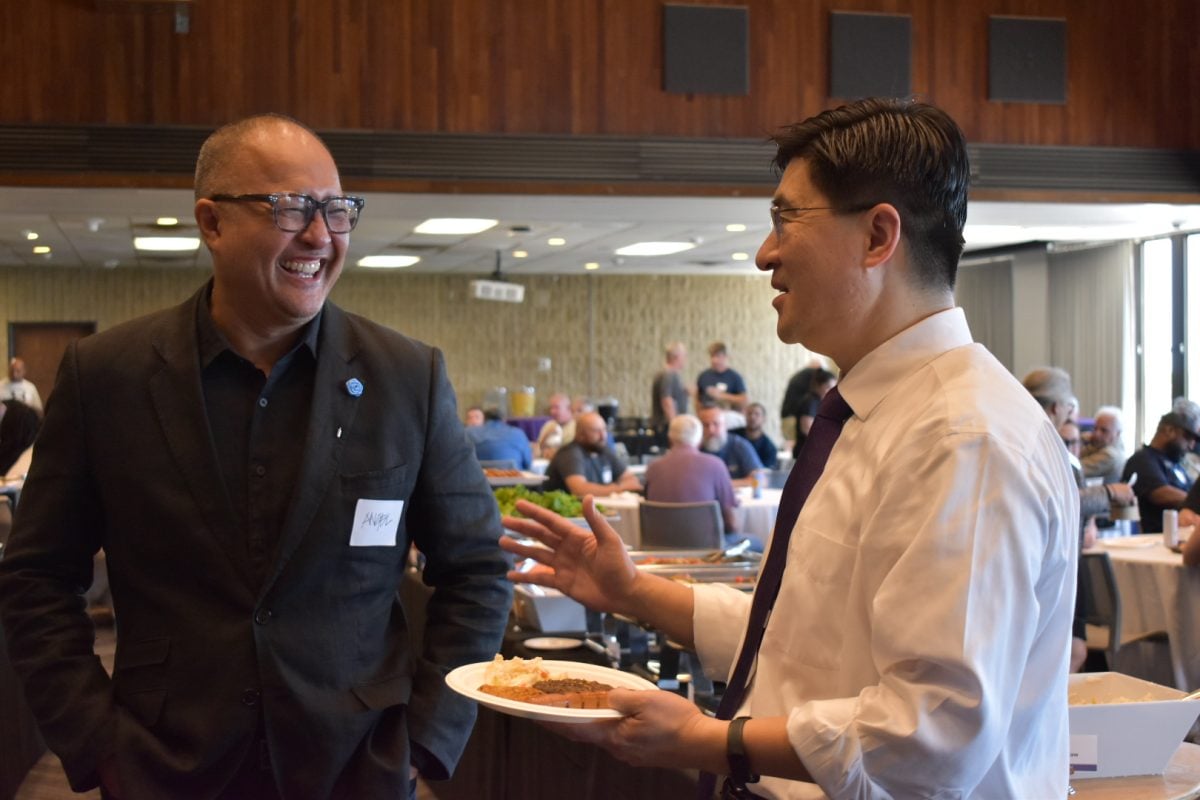
Harvard Prof. Christopher W. Stubbs presented on the unprecedented efforts of the Vera C. Rubin Observatory to map, track and photograph the ever changing night sky in a presentation Friday in the Ryan Family Auditorium
The talk, hosted by Northwestern’s Center for Interdisciplinary Exploration and Research in Astrophysics, lasted over an hour and was attended by hundreds of students, alumni and Evanston residents.
“The sky is not static, even though you’re used to all these pictures in astronomy textbooks that make it look like nothing’s going on. That’s not true,” Stubbs said.
The observatory, named after renowned physicist Dr. Vera C. Rubin and located on the Cerro Pachón mountaintop in Chile, discovered over 2,000 new asteroids within one week of operation, Stubbs said.
Over 20 terabytes of imaging data per night are produced by the observatory, and it is a crucial instrument in working to understand the mysteries of the dark matter and dark energy that make up over 90% of the universe, he added.
Throughout the talk, Stubbs made the observatory interactive, from sharing a vlog-style journey of how one reaches the telescope to peppering the lecture with jokes at the expense of theoretical physicists.
He also highlighted Rubin Comet Catchers, a citizen science program that allows anyone to become an astronomer for a day and assist in mapping comets.
“There’s this really cool disruptive technology that’s going to change everything that we do,” said Stubbs.
He explained that artificial intelligence could assist with cloud avoidance, prevent telescope failures and analyze over 20 years worth of stored documentation, as well as display data quickly to researchers and the public.
He said that latest undertaking at the observatory may become one of his most ambitious, as it aims to photograph the sky over the course of ten years.
Fifth-year Ph.D. candidate in astronomy Emma Kaufman, who studies stars and magnetic fields, said she is excited about the new project’s potential to provide insights into how stars change over time due to the range and quality of the research being conducted.
“I think the imaging he talks about is such an exciting new project,” she said.
According to Stubbs, another primary objective of the Rubin Observatory is to prevent hazardous asteroids from reaching Earth’s surface through mapping and predicting travel patterns.
“There is some likelihood that there’s an asteroid out there with our zip code on it,” Stubbs joked.
CIERA board member Robert Shaw, who attended the event, said he enjoyed Stubbs’ talk and believed it could spark more public interest in astronomy.
“He made the science seem very understandable,” Shaw said.
Email: [email protected]
X: @MaryclareN08
Related Stories:
— Research Roundup: Novel celestial discovery and solar power advancements
— Northwestern Prof. John Rogers wins Royal Society’s Bakerian Medal and Lecture
— Northwestern undergraduates explore research through grant opportunities