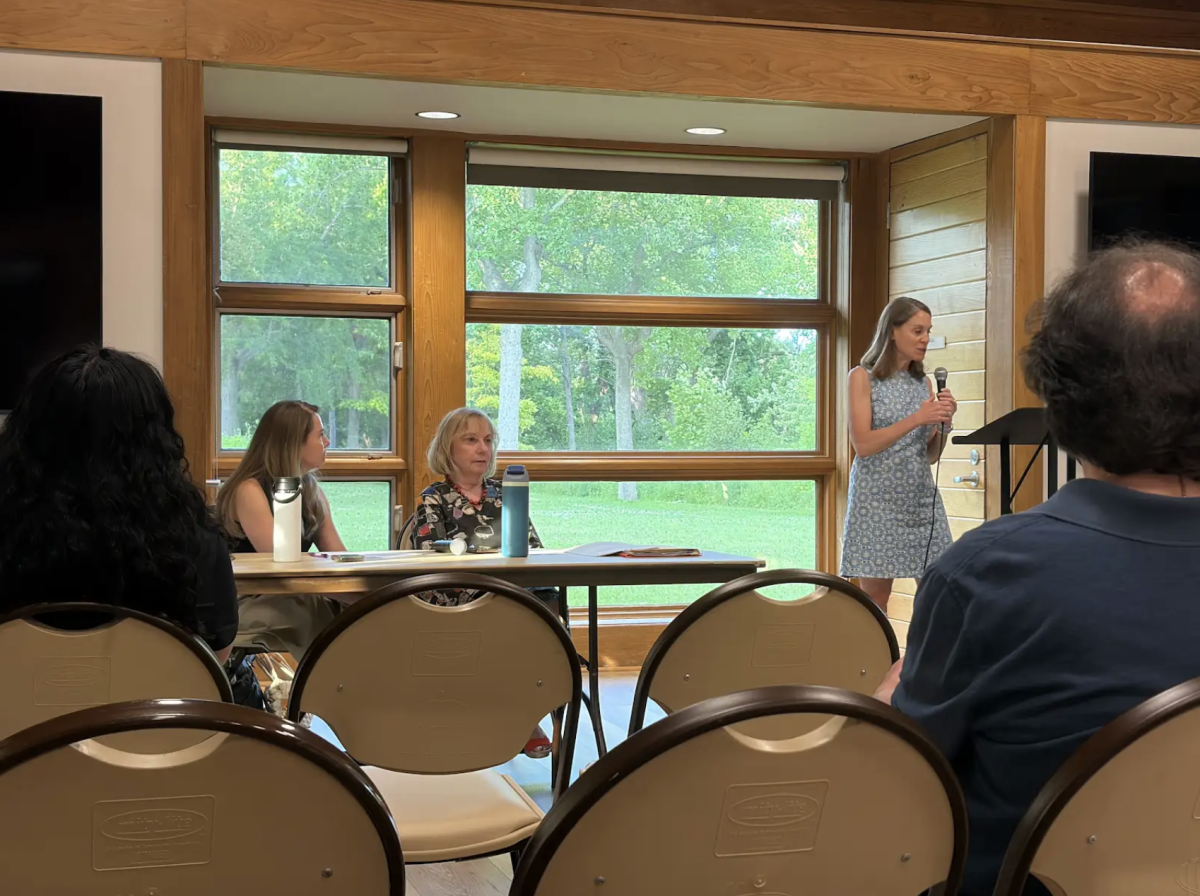
The Reparations Stakeholders Authority of Evanston held a community meeting at the Faith Temple Church Monday night to discuss how to allocate its $1 million reparations fund.
The forum, intended to solicit recommendations from Evanston’s Black residents, came four months after the initiative’s first community meeting in May.
Turnout at the meeting was limited due to a concurrent school board meeting and a City Council meeting, according to RSAE Operations and Engagement Manager Vanessa Johnson-McCoy. Fewer than two dozen people attended.
RSAE is a private nonprofit organization, distinct from the municipal Evanston Reparations Committee, which was founded in 2019 to distribute $10 million in city funds as reparations to Black residents. The reparations have been allotted in the form of grants for down payments or repairs for homes.
Johnson-McCoy said the RSAE’s current funds came from individual donations from the Evanston interfaith community. She hopes that, with continued community engagement, RSAE will begin distributing the money by the beginning of the new year.
Rev. Dr. Michael Nabors, the pastor of the Second Baptist Church in Evanston and president of the Evanston-North Shore Branch of the NAACP, emphasized that the city’s Black community “needed a nonprofit organization that was in control of Black men and Black people.”
Johnson-McCoy asked audience members to propose ideas for using the reparations fund. She said the ideas would be compiled and sorted to inform the allocation of the reparations.
Attendees at the May meeting proposed grants for home repairs, resources for property tax remediation for seniors and grants and loans to fuel local economic growth.
Rev. Jermaine Ross-Allam, director of the Presbyterian Church’s Center for the Repair of Historic Harms, delivered a keynote address that touched on various of religious and political themes, including the spiritual necessity of reparations in Christianity, dissatisfaction with mainstream Black American politicians and interfaith and international efforts for reparations for colonialism and slavery.
“You should understand that we live in a national culture that is morally perverted to its core because it has chosen, time and time and time again, to attempt to get rid of the problem rather than realize that it itself is the problem,” Ross-Allam said.
Ross-Allam criticized what he called the “Obamala effect,” a portmanteau of Barack Obama and Kamala Harris, referring to the perceived tendency of some Black politicians to abandon their Black constituencies by taking moderate stances on issues of racial justice. Providing an example of liberal inadequacy, he specifically mentioned Obama’s notion in a 2021 podcast episode that reparations were a nonstarter due to white backlash.
Nabors said he hopes that RSAE can eventually raise $5 million for its reparations fund. But before then, the organization needs to determine how to distribute the $1 million from its donors, Johnson-McCoy said.
“It feels like they’re just waiting for us to start giving it out and that they’re going to commit to there being more,” Johnson-McCoy said. “That would definitely be something that we will have to continue looking at because we hear a million dollars may go fast.”
Email: [email protected]
X: @MaxTuretzky
Related Stories:
— With $1 million raised, RSAE turns to Black residents to shape reparations allocation plan
— ‘Poetic justice’: How cannabis fuels Evanston’s reparations