On New Year’s Day 2021, five days shy of a day that would live in infamy in American history and fundamentally reshape her political career, former U.S. Representative Liz Cheney was visiting her family. She was discussing President Donald Trump’s political challenges to the certification of 2020 electoral results with her father, former Republican Vice President Dick Cheney.
Before she departed from her parents’ home that day, she recounted him coming out to the driveway, giving her a hug and saying, “Defend the republic, daughter.”
“That was the gift of understanding how important the moment is, but the sadness that we are where we are, as well,” Cheney said.
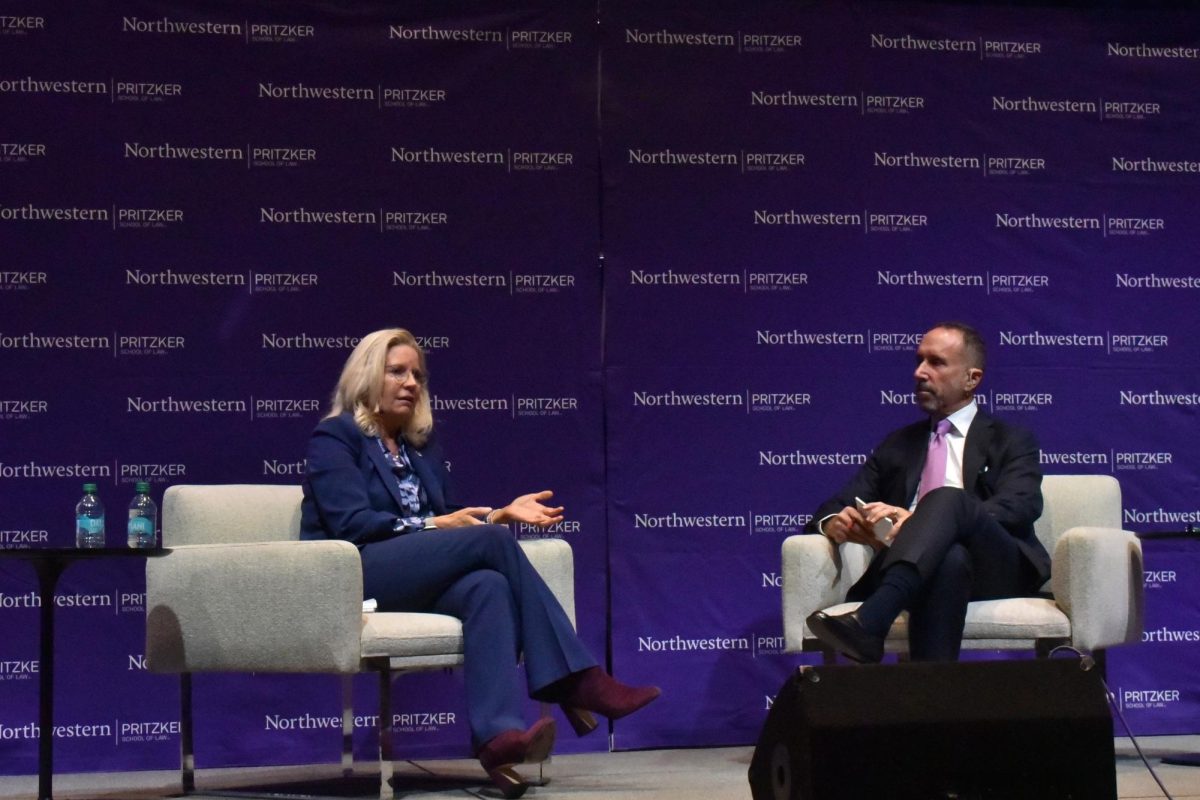
While the events of the Jan. 6 insurrection and Cheney’s decision to impeach and further investigate Trump afterward ultimately cost her Wyoming congressional seat and role in national Republican leadership, it garnered the rapt attention of hundreds of attendees present at Pritzker School of Law’s Thorne Auditorium on Friday afternoon.
Cheney’s sold-out event was the latest installment of Pritzker’s Knox Conversations speaker series, which aims to foment respectful public discourse important to the legal community.
The nearly 90-minute repartee touched upon Cheney’s conservative legacy, her time in the House Select Committee investigating the Jan. 6 insurrection and her own prognosis for the Trump-dominated GOP, moderated throughout by Paul Meister (JD ’87), Vice Chair of Chicago-based asset manager GCM Grosvenor.
From the conversation’s outset, Cheney disputed that her opposition to Trump was an act of political courage, but, instead, one required of her oath and duty to the U.S. Constitution.
Instead, she highlighted the role of former Vice President Mike Pence and Republican state legislators in refusing to overturn election results in favor of a Trump victory.
Cheney praised their commitment to the ethical obligations of the law in upholding President Trump’s electoral loss in 2020. But, she also probed the audience to think of the actors who hold those positions under the second Trump administration, which she said has been rife with controversial political appointments and encroaching threats to the balance of powers.
“You can’t read that testimony about what Donald Trump tried to do (on Jan. 6) and not understand the danger that we are facing,” Cheney said.
Cheney added that her eventual collaboration with the former House Speaker and U.S. Rep. Nancy Pelosi (D-Calif.) on the select committee, though surprising to them both, was a moment of recognition of the existential threats facing American democracy.
While Cheney acknowledged that political culture and debate on Capitol Hill incentivize “toxic” and “bitter” behavior between the parties, it is a hurdle voters must clear at the ballot box to preserve free and fair elections in 2026.
“We have to protect the republic by setting partisanship aside,” Cheney said. “I don’t think there’s anything more important than that.”
By the end of the event, Cheney encouraged Pritzker students to learn from one another’s beliefs and remain committed to the ethical obligations that come from legal training.
The post-partisanship message resonated with Pritzker Master of Law candidate Mauricio Domínguez, who emphasized that prioritizing political incentives over institutions has led to democratic crises worldwide.
“As lawyers, we have a commitment. It doesn’t matter your political beliefs,” Dominguez said. “We have a commitment to respect the law, to embrace the law and to conduct ourselves in a legal way all the time.”
Master of Law candidate Sofía Ortúzar said she found the event provided a more complex understanding to the study of law and the underlying commitments behind it.
“You may be taught things like the statutes, the cases, but then when you have a real problem, you need to know how to confront that as well with ethics,” Ortúzar said.
Email: [email protected]
Related Stories:
— NUGW talks Powell Memo, higher education attacks in Solidarity Committee workshop
— Chicago Mayor Brandon Johnson discusses policy priorities at Northwestern forum