In Focus: Amherst account inspires Northwestern student to reveal own sexual assault
November 27, 2012
Earlier this quarter, an Amherst College student garnered national attention for her account of callous treatment by school administrators following her rape. For one Northwestern student, the story was all too familiar.
“I battle my memories of the rape every day,” Weinberg senior Lauren Buxbaum wrote in a Facebook status posted Oct. 18. “It consumes me in a way I hope none of you ever experience. The only thing that was holding me together was my life here at Northwestern. And now that has been taken away, and I don't even have the energy to battle for my life back.”
Like former Amherst junior Angie Epifano, Buxbaum was raped. Like Epifano, Buxbaum was transported by campus police to the hospital and admitted to a psychiatric ward after she expressed difficulty dealing with the assault.
“It was seriously like reading my story,” Buxbaum said of the Amherst account.
But unlike Epifano, Buxbaum said she felt pressured by the administration to go on medical leave until she was “healthy” enough to return to NU.
Buxbaum’s story exposes the harsh realities of policies that attempt to balance the safety of individual students with that of the broader NU community. Despite new resources and policy amendments, NU’s response to sexual assault still has its flaws.
“Things need to change here too,” Buxbaum ended her post. “Don't forget it.”
Losing control
Buxbaum said she was assaulted off-campus in late July while walking home from a friend’s apartment in the early morning. Her attacker was an Evanston resident she had seen before but did not personally know.
University Police reports indicate officers took Buxbaum to NorthShore Evanston Hospital almost immediately after her assault. Buxbaum said she decided not to press charges because she did not want to relive the traumatic experience.
The next month, Buxbaum discovered she was pregnant. She had an abortion two days later.
When fall classes began, Buxbaum told friends, family and a few close professors what happened but struggled with depression.
In early October, she broke down. In an email to a professor, Buxbaum described feeling hopeless and not wanting to live anymore because of the assault.
The professor called Buxbaum repeatedly, but because Buxbaum had lost her phone, she said she could not answer to explain that she was not suicidal.
“Anyone who’s been raped will tell you you just don’t want to keep going,” Buxbaum said. “It’s not that you want to die. It’s that you just wish that you could crawl in bed all day.”
Police reports confirm UP arrived at Buxbaum’s apartment just after 9 a.m. Oct. 6. Because police officers are unqualified to make psychological assessments, they transported Buxbaum to the hospital for evaluation.
Buxbaum said the hospital triggered memories of the assault.
“I probably looked insane,” she said. “But I wasn’t insane.”
Buxbaum spent the next four days in the psychiatric ward, according to medical records.
Two days into treatment, Buxbaum received a letter from the dean’s office outlining the conditions for returning to NU.
The letter stated if Buxbaum did not sign medical releases, she “would not be allowed to return to Northwestern University.” It also said if she was not deemed “healthy and safe enough,” officials would “work with (her) to take a medical leave of absence.”
Assistant Dean of Students Betsi Burns, who signed the letter, declined multiple requests for comment.
After being discharged Oct. 9, Buxbaum discussed her next steps with NU's Counseling and Psychological Services and the dean’s office. Documents obtained by The Daily show her medical withdrawal was processed by Oct. 15.
An ‘impersonal’ system
Buxbaum and Epifano’s stories have sparked discussions across campus about NU’s sexual assault and mental health resources.
Although CAPS and other outlets treat mental health issues, some students do not always find them helpful.
Multiple students said their experiences with CAPS were distant. Buxbaum referred to CAPS as a “disconnected and impersonal” bureaucracy that should be more “sympathetic.”
Weinberg senior Katie Wells agreed that CAPS can seem removed from students.
Wells withdrew from two classes during her freshman year because of depression. She decided to fully withdraw from classes, a process that typically lasts two quarters, during her junior year. However, the University told her she would have to leave for an entire year because it was considered her second withdrawal for psychological reasons, she said.
Although medical leave was the right decision for Wells, she said petitioning to come back early and re-enrolling was difficult. She had trouble contacting Student Affairs, which conducts initial conversations with returning students, and when she finally did, she said administrators did not fully understand her situation.
“I just felt like they weren’t really willing to hear what I had to say about whether it was a good idea for me to come back,” Wells said. “It was difficult to sit down with them and have an in-depth discussion.”
Other students simply find getting on CAPS’ radar challenging.
McCormick sophomore Kate Matias began struggling with depression last year. Extremely uncomfortable with CAPS’ required phone evaluation, it took her weeks to set up an appointment.
CAPS always has a counselor on call for emergencies, but Matias said she wishes there were open hours for students who just want to talk to someone.
Shaina Coogan, spokeswoman for the mental health student group NU Active Minds, said many of the perceived faults with CAPS stem from the service’s lack of funds, manpower and publicity. It is also difficult to individually serve 8,000 students, she said.
“They don’t have all of the resources that maybe they should,” the Weinberg senior said. “But I guess something that students also have to consider is that CAPS was never meant to be everybody’s personal therapist office.”
Taking a break
CAPS and University officials say medical leave is a voluntary choice made by the student. Although administrators can make strong recommendations, NU cannot force students to take medical leave.
“The fact of the matter is that it is ultimately the decision of the student,” said Patricia Telles-Irvin, vice president for student affairs.
However, Buxbaum said that decision may not be “as clear-cut as they make it seem.”
Medical leave was first suggested to Buxbaum in the letter she received from the dean’s office while in the hospital.
CAPS assistant director David Shor, who was referenced in the letter, said these types of notices are meant to clearly outline necessary steps so students can smoothly transition back to school.
However, Buxbaum said the letter's timing and wording confused her, calling it a “school death sentence.” When Buxbaum discussed medical leave with officials, she said she felt like the decision had already been made for her.
Medical leaves for psychological reasons last a minimum of two quarters, so Spring Quarter is the earliest Buxbaum can return to NU.
Coogan, a former Daily staffer, said it presents difficult choice for both sides when students feel pressured into going on medical leave.
“It comes down to the University not wanting to be liable for something really bad happening,” she said. “In that, I think they are trying to protect their students, but it’s really hard to have one of those one-size-fits-all policies.”
Students and administrators alike recognize the institutional deficiencies that leave students with less-than-ideal options after hospitalization. Some students can continue classes with counseling or a reduced course load, but NU’s rapid quarter system and the time consumed by hospitalizations can compound problems for students who are already behind.
Although officials may view poor academic performance as indicating a student cannot function, for Buxbaum, who maintained a 4.0 grade point average before the assault, the structure of attending classes mattered more than earning good grades.
“Who cares if you get a C if it’s getting you out of bed?” she said.
Laura Stuart, NU’s sexual health education and violence prevention coordinator, said the process can seem unfair to survivors. Some say medical leave can further isolate victims, but Stuart acknowledged that because trauma truly can make it hard to cope, taking time off can be helpful.
“Someone took away your control and violated your boundaries,” she said. “Now that has an impact on your life that might make it difficult for you to function. That sucks. It sucks. People have a right to be mad about that.”
Buxbaum said being confined to the psych ward and medical leave turned her whole life upside down.
“They took an already traumatized person and just made it exponentially worse,” she said. “And then told me it was my choice whether to go on medical leave or not. But you’ve made it so that I am a broken person now.”
A more sensitive response
Buxbaum is not the only rape victim who has failed to connect with CAPS.
Alumna Cassy Byrne (Weinberg ’12) experienced a series of abusive relationships during her time at NU, including one with a graduate student that triggered an eating disorder during her freshman year.
Byrne said it took her years to realize her relationships were unhealthy and to approach CAPS for counseling. When she did, officials instead referred her to the Women’s Center’s more specialized services.
Although CAPS was not very involved in Byrne’s recovery, she appreciated when CAPS shared notes on her case with the Women’s Center. Small details that take the burden off the victim can go a long way, she said.
“The thing we really need is compassion — and not forms,” Byrne said. “It just shouldn't be the victim's responsibility to take care of everything. What they're doing is reaching for help because they can't deal already.”
Byrne said educating others about the psychological effects of sexual abuse should be a major priority for NU.
There is a difference between victims wanting to die and not wanting to live with their current pain, she said.
“What would really help in those situations would be for everyone in an administrative position to be educated and informed about sexual assault and how it affects people,” Byrne said. “You need to sensitize everyone that works in a position of authority.”
A breakdown in communication
According to CAPS and UP officials, emergency measures must be taken once they believe a student is in danger.
“Safety is our first concern,” Shor said. “We don’t want to take risks with people’s safety.”
Aside from letters, the University does not usually interact with students during hospitalizations to avoid interfering with external treatment, Shor said.
However, these procedures caused NU to misinterpret Buxbaum’s situation, Buxbaum said. From the time Buxbaum sent the email until her hospital release, she did not have any face-to-face interactions with NU officials. There was no opportunity for her to explain that she had not intended to kill herself, she said.
Some view the University’s precautions as extreme and premature.
In a statement released to The Daily, Buxbaum’s parents said NU acted more in its own interests than their daughter’s when police transported her to the hospital for psychological evaluation.
“It was an overreaction by the University,” said Nancy Buxbaum, Lauren’s mother. “Counseling would have been a first step. Getting some background after this would have been a first step.”
Both Buxbaum and her parents questioned why no attempt was made to contact her family members, who live about a half hour from NU in Arlington Heights, Ill., until after she was taken to the hospital. Because Buxbaum is an adult, her parents were also not involved in conversations regarding medical leave. Buxbaum added that NU could have contacted her roommate.
Rather than help her recovery, Buxbaum said, NU just made things worse.
“It was just confusing and scary and it took what was already traumatic and made it even more so,” she said.
Steps in the right direction
Reported inconsistencies in NU’s response to sexual assault fall on a backdrop of recent attempts to improve the same efforts.
After a student complaint to the U.S. Office for Civil Rights, NU amended its Sexual Assault Hearing and Appeals System to clarify the time frame for completing complaints and how to report concerns about pending SAHAS proceedings, said Thomas Cline, NU’s vice president of general counsel, in an email to The Daily.
NU’s Student Handbook indicates that the Sexual Assault policy is currently being reviewed and could be revised before the end of the academic year.
The most significant change came last fall with the establishment of the Center for Awareness, Response and Education, NU’s first centralized resource for victims of sexual violence.
CARE is primarily a confidential advocate for sexual assault survivors. Previously victims could seek help from numerous campus resources, but now the center is working to make “all signs point to CARE,” said Eva Ball, NU’s first sexual violence response services coordinator.
CARE is also focusing on education, as Ball is developing a “bystander prevention protocol” to train students and staff about how to react when someone discloses an assault.
“It’s really essential when we’re dealing with people who have been victims of sexual violence that they’re in control, that they’re making decisions for themselves,” she said.
But CARE can be minimally involved in cases like Buxbaum’s, which involved both sexual assault and safety risks. UP Deputy Chief Dan McAleer said counselors do not accompany officers on wellness checks because suicidal individuals pose a risk to others.
Consequently, Buxbaum did not meet with CARE until after her hospitalization. She said she would have preferred the center to be involved sooner.
“There should be people like that who are the first wave of contact,” Buxbaum said. “Not scary people in uniforms, coming to tell you that you have to go somewhere.”
Confronting a tough reality
Nearly two months after her psychiatric stay, Buxbaum is still struggling with the consequences of medical leave.
Because individuals on medical leave are not active students, they no longer qualify for federal financial aid. Buxbaum works five different babysitting jobs in addition to her job at Pick-Staiger Concert Hall — one of her few points of contact with NU — to pay for her Evanston apartment.
Buxbaum will not be able to write her senior thesis with other American studies majors she has known for the past three years, and without an undergraduate degree, she can no longer attend graduate school next year at Yale University, where she was offered a position.
“I feel like a loser, like an outcast,” Buxbaum said. “Like I’m not supposed to be here, that I did something wrong. That because it’s going to take me five years to graduate, that I’m a failure.”
Buxbaum said she has not yet decided when — or if — she will return to NU.
Though she said she misses her friends and classes, at this point she is unsure about the re-enrollment process.
“Are they going to be mad when they find out that I am so upset with the way that they treated me?” Buxbaum asked. “Will they put up more hurdles or not believe me, that this happened?”
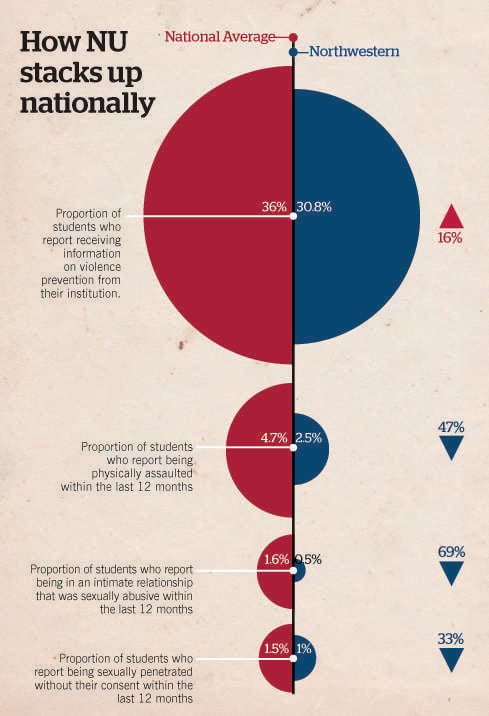
View a larger version of the info graphic above this story.


What an incredible article. Thanks to these brave students for sharing their experiences.
[Reply]
It's really saddening to know this is happening here.
Also, can you link to a larger version of that infographic? It looks like it says 1% of NU students have been raped within the past year, which sounds terribly, terribly high...
[Reply]
CC Reply:
November 28th, 2012 at 1:16 am
Funny... 1 percent doesn't sound high to me at all.
http://www.oneinfourusa.org/statistics.php
[Reply]
Laura Anne Stuart Reply:
November 28th, 2012 at 10:08 am
The "one in four" statistic that is cited on the One in Four website is looking at cumulative lifetime experience of rape and attempted rape among college women, while the 1% figure asks about non-consensual penetration within the last 12 months at NU. This data is taken from the National College Health Assessment, which was conducted at NU in 2011.
So the 1% figure does not represent all of the students at NU who have ever experienced any kind of sexual violence (which includes many other types of non-consensual contact); that number is likely much higher. No amount of sexual violence is ever acceptable, but I don't want people to read that stat and think that somehow the "one in four" numbers do not apply here.
[Reply]
Jeremy,
I've added a link to a larger version of the info graphic at the bottom of the story.
Patrick Svitek
Online managing editor, The Daily
[Reply]
“Who cares if you get a C if it’s getting you out of bed?”
This quote is exactly why I refuse to take a medical leave for my psychological problems. I struggle with depression and suicidal thoughts and going to class often is the only thing that gets me out of bed, but I will never openly let the university know because it would devastate me to be taken away from the one thing that gives my life purpose.
[Reply]
Lauren Buxbaum Reply:
November 28th, 2012 at 1:20 am
Dear "Withheld,"
Sending much love your way. But make sure you take care of yourself, too. I can guarantee you your life has more purpose than school. Just reading your comment warmed my heart and made me feel less alone. Take the time and care you need to get yourself out of "the pit." I'm down in it with you, and there are some people here that can help you out of it without taking away the things you love.
If you'd like to learn more about it, please don't feel shy about emailing me at LaurenBuxbaum2013@u.northwestern.edu
Lauren
[Reply]
Lauren Caruba,
I can't thank you enough for writing this. So many happy tears right now. I'll forever be grateful.
Lauren
[Reply]
As someone who has personally gone through sexual harassment on this campus I feel complete empathy for Lauren not only because I have also gone through what she has experienced at Northwestern but also because I have dealt with the administrative side of this.
I have to tell you since experiencing the harassment my life at NU has completely changed and the indifferent administrative response and expectation that you'll get better soon get over it kind of deal is personally extremely frustrating.
It really fucks with your mind and especially when you feel like you end up being responsible for the shit that has happened to you. For personal reasons I chose not to take a medical leave and it has been an excruciating experience ever since.Thankfully, I was able to find a community outside of this school to "escape" from and that's honestly the only way I feel like I'm coping.
It doesn't surprise me that private institutions deal sexual harassment in such a backward inefficient and hostile manner. I have to mention that in lauren's status she explicitly mentions that it is so WRONG to say that NU is better or different because it's not and it hasn't been.
I'm really sorry Lauren and I know that you'e probably heard that a million times but I really am. Sadly I'm not brave enough to share my story publicly like you are but you have my utmost respect for your courage speaking out about this. If you're interested in talking more about it with someone who has genuinely been through what you have gone through I'd be more than happy to do so.
You'll be amazed by how similar our experience has been.Let me know through the comments and I'll contact you directly.
[Reply]
Lauren Buxbaum Reply:
November 28th, 2012 at 1:50 am
LaurenBuxbaum2013@u.northwestern.edu
Please yes.
[Reply]
Kelly Pinter Reply:
January 10th, 2013 at 8:22 am
I am a PhD student at Loyola Chicago doing a dissertation on sexual assault on college campuses. If there are any adult (18 and over) survivors on this forum that identify as women, were assaulted while enrolled in college, and the assault occurred between 2002 and the present day, I would love to hear your point of view about the process of dealing with this in college. The point of the project is to get survivor's input on what universities can best do to aid survivors after an assault and also to help with prevention. You will be paid $20 for your time and everything is confidential. Please contact me at kpinter@luc.edu if you want to help out. Thanks!
[Reply]
I am not the first to comment on this article saying I, too, have been sexually assaulted while a student at NU. I know I will not be the last. For that, I am heartbroken. But I'm not here to share the nitty gritty details of my story—Lauren Buxbaum has been so, so brave in doing that, thus giving a human voice to this problem.
I am sorry to turn the personal into the political, but NU administration, PLEASE listen to us. Morty, you said you would take a close look at mental health services after Alyssa tragically left us. PLEASE, please, at least just this once, mean what you have said. I, like Ms. Buxbaum, loved NU once—never missed a home game—but after my shoddy experience with CAPS, that purple pride has died. I'm sick of playing pretend, and I'm sick of being a fake smiling NU student featured in glossy publications that you send out to prospies, and I am eagerly counting down the days until commencement. Mr. Schapiro, because of all of this, I will never be one of your big-ticket alumna donors. Politically, I guess, that means you shouldn't pay attention to us. Personally, you really effing need to.
To my fellow Wildcats who have been victims of sexual violence, please believe that it does get better. Each night, in the very bed in which I was raped, I can now sleep soundly. As for NU admins who've been ignoring our mental health problem (or at least relegating it to the backburner), can YOU sleep soundly?
[Reply]
Kelly Pinter Reply:
January 10th, 2013 at 8:27 am
I am a PhD student at Loyola doing a dissertation on sexual assault on college campuses. If there are any adult (18 and over) survivors on this forum that identify as women, were assaulted while enrolled in college, and the assault occurred between 2002 and the present day, I would love to hear your point of view about the process of dealing with this in college. The point of the project is to get survivor's input on what universities can best do to aid survivors after an assault and also to help with prevention. You will be paid $20 for your time and everything is confidential. Please contact me at kpinter@luc.edu if you want to help out. Thanks!
[Reply]
Voluntarily taking two quarters off from NU to deal with OCD/depression was the best thing I ever did for myself. It is ridiculous, and highly sucks, that they pressured you into taking leave against your will--but don't let ANYONE (including yourself) make you feel bad about it. You are NOT a failure. (The scumbag who attacked you is, and the administration a bit as well).
One year is a drop in the bucket of a life. From experience, I promise you that you'll be able to get back on track should you decide to return, even though leave was never part of the original plan.
[Reply]
This article is extremely well-written and well-researched. Thank you to Lauren Buxbaum for sharing her story (and to the other students for sharing theirs) and to Lauren Caruba for telling it so well. However, I am surprised that medical leave is painted in such a negative light. I (voluntarily) took a medical leave to deal with my depression, and while it was one of the most difficult things I've ever done, it ultimately saved my life. I agree that mental health services at NU leave much to be desired. But the medical leave process is one thing about CAPS that I think works. Yes, there are hurdles when re-enrolling. But those are in place to make sure students who take medical leave don't fall back into the same holes they were in when they left.
[Reply]
qbe Reply:
November 30th, 2012 at 5:05 am
I don't think medical leave should be forced on students. Knowing there was a forced process in place that would probably lead to me having to take quarters off prevented me from going to the psych ward when I really needed to once. Having a medical leave available is one thing; forcing it on students is another.
[Reply]
Thank you Lauren Caruba for a well written, well-researched article. Lauren Buxbaum, you are so brave to tell your story and perhaps change someone elses life.
[Reply]
Amazing women dealing with adversity. I wholeheartedly agree with criticism of CAPS - I had the pleasure of being "processed" by them for an eating disorder and depression during my sophomore year. The experience was so logistically challenging and impersonal that it made me feel even more isolated and reluctant to seek help. However, the burgeoning peer support networks at NU are something to watch - https://www.facebook.com/events/164091317067185/ and http://nulistens.wordpress.com/.
[Reply]
Adding my voice to the list. I was also sexually assaulted at Northwestern. I never pressed charges because I didn't understand that it doesn't have to involve intercourse in order to be assault. I also knew that I'd be asked why I went to his room and why I eventually relented rather than keep saying no.
Thank you to both Laurens for writing this and for sharing your story.
[Reply]
Kelly Pinter Reply:
January 10th, 2013 at 8:29 am
I am a PhD student at Loyola Chicago doing a dissertation on sexual assault on campuses. If there are any adult (18 and over) survivors on this forum that identify as women, were assaulted while enrolled in college, and the assault occurred between 2002 and the present day, I would love to hear your point of view about the process of dealing with this in college. The point of the project is to get survivor's input on what universities can best do to aid survivors after an assault and also to help with prevention. You will be paid $20 for your time and everything is confidential. Please contact me at kpinter@luc.edu if you want to help out. Thanks!
[Reply]
Really great reporting by Lauren Caruba, revealed an immensely flawed system. So much respect for Lauren Buxbaum (and other students like Katie Wells!) for sharing their stories with us- let's hope we make an impact for survivors on campus. As someone who also dealt with the mental health system at NU and is a survivor of sexual assault, I completely relate. We need organizing around this issue!
[Reply]
Thanks for this article, and thanks for mentioning CARE. Eva and I appreciate your help in getting the word out to sexual violence survivors about CARE (since it's still a relatively new office), and we're working hard to make it easier for survivors to access the support services they need. We welcome feedback about our efforts, too. You can contact us at care@northwestern.edu.
[Reply]
Excellent work of journalism, and thank you to all of the students brave enough to come forward and share your stories. I am a Medill grad, class of 1993, and I wrote about the flawed sexual assault procedures at NU more than 20 years ago. I also relate to this story because my brother committed suicide at MIT while I was an NU sophomore. And I dealt with students with mental health issues while teaching at an NU summer program. I always erred on the side of getting students help, even when they were reluctant, and I understand and applaud the university for taking swift action to prevent potential student suicides. However the process and procedures in this case certainly seem overly cold and punitive toward a victim of sexual assault. What's lacking is a compassionate human being to help students who are in pain. It sounds like CAPS needs a serious overhaul. Also, is there anything the university can do to inform parents of students over 18? Can we get students to sign a consent form when they enroll giving the university permission to contact them? No one in my family contacted us about my brother's issues until it was too late. We had no idea he was depressed, even though members of the university community certainly did know. Thanks to all involved for bringing these issues to light.
[Reply]
Susan Reply:
November 28th, 2012 at 11:48 am
CAPS does not make known that students have to sign a form EVERY YEAR to give parents permission. WHERE is that information? In emails to every student as they re-register each quarter? There is inefficiency, ineptness. But there are caring individuals on this campus... OUR WORK IS NOT DONE. But the Laurens and Katie and all of those in this article have started the conversation and let it continue.
[Reply]
I also had HORRIBLE experiences with CAPS. They don't actually provide any constructive work there. I'm not quite sure what their purpose is...I think I know what their intention is, but they don't actually fulfill that.
I'm sorry that our university failed to provide you the safety and comfort that you needed in hard times.
[Reply]
I just want to add that Lauren's parents might not feel that sending her to the hospital was an overreaction had they gotten a call that their daughter was dead. If that had happened, as it did with my brother, they would have been demanding why the university had not taken a veiled e-mail suicide threat more seriously. As a parent now, I would hope that schools err on the side of getting students help. Mental health professionals need to be the ones to assess whether a threat is real. With a suicide threat, it is a life and death situation and you can't mess around. Having said that, the university should really work with students and mental health professionals to determine whether it's in the best interests of the student to take medical leave. It sounds like the leave was really pushed on this student and has made her life more difficult.
[Reply]
Lauren Buxbaum Reply:
November 28th, 2012 at 1:38 pm
Hi Jenny,
I can't imagine the pain and frustration that must go along with losing a brother. I think part of the frustration in my case stemmed from the fact that I had been hospitalized before with an eating disorder, and the experience was so traumatic and had caused me to regress so much, that being in another psych ward was more portentous than just "keeping me safe." In fact, it wound up sending me into a tailspin and closer to suicide than I ever had been before. It wasn't just that I went to the psych ward to be evaluated--I was stuck there for 4 long as eternity days because doctors don't come into the ward at all on weekends. It was just limbo--no treatment or assessment.
I do understand why they did it, but I also think that a blanket "one policy fits all" approach to mental health is not the most adequate way to deal with Northwestern students. And while some of the problem lays with NorthShore, Northwestern needs to be aware of what they're putting their students through on the other end of it.
Best,
Lauren
[Reply]
Jenny H. Reply:
November 28th, 2012 at 5:10 pm
Lauren, I'm so sorry that you went through such a horrific, traumatic experience on so many levels. And I'm sorry that the method of help offered to keep you safe was so traumatizing, as well. I'm sure that felt like prison, and it's inexcusable not to send a doctor or psychologist to help you over the weekend. While one size certainly does not fit all, and sexual assault victims should not be treated like criminals, I do, however, think there needs to be a uniform policy in the event of a suicide threat so that there isn't a single case of a legitimately suicidal person who falls through the cracks because it isn't taken seriously. If I had been your professor and had received an e-mail describing that you were feeling hopeless and not wanting to live anymore, and then I couldn't reach you, I would have been alarmed. I would have asked the university to do whatever it could to protect you from harm. I do hope the university listens carefully to your story and reviews its policies. Again, thank you for coming forward. You are brave to do so, and I wish you the best of luck in the future.
[Reply]
Thank you to all of you brave women who have spoken out about your experiences. I graduated a few years ago from Northwestern and had more than one friend who was sexually assaulted/raped while on campus, hearing their stories and reading yours made me recognize that rape is not just a statistic and is actually WAY more pervasive than we think. The way that our administration deals with these events deeply saddens me and I wonder what it will take to change. I wonder what response I would get when the next telethon rolls around and I explain that I don't wish to donate to the school again until I see comprehensive reform to this system? What outrages me the most is that these women seemed to be punished for their rapes, whereas I read nothing about the consequences for their rapists. If a victim doesn't decide to press criminal charges what role does the University play? How can we make the system better for victims so they are more comfortable pressing charges? I know how much it sickened me to see the guy who raped my friend at every sorority formal, at the keg, and in the dining hall -- but I can only imagine what it was like for her.
[Reply]
Thank you Lauren for explaining that being sent to the psych ward without any connection with Doctors or the outside world was the straw that broke the camel's back. Thank you for explaining to the Northwestern community in such a powerful voice that they overreacted without knowing all of the facts in your particular circumstance and that they had phone numbers and information that could have prevented you being "hauled away" like a criminal.
I understand Jenny's comments, but your situation was not like her brothers. And there are details that are very different. Very different.
Thank you for your honesty about your situation.
[Reply]
How to make a safer, more supportive community for women? - this should be a major emphasis.
What to do for and with a victim who has just faced personal assault?
As a semi-older woman who has not faced sexual assault - my perspective is disclosed - I don't claim to know everything but I do think victims should be encouraged to place charges against their assaulters; otherwise, such persons will likely attack again. Plus - it's the right thing to do - have a criminal be held accountable for his act, even if it may be difficult to prove and not always result in a conviction.Are there people who can serve as victim's advocates to support a NU woman through the legal process at this level (not legal, just as a "buddy?"
More generally, how to support a naturally upset victim who has just been personally attacked?! - that is a big issue. I want a victim to feel supported and listened to, and also for a result that (hopefully) the criminal does not get away with the crime.
I do not think that because a woman went to a man's room (or was drunk or in similar circumstances) that should preclude finding that an assault took place and a criminal act occurred. At the same time, there have been multitudes of he said/she said cases on university campuses. But if the typical thing is a woman does not have evidence taken prompty - and have a police officer seek witnesses, etc, and file a police report and press charges (if the attacker is known). - it seems that a bad guy won't fear repercussions. Bad guys shouldn't operate with confidence and brazenly be out there, even if all we can do is "limit" such bad behavior, anything is better than nothing.
[Reply]
I am lucky enough to never have been a victim of sexual assault, but I am a Northwestern student and I want you to know that I support you Lauren. I hope that in light the recent obvious failures of our school's mental health programs we are able to enact real change for NU students. Thank you for sharing your story to inform and inspire us to ensure it is never allowed to happen again.
[Reply]
Thankfully, I was not a victim of sexual assault, but I was forced to take a leave of absence from Northwestern for other reasons.
I couldn't sympathize more with what a cold and uncaring process it can be to deal with some of the administration at NU over withdrawing or re-enrolling. Some people really care (usually professors or department members), but others are absolutely callous - or they treat you like a spoiled, entitled brat. I also felt the pain of being removed from my friends, peers, and graduating class while having to maintain a semblance of happiness or normalcy, and it sucks. It doesn't help when administrators brush you off like a liability or a deadbeat.
Thanks for sharing your story, Lauren. I'm sorry for what you've gone through and I wish you the best of luck!
[Reply]
W Reply:
November 29th, 2012 at 9:36 pm
I'm an NU student who has experienced this as well. The most supportive people from the university have been my professors and department members, most certainly not administrators. When attempting to return from a medical leave, I never had more than a 5 minute phone call to explain why I was ready to return, and how extensive my treatment had been while I was gone. And that was only to get a re-entrance interview with psych services. Everything about the process was impersonal. It sounds like this is a trend, considering how the students in this article faced similar problems regardless of their reason for a medical leave.
[Reply]
Joy F Reply:
January 27th, 2013 at 10:17 pm
Hi W (and anyone else reading this :)),
My name is Joy, and I'm a SESP grad student. My thesis is focusing on college administration's programmatic response to alcohol-based sexual assault and its efficacy. I'm trying to get a sense of what has been implemented, but also get a perspective on how students have responded to these programs and their impact on the greater community. I'm focusing more on NU, but I'd love to hear input from other students who may be reading this. If anyone would be willing to help assist me, you can email me at j.fernandez@u.northwestern.edu. Thank you!
Joy
[Reply]
As a victims advocate, I counsel those involved in domestic violence and work to break the cycle of injustice. I'm sorry this happened to you. Sending you so so much love.
[Reply]
I am impressed by the outpouring of support for people who have been sexually assaulted. Bravo Northwestern community! I am a clinician dedicated to working with people who have experienced trauma, sexual or otherwise. Most often will "recover" from trauma quite differently based on many factors. Each person is different and should be handled very carefully and accurately from the start. Perhaps this discussion will begin a process to look at how these situations could be handled more uniquely.
This next comment is for all the people who a) have experienced some kind of trauma and chose not to tell anyone b) told someone once, and did not get further intervention or c) those who read this article and chose not to write a comment at all, but are either crying or nodding their head saying "yes, that is me too"...THE TIME IS NOW TO REACH OUT. YOU CAN FEEL BETTER. YOU DESERVE THAT PRIVILEGE YOU USED TO ENJOY.
Porchlight Counseling (847-826-8273) is offering a no-cost group to meet others face to face to talk exactly about these issues. Call now and enroll for the group forming December 9th. OR call or email me privately to discuss how you can get on the road to healing and getting on with your life. NO ONE will be denied, regardless of experience. Be brave. You can do it. mnanos@yahoo.com or 773-551-3652.
[Reply]
[...] In Focus: Amherst account inspires Northwestern student to reveal own sexual assault (Lauren Caruba, The Daily Northwestern): [...]
[...] recent accounts by students from Amherst College, Northwestern University, and Rice of how they were treated in the aftermath of sexual assaults have brought much-needed [...]
[...] UNC students’ accounts come after a series of disturbingly similar stories from Amherst, Northwestern, and Rice and recent Title IX complaints at colleges including Princeton and Yale (which, full [...]
[...] feel that they only matter to Northwestern as dollar signs and future award recipients, and feel uncomfortable accessing the impersonal psychological treatment services that exist currently. We’re not saying ten thousand dollars would fix this problem or even come close, but using [...]
Wow that was odd. I just wrote an very long comment but
after I clicked submit my comment didn't show up. Grrrr... well I'm
not writing all that over again. Anyway, just
wanted to say great blog!
[Reply]