The Buffett Institute for Global Affairs hosted its two-day spring symposium “Brave New Futures,” where experts discussed topics including sustainability and art as a tool for social change, on Thursday and Friday.
Journalist and podcaster Qing Wang and Nataliya Kos’myna, a research scientist at the Massachusetts Institute of Technology’s Media Lab’s Fluid Interfaces group, opened the event with a panel titled “Human Relationships.”
Wang told the audience she has interviewed over 1,000 people, ranging from refugees in Syria and Lebanon to soldiers on the Russia-Ukraine war’s frontline, about what makes a life worth living in “extreme situations.”
“I found the answer has something to do with human relationships,” Wang said. “It is desire, the ability and sometimes simply the possibility of staying connected to the people around them.”
Kos’myna tackled the theme from a different angle. She said she found in a research study that participants who used large language models in essay writing have lower brain connectivity than those who used a search engine or no tools.
She added that while technological innovations are important, it is also essential to understand “how much these tools are taking from us and how we can give humans control back.”
Buffett Institute for Global Affairs Director Deborah Cohen said the symposium’s theme was sparked by conversations with students who were pessimistic about the future.
“They were saturated in dystopian ideas but also looking to what happens next,” Cohen said. “Those are sets of global questions in which the Buffett Institute should be really in there.”
The symposium featured a range of panelists, including economist and entrepreneur Suhani Jalota and Data Science Nigeria CEO Olubayo Adekanmbi, who both spoke during the “Future of Work” panel.
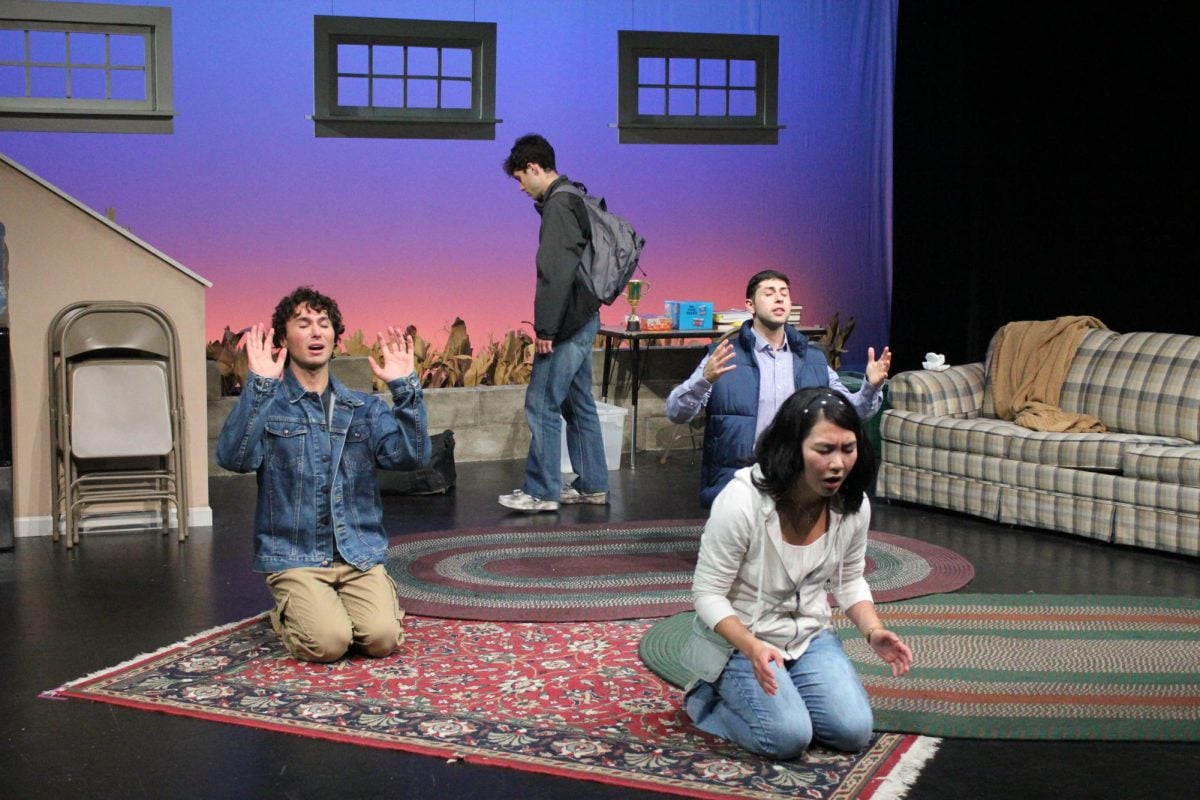
The “Arts of Social Change” panel featured filmmaker Bing Liu, director of the Emmy and Oscar nominated documentary “Minding the Gap,” and poet and rapper Omar Offendum.
Offendum, along with Palestinian multi-instrumentalist Zafer Tawil, opened the symposium Thursday with a performance of original poems and raps hosted by the Buffett Institute, A&O Productions and the Middle Eastern North African Student Association.
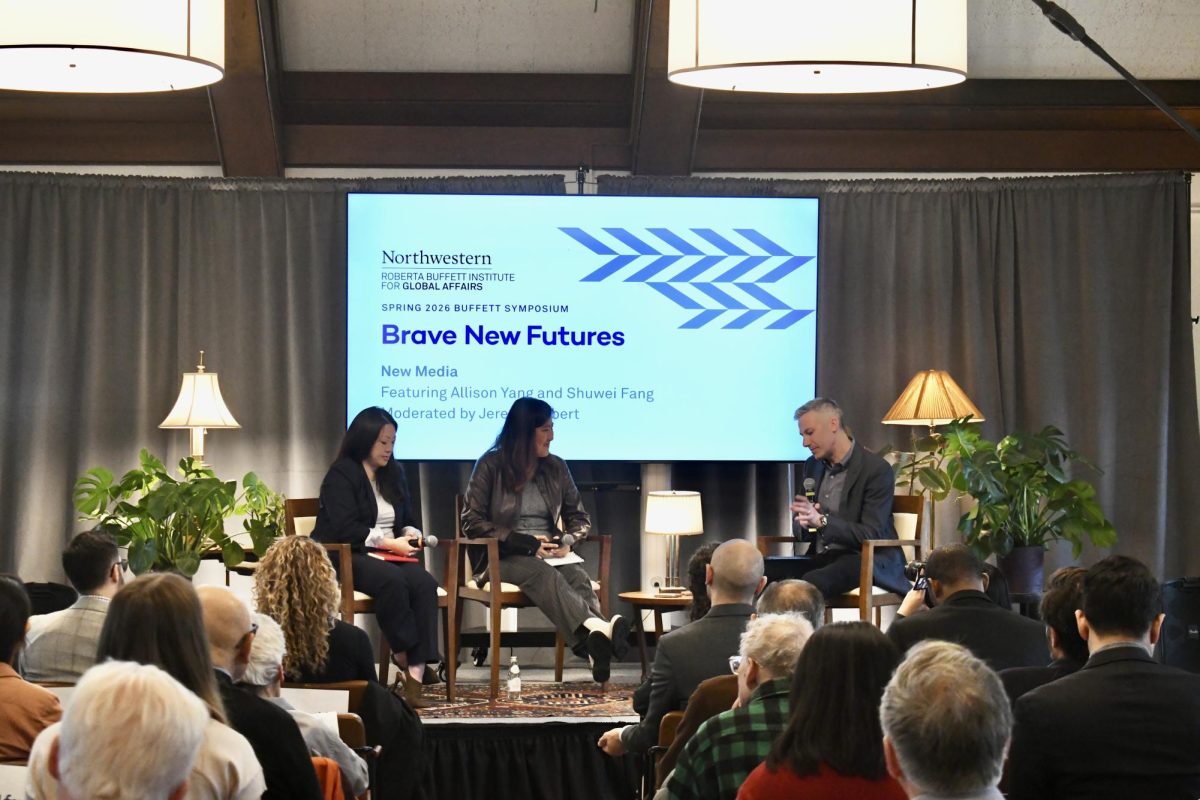
Medill junior Jerry Zhou said he attended the symposium’s “New Media” panel after he heard about the event in a class with Medill Prof. Jeremy Gilbert.
Gilbert moderated the panel, featuring Allison Yang, the founder and CEO of the game studio Reality Reload, and Shuwei Fang, a fellow at Harvard Kennedy School’s Shorenstein Center on Media, Politics and Public Policy.
The two discussed topics like the benefits and drawbacks of the emergence of artificial intelligence in media.
“We are making this visa application where we have journalists on our teams who collected so many stories,” Yang said, referencing her mobile game H1B.Life, which is slated for release this summer. “AI couldn’t do that, but it pretends it can.”
Climate activist Vanessa Nakate, who founded the Rise Up Movement to provide a platform for African climate activists, and New York Times Opinion columnist David Wallace-Wells spoke at the panel “Planetary Futures.”
Wallace-Wells said humans have already “transformed” the Earth, noting that humans and livestock make up a significant portion of the world’s mammal biomass.
“I’m hoping, naively, that the pendulum can swing, and we can once again start cultivating a sense of solidarity, global solidarity, mutual obligation and a sense of shared future,” Wallace-Wells said.
Email: [email protected]
Related Stories:
— Students criticize ‘performative’ COP30 at Buffett Institute research presentation session