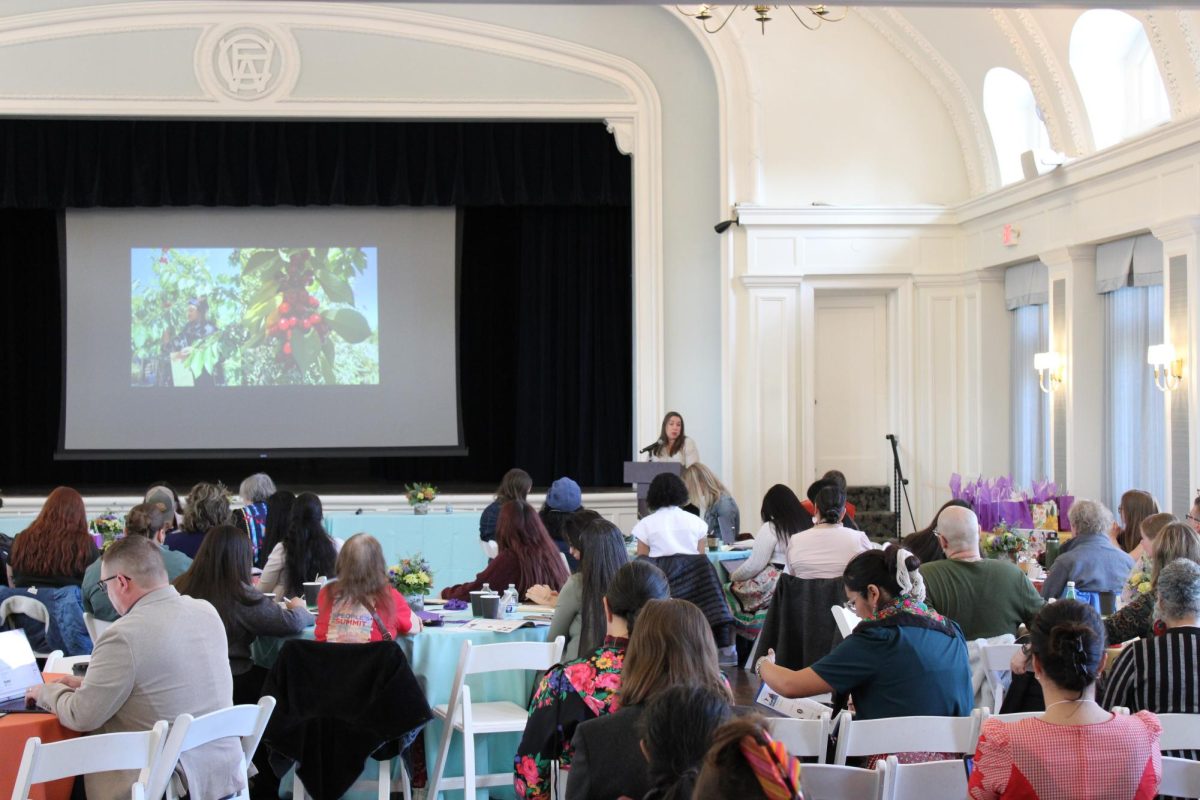
Indigenous scholars, leaders, students and community members shared research during the Center for Native American and Indigenous Research’s 8th Annual Research Symposium on Thursday and Friday at the Woman’s Club of Evanston.
The event included speeches, panels and poster sessions. In her opening keynote speech, New York University Prof. Eve Tuck presented her research on the rematriation of land to Indigenous communities as well as youth land education programs.
Tuck, who is Unangax̂ and an enrolled member of the Aleut Community of St. Paul Island, Alaska, discussed her study “Youth in Relation to Returned Land.” In this study, she investigated the impact of land in Oakland, California, being returned to the Ohlone people through the Sogorea Te’ Land Trust.
“Most scholars investigating the inequalities experienced by Indigenous people around the globe have concluded that dispossession from our own homelands is the root of many other forms of inequality,” Tuck said.
On Friday, Washington Post reporter Dana Hedgpeth spoke about her investigative reporting on Native American boarding schools.
In a five-part series, Hedgpeth’s team uncovered data that revealed over 3,100 children died in these boarding schools — more than three times as many as reported by the U.S. government.
“Too often, mainstream America, which is who I write for, doesn’t know these stories,” Hedgpeth said. “They’ve forgotten us. And sadly, too often, we ourselves have forgotten our own stories.”
Hedgpeth said uncovering the truth of Native American boarding schools was “perhaps the hardest, but the most rewarding” story she has ever written.
She told The Daily that she needed to empathize with sources and “meet them where they are.”
“You’re telling these stories because anyone who has family or friends or a child or a loved one can relate,” Hedgpeth said. “There’s nothing more painful than having someone you love taken away from you. And what the U.S. government did in that policy — that’s what that did, and the story still resonates generations later.”
Hedgpeth, who is an enrolled member of the Haliwa-Saponi tribe of North Carolina, said one of her goals is to capture the reader’s attention so they can be informed about Indigenous stories.
“In a strange way, even though you’re writing about death, it’s a beautiful thing to watch people go through that journey in the present, take them in the past and go back and forth,” Hedgpeth said. “Then you’ve taken the reader all the way through, and they’ve followed you on this entirely long, complex and deep journey.”
CNAIR’s Associate Director Pamala Silas said the research symposium has expanded in its eight years of existence.
In its first year, she said, it included a few students and professors and lasted only three hours, but now, the event spans two days and hosts “top scholars in the country.”
“How did Northwestern land all of them? Why?” Silas said. “Because we built the community that they need to do their work.”
Email: [email protected]
Related articles:
— NAISA hosts presentation on history of Indigenous activism on campus
— Northwestern scholars celebrate Indigenous knowledge, heritage at research presentation