For many Asian and Muslim families across Illinois’ 9th Congressional District, casting a ballot in Tuesday’s primary election represents a once-in-a-generation opportunity.
But language access, voter mobilization and low trust in government, among other factors, will all impact how Illinois’ Asian and Muslim voices are represented.
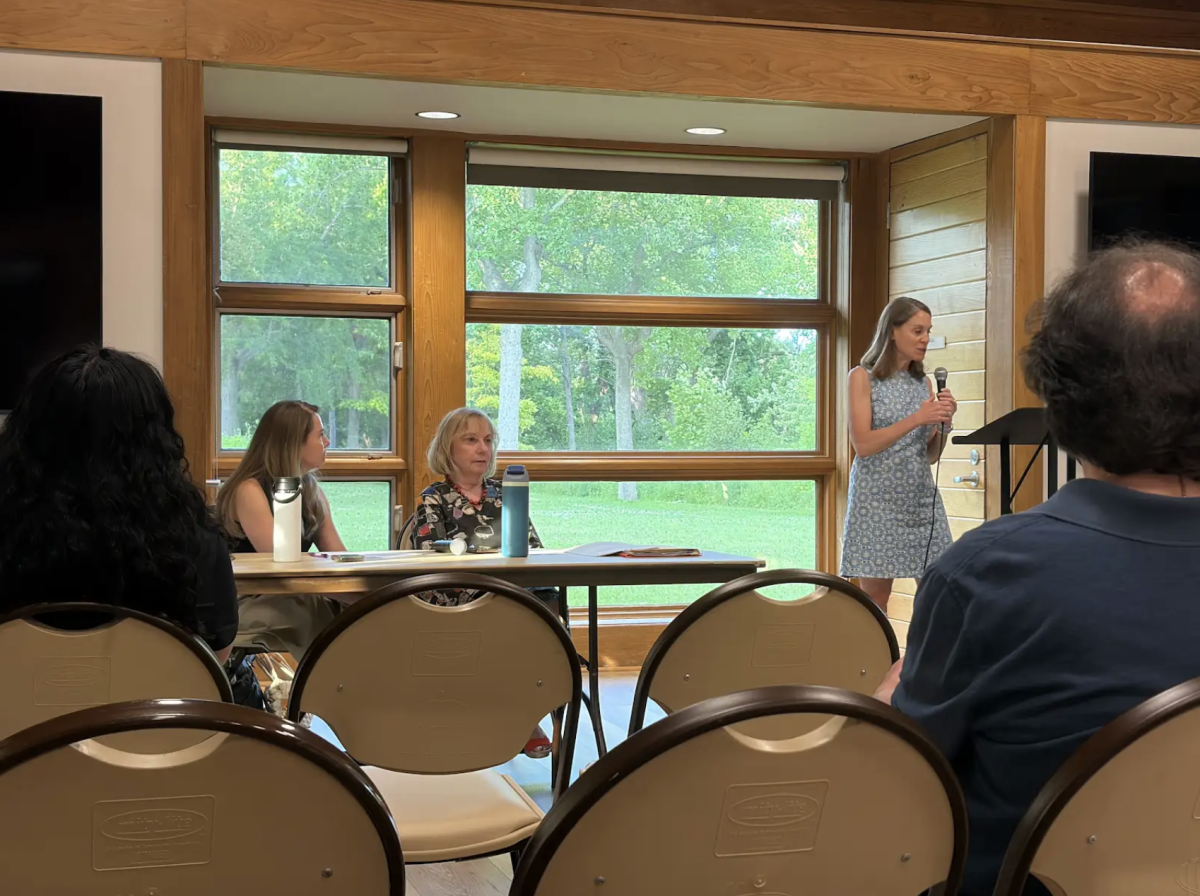
The Pan-Asian Voter Empowerment Coalition, a group composed of 19 different Asian American advocacy organizations from the Chicago area, hosted a forum on Feb. 9 for Democratic candidates running to represent Illinois’ 9th Congressional District.
While the event aimed to boost civic engagement and voter turnout, it was also a chance for candidates to hear directly from Asian American constituents, who make up roughly 15% of the 9th District.
“People assume that Asian Americans are an apolitical community, but that is not true, and we know that it largely comes down to barriers and access,” said Asian Americans Advancing Justice Organizing Manager Anooshka Gupta. “And so our goal is really to fight back against that narrative and have people understand that Asian Americans do care about what’s happening in their community.”
Immigration, anti-AAPI hate, xenophobia and rising costs were top concerns for attendees from across the district, according to Gupta.
She added that accessible health care, especially for the elderly, has also been on voters’ minds. Concerns surrounding health care have only grown, Gupta explained, since the closure of Weiss Hospital in Chicago last September following Medicaid and Medicare funding cuts over health regulation noncompliance.
Illinois is also home to the largest per-capita Muslim population in the country, according to a 2022 report by the Illinois Muslim Civic Coalition, the University of Illinois Chicago and the Institute for Social Policy and Understanding. According to Amina Barhumi, the Coalition’s executive director, the community’s diversity allows Muslim advocacy groups to collaborate with a broad coalition of organizers and voters.
The Muslim community, she explained, is not a “monolith.”
“There’s no race or ethnicity that is the largest segment of the Muslim community,” Barhumi said. “So we feel like we’re uniquely placed. We work across races and faiths and ethnicities.”
The Coalition works with over 150 organizations and individuals to educate voters, according to Barhumi. The organization has also worked with Asian organizations, including at February’s PAVE forum, to emphasize state-wide issues like affordability and healthcare services to candidates.
Other issues, like “never-ending wars,” also remain a top concern within the Muslim community, according to Barhumi.
“Economic support into forever wars, being complicit in genocide, our money funding ICE, federal agents and surveillance — this is not something that people here in Illinois want,” she said. “The Muslim community very much aligns with that.”
She also referenced the influence of outside groups in the election, including right-wing donors and the American Israel Public Affairs Committee, adding that it is important that “we elect ethical leaders to pass just laws.”
As the primary election approaches, advocacy groups in Chicago are working to ensure that voters’ voices are heard not only at forums, but also at the polls.
Longstanding immigrant and refugee aid nonprofits Chinese Mutual Aid Association and Trellus will be hosting a polling station during the primary election at their joint West Ridge office at 2424 Peterson Ave. in Chicago, at the edge of the 9th District.
Respectively established 55 and 48 years ago, CMAA and Trellus have established deep ties with immigrant communities through their longstanding advocacy, Trellus Co-CEO Rebecca Creighton said.
“Having and making sure that we are a space that they can see themselves and feel safe and comfortable is really important now more than ever,” Creighton said. “People go where they trust, right? And you at least increase the chances that people will show up, if they’re in a space and see people that they trust there.”
CMAA Executive Director Rhea Yap emphasized the importance of this connection, noting that many of the refugees her organization serves have fled government persecution in their home countries. While she called the U.S. a “safe haven” for many, many remain skeptical of government agencies.
Trusted community organizations, Yap said, act as a stopgap to overcome that distrust.
Since 2003, AAJA has engaged in a poll-watching program to ensure accessible voting across Cook County. For the upcoming primary election, Gupta said the organization plans to send about 40 volunteers to polling locations across Cook County in “designated language precincts.”
As areas with a high concentration of limited-proficiency English speakers, those locations are required under section 203 of the Voting Rights Act to provide foreign-language voting materials.
AAJA will then present volunteers’ findings to the Chicago Board of Elections and Cook County Clerk, the head election officer for the county, to identify potential areas of improvement, according to Gupta.
Though Yap noted Illinois has relatively robust language access support, given the sheer number of languages and dialects within the Chicago area’s pan-Asian community, many residents still struggle to navigate election material.
“We want people to fully participate, and we want them to be inspired, keep learning, keep growing, so one day they will improve their English,” Yap said, referencing the organization’s English learning and citizenship resources. “But once they have that right to vote, we don’t want them to be limited.”
The Coalition and other Muslim advocacy groups are also mobilizing voters within immigrant communities to go to the polls.
Muslim voters are “ready” and “wanting” to fully participate in the voting process, according to Barhumi.
“Here in Illinois, we’re uniquely placed that primaries oftentimes can determine what the outcome of the November election is going to be because we live in a supermajority blue state,” Barhumi said. “With primaries, as compared to any other election, usually there’s lower turnout, and oftentimes people of immigrant backgrounds are oftentimes not aware that there’s even an election.”
The Coalition has engaged in nonpartisan “get out the vote” efforts, including phonebanking, canvassing and networking with faith leaders to increase civic participation. Recently, the Coalition ran a “Believers to the Ballot” initiative to take residents to early voting locations.
“Good old-fashioned organizing” and one-on-one conversations, Barhumi said, are powerful tools to engage voters for this important race.
“While in some races, it feels like too many candidates, I think it’s a good problem to have,” Barhumi said. “Based on national data, I think we’re able to see, even based on some of the early voting, this is going to be a really powerful turnout.”
Email: [email protected]
Email: [email protected]
Related Stories:
— Democratic congressional candidates discuss immigration, anti-AAPI racism at PAVE forum
— ETHS students reflect on casting first ballots in congressional primary
— Leading congressional candidates talk federal immigration enforcement, Israel at forum