As an undergraduate, seventh-year Ph.D. student in mechanical engineering, Sylvia Tan had no idea what haptics technology consisted of.
Then, she came across the work of McCormick Prof. J. Edward Colgate. After Colgate gave her a demonstration of a haptics device in his lab, Tan said the trajectory of her life changed.
When she joined the lab of Colgate and McCormick Prof. Michael Peshkin, their work was mainly focused on surface haptics, the tactile vibrations that give a sense of texture or friction on touchscreens or trackpads.
Tan and the professors came to realize that surface haptics technology does not provide a very realistic representation of touch because it’s missing a crucial element of human sensation: spatial information.
Since touch puts different amounts of pressure on different parts of the fingertip, according to Tan, the all-or-nothing vibrations of a flat touchscreen cannot realistically replicate spatial resolution.
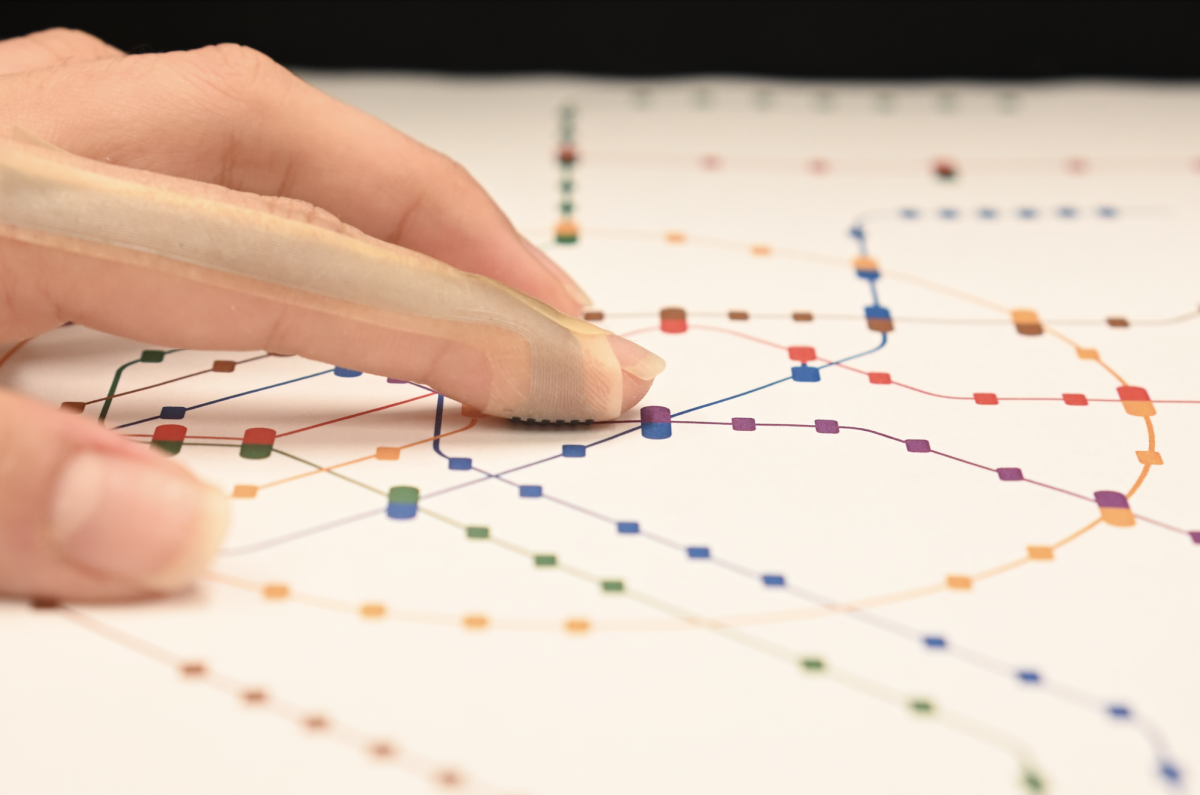
To fix this, Tan developed VoxeLite, a wearable fingertip device that realistically emulates touch sensations by providing spatially-distributed forces to the fingertip.
The device contains an array of actuators, or “nodes,” that generate electrostatic force onto the fingertip. Roughly as thin as a bandage, VoxeLite weighs less than a gram and represents a novel approach to haptics engineering that goes beyond the limits of surface haptics, Tan said.
The Daily spoke with Tan to discuss her journey into haptics engineering and potential applications of the VoxeLite technology.
This interview has been lightly edited for brevity and clarity.
The Daily: How did you get into haptics technology? What drew you to this field of engineering?
Tan: My undergraduate degree was in mechanical engineering, and I got a minor in art, and the art idea, specifically, is ceramics, which is inherently a very tactical-based art. I think with many people who do different things, you want to try and find ways to combine them. So, I was trying to find ways to think, “How can I combine engineering and art?” I didn’t really want to give up either side too much, but I wanted them to both be part of my work. I honestly love school, so that’s how the grad school part came in, and I just searched for a bunch of different professors … I came across Professor Colgate’s work, and I just read up about it. I thought it was just so fascinating because it was studying touch on the engineering side. I use (touch) so much as an artist to do my work, but I never really thought much about, “Can I actually study this sense?”
The Daily: How do you get the feeling of a texture to really be there when you’re working with something that’s paper-thin?
Tan: I think the first thing is realizing that you don’t need a lot of information or motion for you to feel it, because, for good and bad, humans are so sensitive. So, I can afford to have very small motions, and you can feel it. On the other side, it also means that I’m limited to the type of textures I can create, because my device, being so thin and so light, can’t move a great amount. That’s the boundary of the work: I’m trying to generate texture sensations … If I indented this table, I can feel the edge poking in. I’m not going to be able to do that because I can’t get that level of displacement with something that thin right now.
The Daily: And this all works through vibrations?
Tan: Yeah, they’re basically vibrating, because they’re moving at very high frequencies, but they can move from 0 Hz to 800 Hz. If you pass that 200 Hz range, they’re vibrating, but we can control that vibration, so imagine, I can control exactly how it’s moving up and down, but I can move them up and down really fast and at any displacement. So they’re vibrating, but it’s a very controlled type of vibration.
The Daily: Could this be used for braille?
Tan: Yeah, that’s one of the biggest applications that people are interested in, because it’s such a direct influence it could have, and clearly, (people who are blind) need that spatial information the most out of anyone. The size of braille, actually, is not extremely fine. It’s actually pretty coarse in comparison to what I’m working on. We have done very preliminary work just to see if we can make devices that (replicate) braille size, but we haven’t done any experiments to see how effective they are.
The Daily: Where do you see VoxeLite being in 10 or 15 years?
Tan: We didn’t make it to be a product, so that’s the first thing. It’s very much a research tool. That’s where my interest lies, and we built this tool to understand how humans perceive things, and then to hopefully build another version that is even better … Hopefully, other people, from this paper, will get interested in this kind of work, researchers who can put out another version and get textures that actually feel good and don’t have the limitations this device has.
The Daily: You were saying you liked art. What are some of the applications of VoxeLite in that sense?
Tan: There are actually some other researchers who have looked at this. A lot of it is in trying to teach art … So much of teaching ceramics, which I also do here, is verbal. The student is looking at you doing it, visually, and then you just tell them what you are doing, but it’s really hard to actually explain to them what you’re feeling, which is the main part of ceramics. There are some researchers, I think in Japan or Korea, who tried to record the signals that a professional artist is doing with their hands and then play that back to a student so that the students can directly feel what the instructor is feeling to help them learn to do the art and learn faster or maybe learn a different way, but that requires very good recording and very good playback, so we are not quite there yet, but that’s one example that has been looked at.
The Daily: Is there anything else you would want people to know about VoxeLite or the field of haptics engineering?
Tan: Even though we are all haptics engineers, haptics actually encompasses a lot of different fields. Maybe the engineering side is more straightforward — mechanical engineers, electrical engineers, computer science — but we also work with neuroscientists, materials scientists, psychologists, and you require all that very varied knowledge to be able to do haptics. Even though we are based in the mechanical engineering department, haptics is something that extends far more than that.
Email: [email protected]
Related Stories:
— VentureCat audience favorite Lab brings the electronics lab to anyone