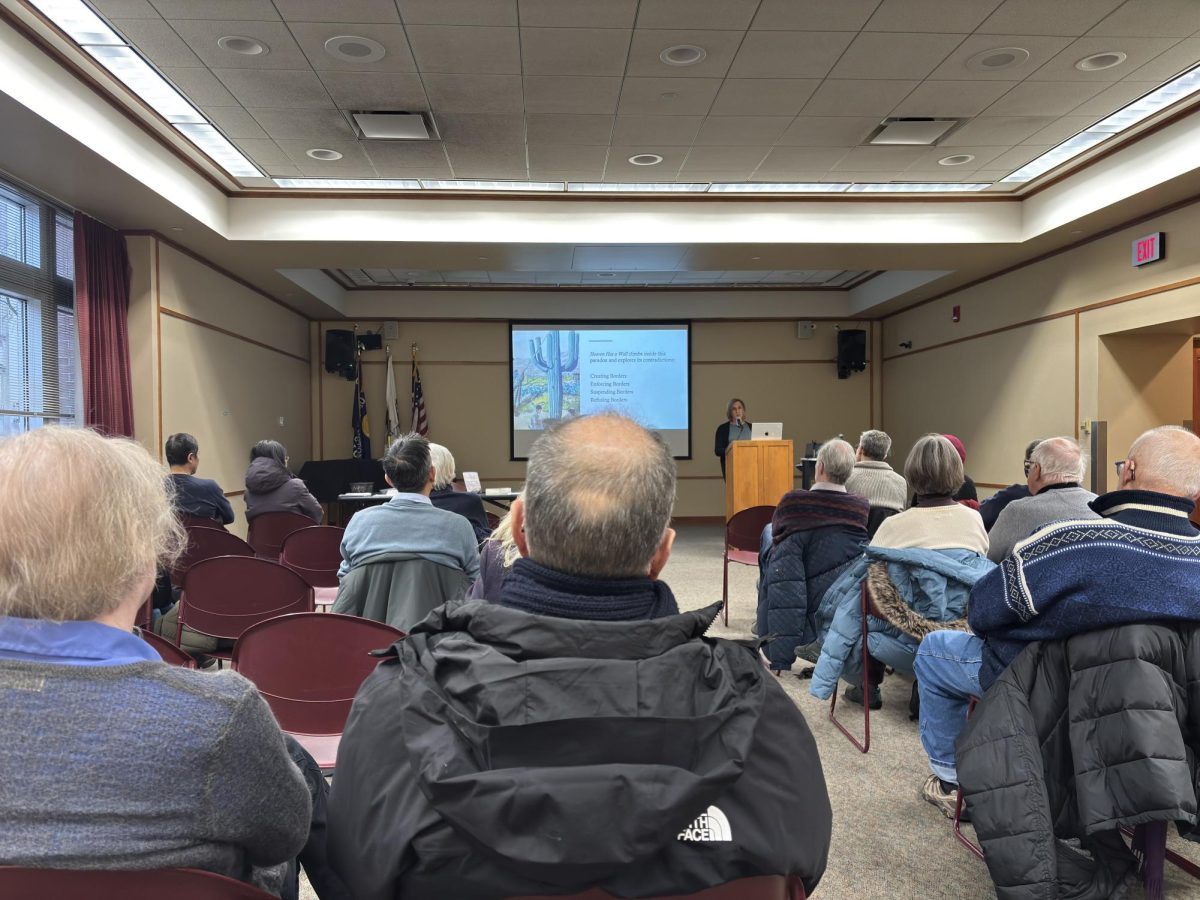
Community members braved extreme weather conditions and ventured to Evanston Public Library on Saturday to attend political science Prof. Elizabeth Shakman Hurd’s lecture on “American Border Religion.”
Hurd’s talk was based on her 2025 book, “Heaven Has a Wall,” where she explores political and religious symbolism of borders in American culture.
Her interest in borders and religion stemmed from her observation of how Americans differentiate themselves from the rest of the world, she said, frequently positioning themselves as a “superior” or “chosen” population.
“Borders are more complex than they seem at first glance,” Hurd said. “They’re liminal zones. They’re places of extremes, of exceptions, of special rules. There’s this enforcement and erasure, there’s the entrenchment and there’s transcendence.”
She delved into what she described as the “paradox” of American identity through the complexities of borders, where the United States desires both to strictly enforce and to transcend or even erase borders.
Hurd asserted that America’s desire for growth and exceptionalism has led to the mass dislocation and disruption of Indigenous populations through the use of borders. She traced this pattern back to the mid-19th century, highlighting how pressure and conflict have shaped the expansion of U.S. borders.
Hurd explained how her book delves into the complex power dynamic between Mexico and the U.S., along with the historical theme of “suspension and manipulation of borders for those who have resources and power.”
She tied borders and religion together by introducing an idea of a shared form of power between America and Israel called “AmericaIsrael.” Hurd described how the pairing of Israeli, U.S. and Jewish symbols in everyday life reflects America’s political support for Israel.
Hurd said this ideology also leads to a “very dark logic” where Jews are depicted as outsiders who are unable to be fully incorporated into American society unless they fully convert to the “religion of Americanness.”
Hurd ended her presentation with a map of North America’s 100-mile border zone, which outlines the areas within 100 air miles of U.S. borders and coastlines where Customs and Border Protection has increased authority for immigration enforcement. The highlighting of America’s borders gave audience members a clearer idea of how populations, ports and airports are concentrated in the country’s borders.
“The zone covers major cities, including Chicago,” Hurd said. “Because of Lake Michigan, there’s a water boundary. It also covers two-thirds of the United States population, so almost all of us live in the border zone. And so we can ask now whether this is even relevant anymore today, how the border has moved such that border enforcement is now everywhere, even here in Evanston.”
Anne Sullivan, an attendee and former securities lawyer, said she came to the event due to her interest in borders, stemming from her experience living in Mexico and her extensive time overseas.
“Borders, to me, involve jurisdiction, and how people exercise power to exercise their jurisdiction,” Sullivan said. “We have, under the doctrine of extraterritoriality, imposed our jurisdiction all over the world.”
The 20 attendees also had the chance to discuss the themes and historical events Hurd presented. Some members of the audience expressed their concerns about America’s current sociopolitical climate, while others shared their experiences as Americans in a global setting, particularly concerning how other countries and communities viewed American politics and culture.
Lorena Neal, the legal literacy librarian at EPL, said Hurd wanted to share her new book with a broader, nonacademic audience, given increased federal immigration enforcement in the Chicago area and Minneapolis.
“The Evanston Public Library is always happy and willing to provide that sort of space to allow for communication between the academic world and the ‘outside world’ in our community,” Neal said. “After the news this morning out of Minneapolis, it just underscored the need for us to be talking about this as a community.”
Correction: A previous version of this story incorrectly referred to Hurd’s book. The Daily regrets this error.
Email: [email protected]
Related Stories:
— Leading congressional candidates talk federal immigration enforcement, Israel at forum
— Border Patrol covertly filmed Dec. 17 protesters with Meta smart glasses, Daily analysis finds
— Northwestern professors explore recent protests in Iran in panel hosted by MENA Studies