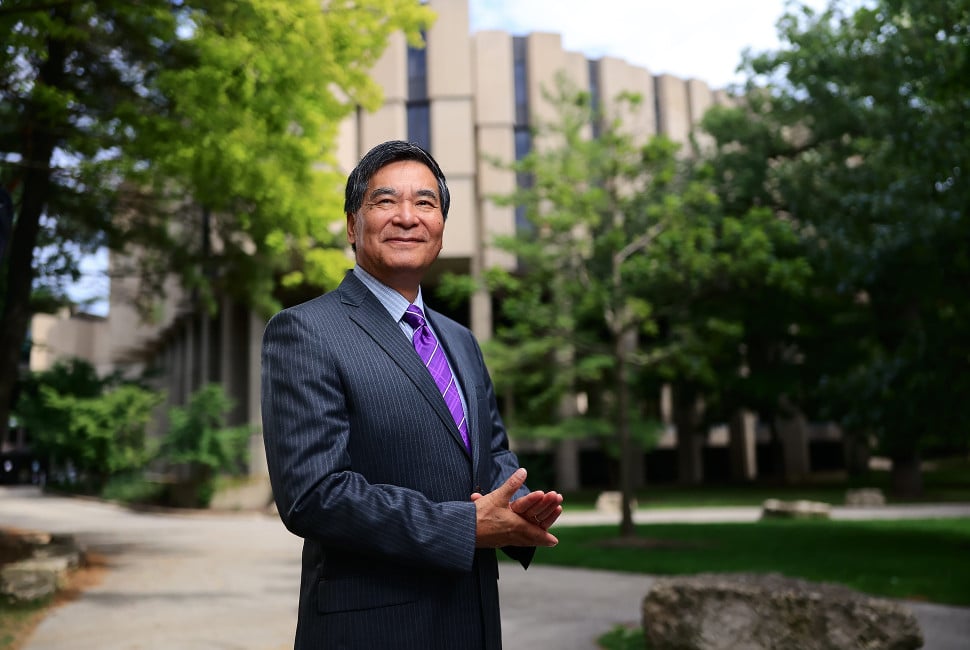
More than 50 people attended a lecture titled, “Sudan and South Sudan in Context,” by Loyola University Chicago history Prof. Kim Searcy on Wednesday evening.
The talk, hosted in 620 Library Place, was presented by Northwestern’s BlackBoard Magazine in collaboration with the Program of African Studies and the Middle Eastern and North African Studies Program.
The lecture covered Sudan and South Sudan’s history, beginning with the late 1800s and extending into the present. The British and the Egyptians ruled Sudan from 1899 to 1956 in a dual colonial government known as the Anglo-Egyptian Condominium.
Searcy, who teaches courses related to African history and Islam, spoke about the legacy of British colonialism in Sudan, particularly in the western region of Darfur. He cited British imperialism in the creation of a “divide-and-rule” form of government, in which the British separately governed the predominantly Arab and Muslim north of the country and the diverse, multiethnic south, resulting in a “racialized hierarchy,” unequal development between the regions and the development of paramilitary groups.
After tensions reached a breaking point, culminating in civil war in 2011, South Sudan seceded from Sudan.
In 2003, the conflict in Darfur began when rebel groups revolted against the Sudanese government. At the time, some American celebrities publicized atrocities during that war, particularly the genocide of the Darfuri people. But, as Searcy added, Sudan began to “fade from the consciousness of America and the West.”
“That war never ended,” Searcy said. “What’s going on now in Sudan, that’s a continuation of that war in 2003.”
In April 2023, war broke out between the Rapid Support Forces, a paramilitary group, and the Sudanese Armed Forces. In the two years since, more than 150,000 people have died and nearly 13 million have been displaced. Famine has also devastated multiple regions of the country: According to the World Food Programme, 21.2 million people face acute hunger.
On Oct. 26, the RSF seized el-Fasher, the capital of Sudan’s North Darfur state. Scenes from el-Fasher prompted horror from the international community, as members of the RSF began posting videos on social media documenting the militia’s use of torture, murder of civilians and massacre of entire villages. Satellite images of large swaths of land soaked in blood visible from space went viral.
The United Arab Emirates, an ally of the U.S., have faced criticism for supplying weapons and aid to the RSF.
Medill senior and Creative Director of Blackboard Magazine Mariam Cosmos explained that the lecture was organized to give students the opportunity to develop a historical understanding of, as Cosmos called it, the “forgotten war” in Sudan.
Cosmos added that the talk also aimed to create a space for students to show their solidarity, especially for students who are a part of the Sudanese diaspora.
Cosmos, who is originally from South Sudan, said she believed mainstream media has pushed Sudan to the periphery.
“Oftentimes in the West, there’s not a lot of understanding of what is truly going on on the ground, as well as that of the people who are experiencing these atrocities,” Cosmos said. “They’re not just like numbers. These are individuals with aspirations and hopes in their own lives and are deserving of dignity.”
Weinberg freshman Dina Elamin, whose family is from Sudan, noted that the recent spike in attention to Sudan is unusual in comparison to the media’s lack of attention over the past two years.
For her, the media’s dearth of coverage speaks to the normalization of African suffering.
“It’s just been a really big thing for a lot of Sudanese people to not be seeing any coverage about your country, even though you have the largest humanitarian crisis (and) largest displacement crisis,” Elamin said. “Then to be seeing coverage on a lot of different other conflicts around the world, a lot of different genocides around the world, but just not this one … it’s really disappointing.”
Elamin said she was surprised by the number of attendees at the lecture, which exceeded her expectations. She said she expected only a few Sudanese people to attend, and so the number of people from diverse backgrounds coming together to learn was significant.
Increased discourse and renewed attention on Sudan is a welcome shift, Elamin said.
“I just hope that people do something about it,” Elamin said. “Posting about it on social media and exposing yourself to what’s happening is important, but that’s not enough to bring about action and bring about change.”
Next Wednesday, BlackBoard and MENA are hosting a film screen of “Sudan, Remember Us,” a 2024 documentary about the Sudanese protest movement in 2019.
Email: [email protected]
Related Stories: