Abu Hoque (SESP and Weinberg ’25) said he recalls struggling to remember the languages he grew up with. After moving to Atlanta from Bangladesh at age seven, his Bengali, Hindi and Urdu stopped growing with him.
“In terms of community in the U.S., I had no one to speak to,” he said.
Feinberg student Ramzy Issa (Weinberg ’23) said that during the pandemic, he felt isolated and missed being around the Palestinian and Chaldean communities that had always surrounded him.
Distance from that community felt heavier, said Issa, when Israel escalated its violence against Palestinians during the COVID-19 pandemic, including the “medical apartheid” in the West Bank through limited access to vaccines, the displacement of Palestinians from their homes in Sheikh Jarrah and settler attacks in farming and rural villages, including Issa’s home village, Taybeh.
To preserve and nurture their communities in Chicago, Hoque and Issa launched Masira this month. Masira is a Middle Eastern, North African and South Asian space that connects people from the MENASA region through periodic cultural events while donating proceeds to the spotlighted region, combining activism and solidarity in an effort to address community-based issues. The organization isn’t confined to a physical location but is people-centered, constantly switching locations for its endeavors.
“In Masira’s core, it’s to bridge people and bring them together to meet in the city of Chicago,” Hoque said. “It’s having dope people meet other dope people.”
Issa said their partnership thrives because of a balance of his “type A” and Hoque’s “type B” skills. Issa’s understanding of organization from his medical background and Hoque’s financial literacy from his investment banking experience create a well-rounded duo that is united in creativity and friendship, they said.
Hoque came up with the idea of Masira over a year ago while studying with Issa at the Galter Health Sciences Library & Learning Center at Northwestern Medicine.
Issa started a dabke dance team, Harakat, at NU in 2022. Dabke is a style of traditional Levantine folk dance. Hoque said he wanted to create a space around the Arabic word “harakat,” meaning movement, and was inspired by Issa’s dance team.
But the name “Harakat,” though personally meaningful to them, did not fully capture their vision, they said. After studying more than 50 Arabic words, Hoque landed on “Masira,” which means “journey.” They said the name represents not only movement, but people connecting, growing and finding meaning wherever they are, as well.
Masira evolved again after Issa received an espresso machine from Hoque and two mutual friends for his birthday. He refined his recipes and eventually hosted a coffee pop-up in August. Issa and Hoque came to see coffee as a “social lubricant” that could spark community, creativity and connection, as well as an alternative to alcohol, which most people in their community don’t drink.
Coffee brewing, however, wasn’t the only endeavor that shaped Masira.
Hoque also brought fashion to the space. His childhood friend, Faith Kumi, recalled Hoque’s early passion, saying he has been interested in fashion “for as long as she’s known him.”
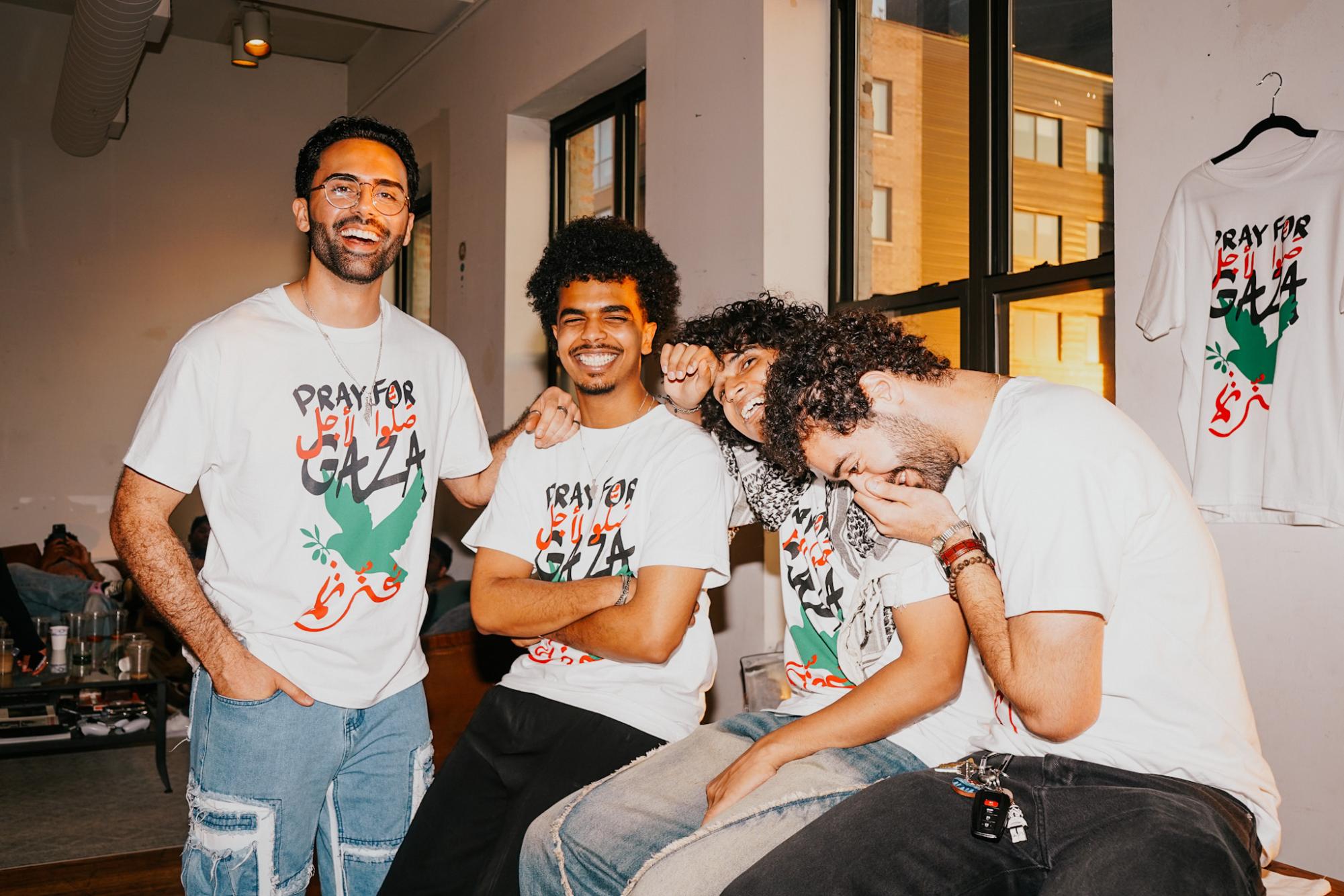
For Masira’s launch, Hoque designed “Pray for Gaza” T-shirts and Masira tote bags. He said he plans to design more clothing for Masira events.
In early October, at 1278 N. Milwaukee Ave., more than 160 guests across Chicago drank Issa’s Palestinian coffee, listened to an Arabic DJ set and browsed Hoque’s designs.
For future events, they said they plan to spotlight other regions, starting with Sudan. Each spotlight, they said, is a chance to learn about a new culture and create unity and impact across borders.
The initial launch raised $4,025 for the Palestine Children’s Relief Fund. Raising funds is not the only form of activism Hoque and Issa said they aim for.
“Regardless of how educated a person is, bias and ignorance when it comes to human rights come from a lack of friendship,” Hoque said. “If people had a Muslim friend, there would be less Islamophobia. If people had a Jewish friend, there would be less antisemitism. If people had a gay friend, there would be less homophobia. Aspects of friendship and community bridge hatred and gaps within the broader places we live in.”
Issa simplified the duo’s activism further and said cultural practices and community are a way to actively defy oppressors.
He said celebrating culture and being “joyful and smiling amidst the hardship” that they experience is important.
“It’s defying the colonizer who wants us to always be oppressed and sad by taking our life away,” Issa said.
Showcasing cultures accurately in a way that respects and uplifts culture itself, Hoque said, is the most difficult part for him. He said he strives to get a crowd to genuinely care and learn about the culture being highlighted.
“Those things are the parts that I struggle with because we only represent two identities within this region,” Hoque said.
Issa said bringing their “amazing” ideas to life is another challenge.
“What is feasible? What is realistic? How do we tackle it?” Issa said.
Sudanese American Faris Haghmad (SESP and Weinberg ’25) attended the launch event as both a friend and spectator.
He said it is difficult to make connections as a post-grad without an easily accessible campus community and appreciates the atmosphere Masira provides.
“I appreciate providing people a space to be their outlet of cultural expression, where they might not have it elsewhere in their life,” Haghmad said. “I appreciate the fact that it’s such a broad range of cultures with so many intricacies and details being uplifted. That safe space for culture and our everyday life is just really, really important.”
Issa and Hoque said Masira is special because the space prioritizes people who share their cultures and backgrounds over profits and brands. The founders said they wanted to prioritize people who value MENASA culture and community the way they do.
They said Masira felt selfish, in a way, with it being a space for them to explore their evolving identity while connecting with “cool people.”
“In terms of branding, I’m trying to solidify who we are. I’m always changing who we are to be and who I am to be, and this is something that evolves with me,” Hoque said. “Masira was meant for me to experiment (with) what I love doing and see what sticks with me, and with Ramzy (Issa) and the community.”
In the future, Hoque and Issa said they hope to expand their journey even more, possibly through a MENASA publication, unique fashion, insightful art, a coffee clubbing scene and more. They imagine Masira evolving into a lasting network with endeavors that grow with the community, they said.
“I just want to continue to be a safe space for people to continue to grow, a safe space where we continue to foster a way for people to come together,” Issa said.
Issa and Hoque reflected that what began as two friends searching for connection became a living reminder of the culture and tradition that can be created in relation to others.
To them, the connection Masira provides is important on a personal level and for society.
“Existence is resistance,” Issa said. “Joy amidst hardship is resistance. Remembrance is resistance.”
Email: [email protected]
Related Stories:
— Zora’s Place creates space for Black expression and self-care in Evanston