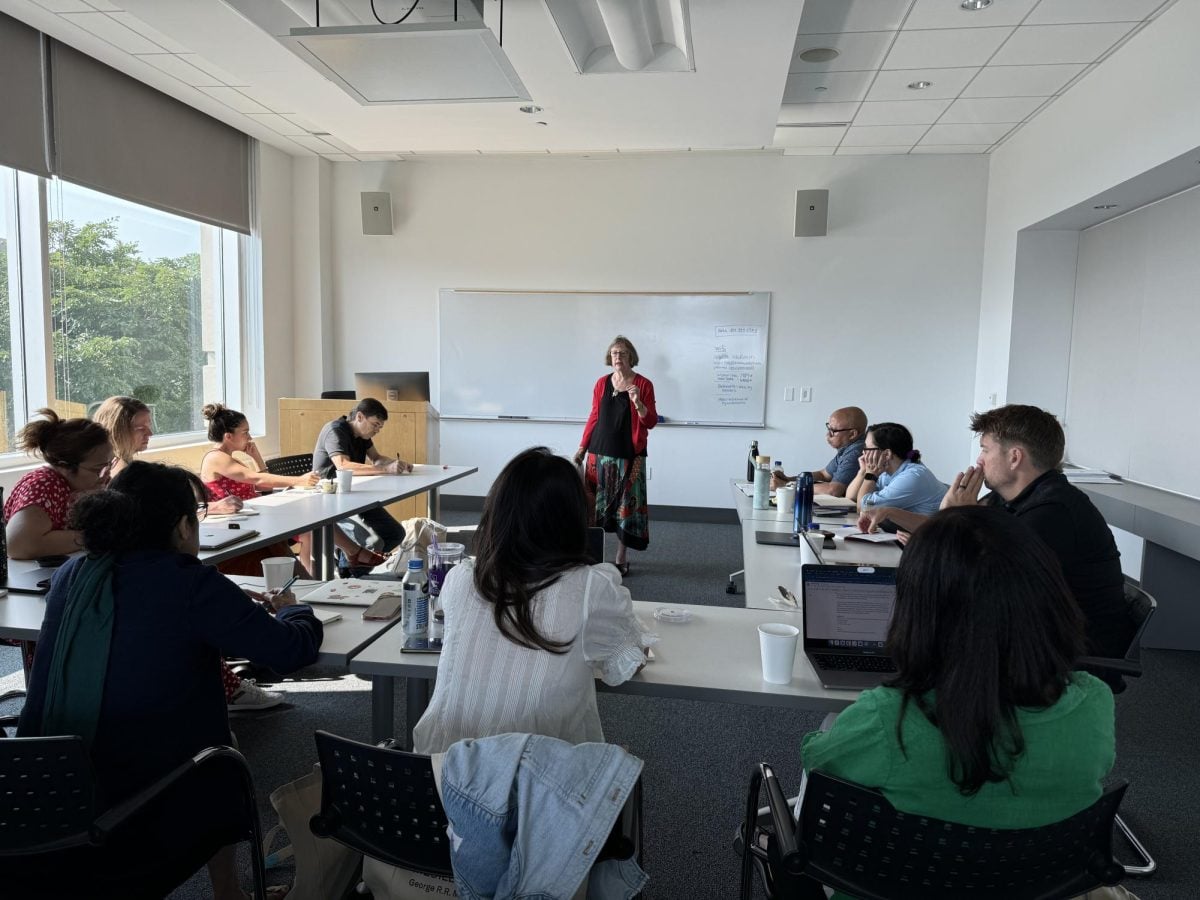
Viewers gathered for a screening of “Bad Press,” a story about the fight for press freedom, followed by a Q&A with co-director Rebecca Landsberry-Baker and Angel Ellis, the subject of the documentary, at McCormick Auditorium in Norris University Center on Friday.
The event was co-sponsored by the Center for Native American and Indigenous Research and the Medill School of Journalism. The documentary recounted Mvskoke Media journalist Ellis’ fight to reinstate free and independent press in the Muscogee Nation.
Out of 574 federally recognized tribes, the Muscogee Nation was one of five with a free press law until November 2018 when its National Council repealed it. Viewers watched a tumultuous process unfold as Ellis unraveled the political tensions in Muscogee Nation as she championed a constitutional amendment for free press, which successfully passed in September 2021.
Michaela Marchi is a program assistant at CNAIR and organized the event, noting the timeliness of a film centered around journalistic freedom.
“Our hope is that the native, Indigenous voice is heard and it’s illuminated how relevant our concerns are to the rest of the country and the world because what they went through, we all have the potential to experience, and we can learn a lot from what the Muscogee Nation did,” Marchi said.
Following the documentary screening, Landsberry-Baker and Ellis answered questions from the audience. Landsberry-Baker kicked off the conversation with her decision to tell this story.
Landsberry-Baker said that although journalists usually are the storytellers with the power, it is not always the case in Indian Country. She wanted to ensure journalists’ stories could be documented while also capturing the community itself.
“I want to show the challenges but also the humor in these situations and how we as Indigenous people use humor as a survival mechanism, and storytelling is at the heart of so many things we do,” Landsberry-Baker said.
Now the director of Mvskoke Media, Ellis said she is continuing the fight, though in a different way than in her time as a reporter.
Ellis said, since the documentary, she has worked to diversify the budget and hire an attorney to enforce the Constitution, including the free speech amendment. She added that she is advocating to adopt the Freedom of Information Act for Muscogee Nation.
Throughout the process, Ellis said the documentary cameras acted like a “shield” for her safety. However, in making and releasing this documentary, Ellis noted her fear in exposing the “dirty underbelly of a very vulnerable community.”
“You spend so much time in an Indigenous community trying to just jockey and move and say, ‘Look, I’m good enough. I’m good enough, I’m strong, I’m independent, I’m knowledgeable, I’m smart,’” Ellis said. “And then here you go and show all your obvious situations where you’re not and you haven’t quite got your s–t together, and people can become very resentful of that.”
Landsberry-Baker echoed Ellis’ fear in representing Indigenous people in a negative light in some aspects of the story, but she said it is the truth they live in and have a responsibility to report.
“That’s what our responsibility is, as journalists, as documentary filmmakers, as storytellers, to present the truth as it is,” Lansberry-Baker said. “And I think it just speaks to the fact that Indigenous people are multifaceted, and we’re not a monolith.”
Angel said more tribes now have adopted free press laws, but the vast majority still do not have free press, and those currently with it are under attack. The communities themselves must drive change, Angel added, but she hopes her work can act as a foundation for other communities to build off of.
Sound arts and industries graduate student Lawrence Lewis said he attended the event as he is currently working on a podcast around Indigenous practices relating to education and power dynamics.
From the event, Lewis said he was surprised to see that the free press issues addressed among Indigenous groups are paralleling current federal government challenges.
“I guess I was looking for what kind of things we could try to emulate as a citizen body and employ against our own federal government at this time,” Lewis said. “But just the fact that this was such a recent event, 2019 and ongoing, it’s interesting and rather disheartening at the same time.”
Email: [email protected]
Related Stories:
— Powwow celebrates advancements for Chicago area Native communities
— NPR’s Nina Totenberg talks Supreme Court, law at Leopold Lecture