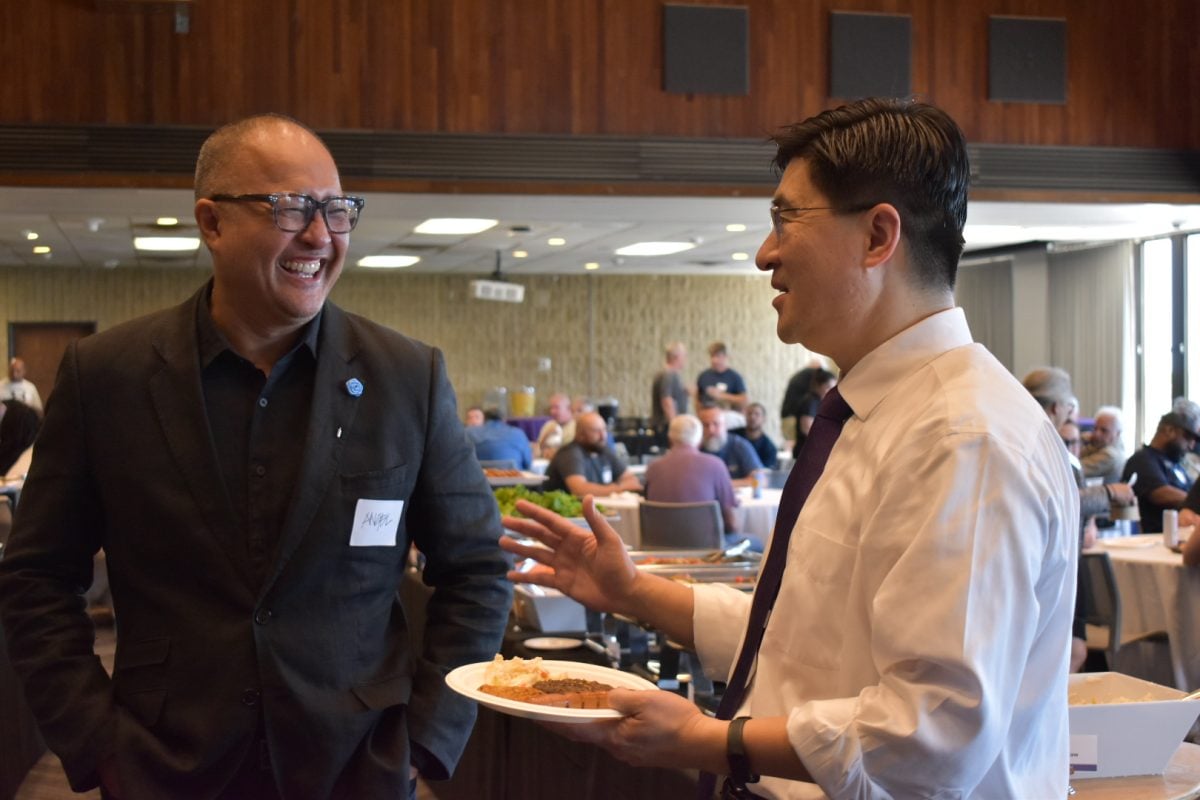
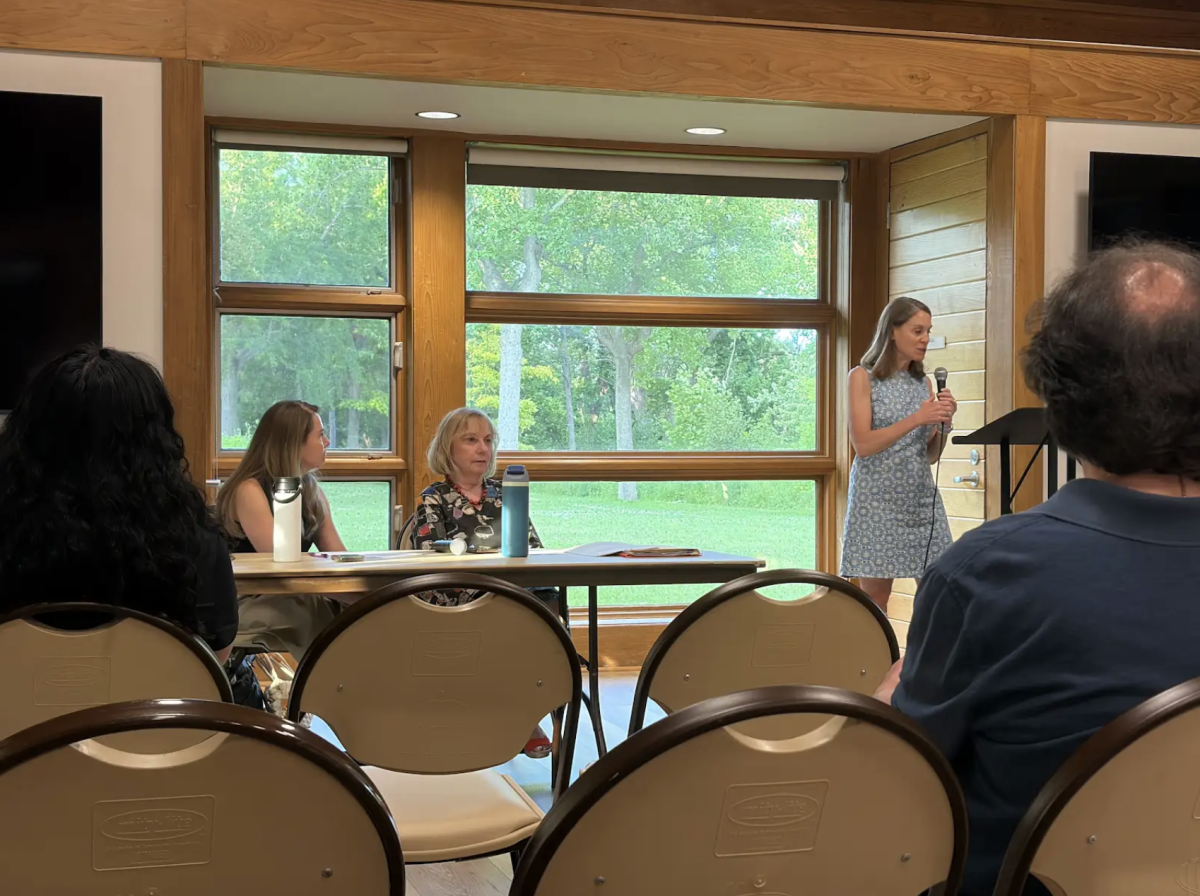
Over 70 community members attended a Foster School family meeting to learn more about the new school’s curriculum and programs Wednesday evening at the Fleetwood-Jourdain Community Center.
Evanston/Skokie School District 65 officials, some school board members and families from schools across the district shared hopes and concerns related to Foster, which is set to open for the 2026-27 school year.
Foster Principal Charlise Berkel also heads the Dr. Bessie Rhodes School of Global Studies, which will shutter after the 2025-26 school year. She began the meeting by describing a “unified vision” across learning environments and emphasizing the importance of diversity and intersectionality throughout Foster’s curriculum. A key component of learning at Foster will be “leveraging identity” and being “culturally responsive,” especially considering the “political climate we’re in right now,” she added.
“I don’t want children to have to choose between their identities,” Berkel said. “They need to have a nurturing place where their multiple identities are accepted and nourished.”
Along with Bessie Rhodes, the board unanimously voted to close Kingsley Elementary School on Jan. 22. The closures have led to the district’s school attendance boundaries being redrawn for the 2026-27 school year and will impact over 800 students, said Stacy Beardsley, assistant superintendent of performance management and accountability, at the Jan. 22 meeting.
With the new boundaries, students from various current District 65 schools will attend Foster.
The school’s opening follows decades of advocacy work for the return of a neighborhood school in the predominantly Black 5th Ward. Prior to the district’s desegregation efforts in the late 1960s, 5th Ward students attended the old Foster school within their community. However, as the district began bussing 5th Ward students to different schools, the old Foster School was converted into the Martin Luther King Jr. Experimental Laboratory magnet school, and eventually permanently closed in 1979.
A 2012 referendum to restore the school was rejected, but in 2022, the District 65 board unanimously approved the plan to build the K-5 school. Construction began in 2024.
“The children that come to Foster School will be part of a historical moment as the first class,” Berkel said. “Even though we think we’re just making choices for our children, we’re making history.”
ACC Reimagined
The district’s African-Centered Curriculum, which centers learning around African identity and heritage, will be a part of every Foster student’s experience. The program, called ACC Reimagined, takes inspiration from Oakton Elementary School’s ACC program. It will incorporate “culturally infused” morning meetings and cultural celebrations, according to Berkel.
Judith Treadway, a longtime ACC advocate, said the curriculum’s primary focus is to bring Black history to the forefront of learning.
“It wouldn’t just be European history,” Treadway said. “It would be American history, which includes significant groups like Blacks, Chinese, Native Americans and everything.”
At Wednesday’s meeting, Berkel emphasized that the curriculum will be guided by core values of identity, justice and intersection, as well as the seven principles of Nguzo Saba and the Sankofa principle, learning from the past to build a better future.
Kingsley parent Samia Yesufu said she thinks Foster’s opening will give the community the opportunity to collaborate between different “socioeconomic statures, different races and different belief systems” to help create an inclusive environment for “all of our children.”
“I think it’s going to be a beautiful contribution to our community,” Yesufu said. “And today just made me feel very enthusiastic about what’s to come.”
Community members look to Foster TWI program, push for STEM focus
According to Berkel, Foster’s Two-Way Immersion program will be based on three pillars: bilingualism and biliteracy “rooted in identity,” high-level academic achievement “propelled by inquiry” and sociocultural competence.
Bessie Rhodes parent Crystal Barriga said she was initially unsure about what Foster’s TWI and ACC program would look like for her child. However, she said that Berkel’s emphasis on intersectionality and her explanation of Foster’s learning environment felt “really positive and very promising.”
“We’re in an increasingly global society,” Barriga said. “So being around kids with families from different backgrounds is going to be important and the experience that we want for our daughter.”
The board voted 5-1 to terminate the Willard Elementary School TWI program on Jan. 27 as part of Phase 3 of its Structural Deficit Reduction Plan, which aims to cut $10.9 to $14.85 million from its budget before fiscal year 2030. The TWI strands for Willard and Bessie Rhodes will be consolidated into two new strands at Foster.
Willard TWI parent Juan Mendoza said he’s happy about the increased staff that will come with two TWI strands being at Foster. He added that he appreciates that the school will emphasize multiculturalism.
“Our culture can be forgotten,” Mendoza said. “So it helps me, or it helps my daughter, move ahead for the future.”
Henry Wilkins, founder of the nonprofit STEM School Evanston, said that despite his disappointment in the lack of STEM talk at the meeting, he was open to being a “thought partner” for future STEM education facilitation at the school.
“I’m frustrated that there wasn’t enough conversation about what they’re doing to incorporate the desires and wishes of the Black community, which asked for STEM to be a key component of the school,” Wilkins said.
In response to concerns about Foster’s STEM curriculum, Berkel said the “most rigorous way” for her to support STEM is selecting teachers who can effectively implement STEM learning approaches. She added that these criteria include the ability to analyze and respond to student data in the i-Ready curriculum, an online program for personalized learning.
Berkel also discussed using vertical dry erase boards in “Building Thinking Classrooms,” which help children visualize mathematical thinking, and having teachers identify which students need math intervention during the almost daily “What I Need” — or WIN — period.
To make school involvement accessible to parents, Berkel also introduced a 10-step family engagement plan that includes community-building opportunities, family engagement and event committees and future family meetings while providing questionnaires for parents to fill in their expectations and involvement interests for Foster.
Despite lingering questions about Foster’s curriculum and the transition process for families, some parents left the meeting feeling positive about Foster’s future.
Yesufu said she is fully committed to Foster.
“We’re doing it together even though we have separate ideas, or desires, or needs or expectations,” Yesufu said. “We’re trying to do it together.”
Email: [email protected]
Email: [email protected]
Related Stories:
— Foster School advocates eager to see 5th Ward students thrive with African Centered Curriculum
— ‘This is a tragedy’: Willard TWI families stand at a crossroads after D65 decides to shutter program
— Chris Van Nostrand named to D65 board as district navigates period of transition