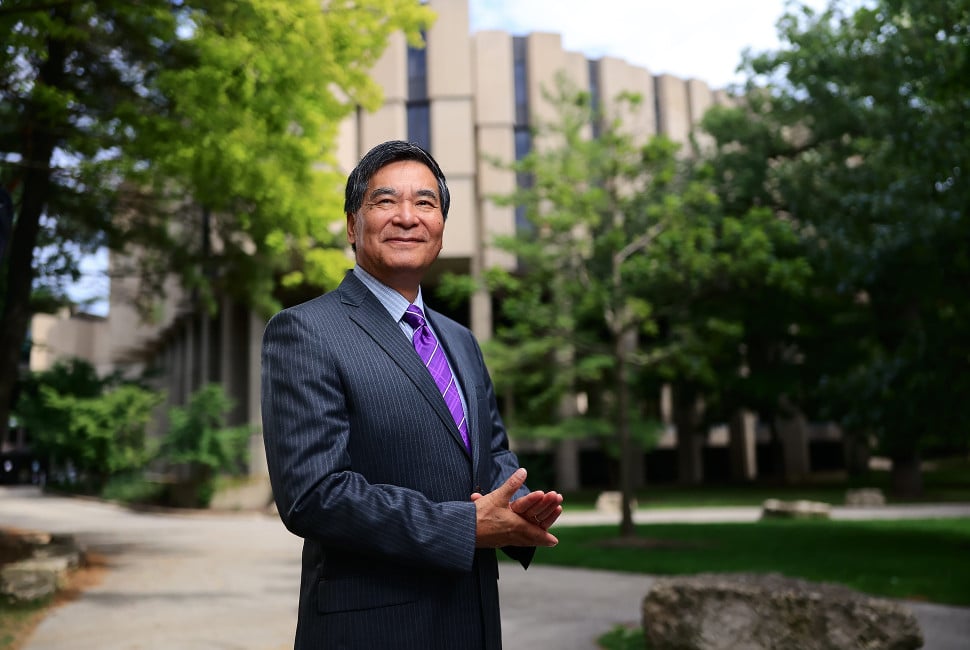
When interim University President Henry Bienen relinquished his post as Northwestern’s head honcho in 2009, most current undergraduate students were too young to be in kindergarten.
Bienen, who became former President Michael Schill’s temporary replacement Sept. 16, is no stranger to the demands of the job he held for nearly 15 academic years.
But if the words he spoke when he was first hired back in June 1994 still ring true, he’d be the first to tell you that inheriting the reins from a contentious predecessor isn’t ideal.
“You have to ask yourself, would you rather come to an institution in dire difficulty or follow a guy that’s done a great job and come to a school that’s very strong. I think the obvious answer is the latter,” Bienen told The Daily for a special June 15, 1994 edition announcing his hiring.
Back then, Bienen introduced himself as someone equally concerned with undergraduate education as he was with research. He admitted that, coming from Princeton University, he didn’t know much about Greek life, but was quick to call himself “a bit of a jock” as he fawned over Big Ten athletics.
During his decade and a half at the helm, Bienen oversaw some of the University’s largest milestones, including the opening of a new campus in the Middle East and a 1996 Rose Bowl appearance, as well as his fair share of challenges like a student-led hunger strike advocating for an Asian American studies department.
Now, at 86 years old, Bienen returns to the fray with an entirely new set of circumstances before him.
A new president’s growing pains
Bienen commended former NU President Arnold Weber, who came before him and kept the school in “good financial shape,” avoided tuition hikes and remained largely uncontroversial throughout his tenure.
“I haven’t learned that much is broken, and I don’t expect many, if any, immediate changes,” Bienen said on forming a new staff.
Unlike Schill, who resigned, embattled by Washington Republicans’ allegations of antisemitism on campus and with a $790 million federal funding freeze in tow, Weber retired, leaving few lingering challenges for his successor.
The Daily reported that students chanted “four more years, four more years” during Weber’s final commencement ceremony in 1994.
Despite an initially smooth transition, Bienen realized that signing on to the same policies that defined Weber’s presidency could lead him astray.
That summer, The Daily published an editorial calling for Bienen to “replace Weber, not replicate” him.
“Northwestern should enter the 21st century with vigor and energy. It can only do that with a president who is willing and open to change,” it wrote.
Though Bienen was tapped for the role in June of 1994, the now-interim president could not move to Evanston until the Winter Quarter of 1995 for a combination of personal and professional reasons. He visited campus frequently during the fall to prepare.
When he finally took over in January, it didn’t take him long to face student concerns head-on.
During his first introduction to students at an ASG-hosted forum, Bienen fielded questions on his agreement with a Weber-era policy of excluding faculty’s same-sex domestic partners from receiving benefits. He said he supported the decision during one of his first interviews with The Daily.
After the appearance, students commended the new president’s openness. Bienen routinely hosted breakfasts in Norris and attended fireside chats with various student groups throughout his presidency.
Nearly three months after the forum, Bienen touted the importance of cultivating diversity on campus during his first State of the University address.
“I don’t expect a utopia,” he said March 28, 1995. “I know universities all too well to expect a community of angels.”
Twelve days later, when a group of Asian American students announced a hunger strike after the University refused to establish an Asian American studies program, it was clear that Bienen’s optimistic image of multiculturalism would not come simply.
Student hunger strike draws national attention
In the spring of 1995, The Rock was marked by sights of tents as student activists protested Bienen’s refusal to establish an Asian American studies department.
Earlier in the year, the Asian American Advisory Board collected over 1,200 signatures calling for Bienen to hire a full-time, tenured director for the proposed department by May 7, 1996, as well as two other professors by the fall.
By the time the protest began on April 12, 17 students had pledged to starve themselves, and 60 others committed to a one-day fast. The following day, an estimated 150 students braved wintry weather conditions to protest outside administrative offices, but Bienen never came outside.
“I’m interested in talking to people, not listening to chants,” he told The Daily.
Though it lulled at some points, the tents did not come down for nearly a month. By Day 9, the demonstration had received national attention. Students at Stanford University, Columbia University and Princeton began their own fasts in solidarity.
The protest persisted into a prospective students weekend, but Bienen didn’t budge.
“I don’t care for the bad publicity, but we’re not going to change the way we do things,” Bienen said. “If you hurt the University, embarrass the University, you haven’t done yourself any good.”
Though the AAAB never struck a deal with the president, he agreed to sit down with them in the beginning of May 1995. Bienen also participated in an open Q&A session for all students on the same day.
Bienen told students that he did not have the power to unilaterally create a new department. While maintaining his skepticism, he told student activists he was not completely closed off to their idea.
“The study of ethnicity is extremely viable and very interesting,” Bienen told students May 2, 1995. “I don’t know if it’s wise, though, to create a lot of hyphenated studies.”
The tents were taken down by students on May 4, but organizers told The Daily their fight was not over and would continue into the next academic year.
Though no department was created until 1999, Bienen referred to 10 Asian American-related courses offered in the 1995-96 academic year as progress.
Federal funding concerns surface
On a much smaller scale than those that plagued Schill’s presidency, Bienen also handled proposed federal funding cuts of his own during the early days of his tenure.
As Republicans sought to address a budget deficit and reverse the course of research funding increases during the Cold War, Bienen cited potential cuts when NU opted to raise tuition in 1995.
Later that year, as loose federal threats to the University’s financial status further materialized, Bienen spoke out against congressional action.
In September 1995, both the U.S. House of Representatives and Senate proposed about $10 billion in student loan cuts, projected to cost NU $500,000, valued at around $1 million now.
“This is a terrible mistake,” Bienen said. “It’s like sticking the camel’s nose under the tent of taxing nontaxable institutions. As a principle, it’s a disastrous one”
At the time, Bienen said the potential cuts would particularly impact need-blind institutions like NU, which couldn’t “create a war chest” with higher education on the chopping block.
Broadening global scope: from British royalty to the Middle East
A Rose Bowl appearance, a royal visitor, an Academy Award winner as commencement speaker: Bienen left a rocky rookie year behind as NU soared into national limelight amid an eventful 1996.
A mere two years after being named NU’s president, he found himself hosting the Princess of Wales in his University-funded home.
Princess Diana visited Chicago that June to visit breast cancer research centers across the city. Bienen showed her around campus, gifted her an NU sweatshirt and accompanied her to a gala at the Chicago Field Museum.
Bienen later told the Chicago Tribune that he danced with her and the pair stayed in touch after she returned home.
The improbable, headline-grabbing connection was an early means of achieving Bienen’s term-long goal of expanding NU’s presence on a global stage.
A decade later, Bienen’s presidency would take him over 7,000 miles away from Evanston to Qatar, where he tested the waters of opening a new campus in Doha.
After negotiations spanned the bulk of 2007, NU joined five other universities that had already expanded to the Middle East hub. The following year, about 40 students began taking journalism and communications classes at the new campus.
Bienen routinely touted the financial benefits of the decision — which was funded by the non-profit Qatar Foundation — but his administration also celebrated the impact it would have for students back in Illinois.
According to then-Vice President for University Relations Alan Cubbage, the move was also aimed at furthering study abroad opportunities and expanding students’ worldviews. He said Bienen had already helped balloon the percentage of students who studied abroad from 8% to 25% over a 10-year span.
Bienen’s legacy follows him back to presidency
At the time, Bienen said there were “no (financial) negatives” to opening the new campus. He even extended his tenure longer than he initially planned to see the project through.
Now, 17 years after NU-Q opened its doors, it could come back to haunt him in his second term.
Less than a month before his resignation, the House Committee on Education and Workforce grilled Schill on NU’s continued involvement in Qatar. Members specifically pressed him on potential Qatari influences and the proliferation of pro-Palestinian sentiments.
As the political climate regarding U.S. involvement and allegiances in the Middle East has shifted, Bienen’s chief accomplishment remains at the forefront of University affairs.
Despite the various ups and downs of a lengthy presidency, Bienen said he could’ve kept the job for longer if he had to, but believed in the importance of fresh leadership.
“I’m not tired, I’m not worn out, I’m not burned out,” Bienen told The Daily in March 2008. “I believe it’s time to have someone else take a crack at it.”
Email: [email protected]
Related Stories:
— A look at Northwestern interim President Henry Bienen’s post-presidency years
— Henry Bienen announced as interim president of Northwestern following Schill resignation