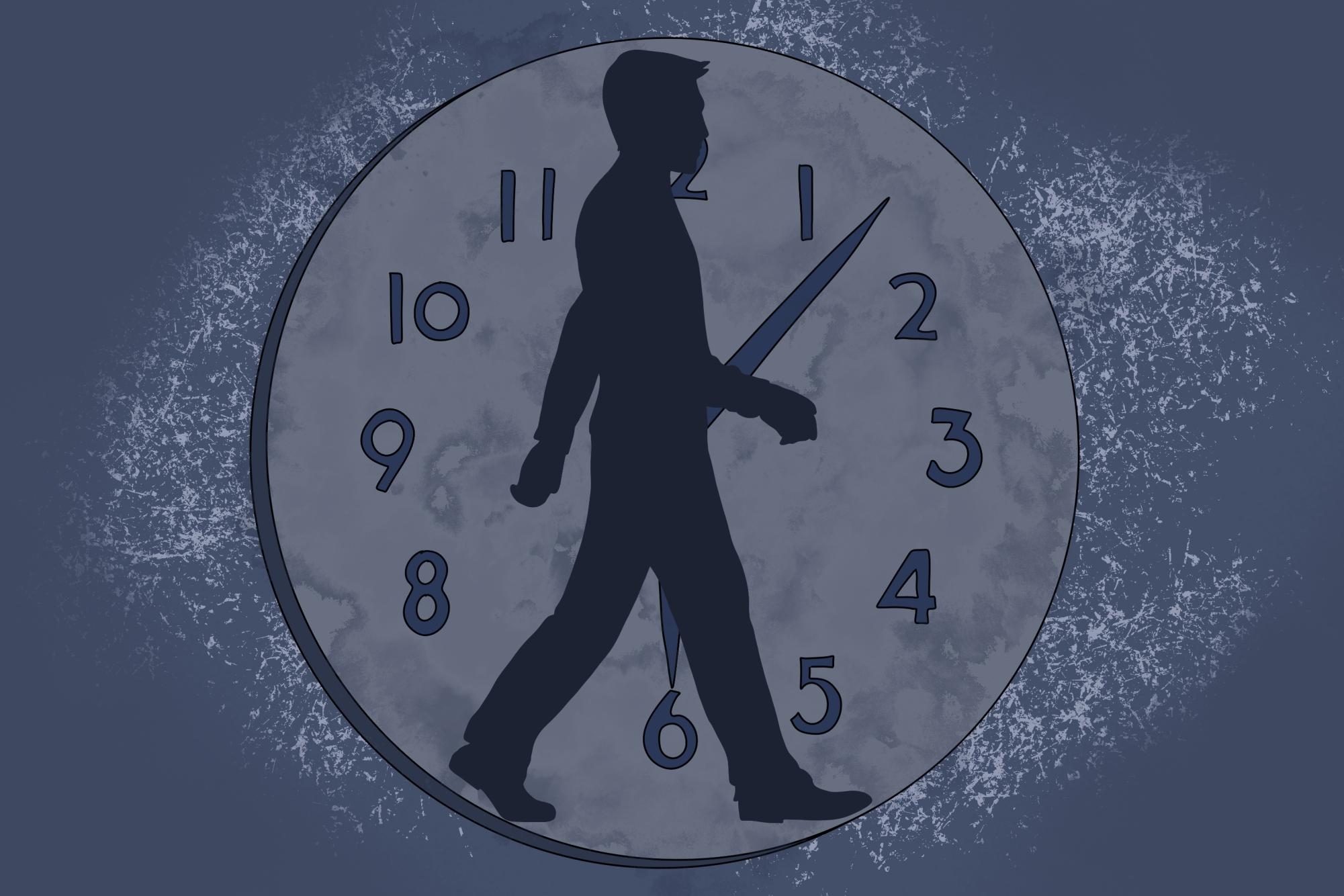
At around nine o’clock in the morning on the 18th floor of the Northwestern Memorial Hospital Arkes Pavilion, a study participant paces the floor.
In a sterile room overlooking the bustling commuters below, she walks briskly to a strip of grey tile, taps it lightly with the pad of her foot, pivots and strides back to a matching marker roughly 12 meters across the room.
Click.
The sound of a timer cuts through the squeak of the participant’s sneakers. After four minutes pass, Mallory Hubbard, an interning clinician and research coordinator, calls out that the participant has reached lap 30 with two minutes remaining.
“Why don’t you guys use a treadmill?” the participant asks, referring to the two machines that occupy the room.
Hubbard explains the body is too fixed in one position on a treadmill to track gait, an individual’s specific pattern of walking.
As it turns out, gait is quite physiologically complex. It’s one of the signals of biological age researchers are examining at the NU Medicine Human Longevity Clinic within the Potocsnak Longevity Institute to understand how humans age and can live healthier for longer.
Walking is an automatic process carried out by the brain and spinal cord, according to Joe Verghese, a professor and the chair of neurology at Stony Brook University who was not involved in the study. But it becomes more demanding when conditions change, such as on a dark street or uneven pavement and as people age or develop diseases that affect the brain or spine.
Measuring the process turns a movement as ordinary as a walk across the room into a biomarker of age. How fast a person walks is “an incredibly powerful indicator” of their biological age and overall health, said Director of Potocsnak Longevity Institute Douglas Vaughan.
Before the walking test, participants complete a battery of evaluations, including neurosensory, cardiovascular and pulmonary tests as well as blood-based biomarkers, to measure their aging. The culmination of these tests determine a participant’s “biological age,” a molecular and cellular level gauge of the wear and tear that aging processes cause in a body. This estimate can predict how much time someone has left.
A participant’s chronological age, by contrast, refers to the number of years a person has orbited the sun. Biological age, however, can exceed one’s chronological age. Gait serves as just one piece of the puzzle in understanding the difference between these measures.
How a smartphone and AI decode the way people walk
Defining aging in gait is difficult because no two people walk exactly alike, Kayan Abdou , a machine learning operations engineer at the Shirley Ryan AbilityLab, said. Rather than using a control group, the lab focuses on identifying “abnormalities” in gait.
To analyze the speed and movement of a participant’s gait, the lab works with physical medicine and rehabilitation Prof. James Cotton, a physician-scientist at the Shirley Ryan AbilityLab. Cotton is developing a unique artificial intelligence software tool that analyzes joint movement, speed and quality of walking. The ultimate goal is to create a new “movement age” by predicting a person’s biological age based on how they move.
“There’s definitely a long way to go to get to that point where we can just ambiently look at how people move and understand what it means about their health status, which is my goal,” Cotton said.
As participants complete a series of 10 assessments, a smartphone mounted on a tripod records them while a small sensor wraps around their hip. The measures include a six-minute “endurance” walk, grip strength, gait speed and balance tests.
Engineers and researchers at the lab then upload and process the tests’ data to run the biomechanical analysis. With each frame of video taken of the participant, the AI algorithm detects 87 key points across the body by placing digital dots at visible features, such as the right knee or the left ankle, to mark 2D joint locations, Cotton said.
But that’s only the first step. From there, Cotton said the system takes the analysis “a step further” by not only predicting where joints exist in space but also calculating the biomechanical joint angles.
The study’s software embeds physical constraints into the model to differentiate realistic movements from impossible ones.
After processing the data, the system then overlays a digital skeleton on the participant, accurately depicting how they move and the granular details of how every joint moves. When researchers measure those parameters over time, Abdou said the way a participant walks can be indicative of their health.
When a person walks, their steps are “very rhythmic,” said Jennifer Brach, a professor of health and rehabilitation sciences at the University of Pittsburgh who was not involved in the study. This means that step lengths and step times are similar between each step, Brach added. For example, if a person claps their hands every time someone takes a step when they walk, it should be a regular beat. When this rhythmic clap is irregular, it’s an indicator of declining health.
One abnormality is toe drag, or small differences in how the right and left feet clear the ground. A prominent statistical association for aging is gait asymmetry — differences in how the lower limbs move, the distance of each step and the speed of steps.
Participants who have experienced a stroke, for example, often have weakness on one side, and identifying asymmetries in limb movement is a strong indicator of recovery or regression in their disease. By comparing step length and stride speed between the right and left legs, the model can determine which side of the body is more affected.
“It can tell us about their brain health, their muscle health, even their balance and aging,” Cotton said.
A new tool for an old indicator of health
Although the clinic’s AI tool is new, researchers say the link between gait and health outcomes is not. Scientists have long used walking speed and gait patterns as indicators of aging, and there are a number of commercial gate mobility applications available on smartphones.
A person’s gait speed typically begins to decline in midlife onwards and continues gradually afterward. In the absence of disease, however, Verghese said the rate of decline is usually very slow.
What remains unclear is whether the new approach provides meaningful advantages over simpler methods of measuring gait already used in research.
“I think it will be another tool to quantify aging,” Verghese said. “The question is if it’s better than what’s already out there.”
While the lab continues studying how the tool might guide interventions for health outcomes, Brach said walking patterns can improve with exercise. When mobility improves, patients often see lower risks of falls and hospitalizations.
“By intervening in their walking, they have a better outcome,” she said. “To me, that means they’re living better and hopefully longer.”
Expanding the science of longevity
The NU Medicine Human Longevity Clinic launched amid a boom in high-end health and longevity clinics nationwide, Vaughan said. The U.S. alone houses around 800 clinics, with global investment in longevity clinics more than doubling between 2021 and 2022, according to A4M Medicine Redefined. Many of these clinics, Vaughan said, operate as “self-service” models, selling supplements or therapies that lack strong evidence of effectiveness.
Yet the Human Longevity Clinic doesn’t fall under this umbrella, Vaughan said.
“Sometimes it can be incredibly expensive, and a lot of untested and unproven therapies are given to people, and we’re not that,” Vaughan said. “We’re about the science.”
Researchers at the University are pursuing something more ambitious: understanding why and how we age.
What also sets the NU lab apart is its emphasis on at-risk populations, said Potocsnak Longevity Institute Fellow Bedirhan Boztepe. This year, researchers are launching a study involving patients with chronic HIV infections to test whether a dietary supplement can reset the gut microbiome and potentially alter their lifespan.
The institute also plans to study a cohort of survivors of childhood cancer to examine how radiation and chemotherapy may have accelerated biological aging. If accelerated aging is identified, Vaughan said, researchers hope to explore ways to slow it.
The clinic hopes to build a sample of people that are representative of Chicago’s population. Program Manager Kathleen Howard said representation is especially important in a city with one of the largest neighborhood life expectancy gaps in the country.
In Chicago’s Streeterville neighborhood, residents live to about 90 years old, on average. Just nine miles south, in Englewood, life expectancy plummets to about 60, according to a New York University Langone Health analysis. Currently, the clinic’s participant sample skews toward higher-income, white individuals. But researchers hope to widen the diversity going forward.
“That’s the gap we want to mind,” Howard said. “We want to make sure what we’re doing works for somebody there versus somebody here who can afford good food, green space, all those things that money buys.”
Walking around the world
For now, Chicago serves as the hub of the operation. But Vaughan ultimately hopes to replicate models of the labs globally to ensure Chicago, or America, isn’t the only place in the world able to implement interventions that mitigate health outcomes. In other areas of medicine, clinicians rely on advanced technologies. The clinic’s simple, stopwatch-only approach makes implementing Vaughan’s grand vision of a longevity lab on every continent easier to achieve.
“Do it in Japan. Do it in South America. Do it in South Africa. Do it in, wherever,” Vaughan said. “Cross those boundaries, those ethnic, cultural, climate boundaries and see if we can find some common interventions that are effective no matter where you live.”
To do so, labs around the world would follow the same protocols, training and trials to collect comparable data, and each lab would conduct their own clinical trials of its tailored interests.
Boztepe said some of the labs would probably have one or two pieces of expensive equipment, but the other tests would be able to be easily set up, making the gait analysis an example of accessibility. The protocols could then be tested across geographic populations that at times differ genetically, socioeconomically and environmentally.
“A person from Chicago is completely different from a person in Japan,” Boztepe said. “The big picture is to make these labs scalable.”
Collaborators in Japan are already underway with their own clinical trials, and Vaughan predicts that labs in South Africa and the United Kingdom will be up and running within 2026.
In order for an academic center to become a longevity clinic, it must share a “similar philosophy and principle of action,” Vaughan said. This philosophy entails a commitment to scientific rigor and doing work for vulnerable populations.
Vaughan emphasizes this rigor because longevity science is often distorted by efforts to help already healthy individuals cheat death using methods that aren’t scientifically grounded.
“We do try to stress that we’re not doing this for the top 1% of people in the world,” Vaughan said.
Within five years, Boztepe said he hopes there will be a consortium in which participating labs share access to a common database by having blanketed protocols and training. This would allow researchers to compare aging trajectories across populations. But individual sites could also adapt studies to their populations to combat health outcomes that pertain to their country.
Although the studies are in the preliminary stages, Cotton said he believes movement might be the “most meaningful version” of a biological age.
“I suppose if my heart is crappy inside me, I probably don’t like that,” he said. “But what I really care about as a human moving in the environment is how well I can do the things I want to do, get out of my house, participate socially.”
That distinction, he said, reflects the difference between lifespan and healthspan. Despite the additional research needed, Cotton said he is hopeful that defining “a movement age” is possible.
“There’s work to do,” Cotton said. “I’m very bullish that we’ll be able to develop a movement age that is meaningful.”
Email: [email protected]
X: @betsy_lecy
Related Stories:
— Northwestern study examines effects of long-term COVID-19 conditions through mobile tracking app
— Northwestern Medicine expands Basic Nursing Assistant Training Program, offers additional cohort
— Students use medical leaves of absence to improve health, recuperate for return to campus