Evanston/Skokie School District 65 parent Jason Orloff had a light fixture crash into him at the Joseph E. Hill Early Childhood Center in the spring.
The light sat right next to where a meeting room divider opened, and the divider bumped into the light each time it was set up, Orloff said, slowly wearing down the stability of the fixture.
“If every roof, every plumbing pipe, every electrical junction, if they’re all in that kind of shape, where things have fatigued … something is going to happen,” Orloff said. “And when a catastrophic failure like that happens, it’s truly a danger.”
Orloff was at the center for a meeting focused on the district’s finances. In the building, another group discussed the district’s facilities — including things like the fatigued light fixture that fell.
The work these groups were doing addressed issues like the light fixture, which is part of the district’s $188 million in deferred maintenance. This, along with the district’s declining enrollment and underutilized capacity, are drivers of District 65’s Structural Deficit Reduction Plan, a project that is now over a year and a half in the works.
Since April, the Finance, Facilities and Student Programming Committees have evaluated their respective topic areas to determine ways the district can cut $10 to 15 million of spending in Phase 3 of the SDRP.
The committees’ work will culminate in a presentation of initial cost reduction scenarios — including potential school closures and consolidations — at the District 65 Board of Education meeting Monday.
Creating scenario criteria
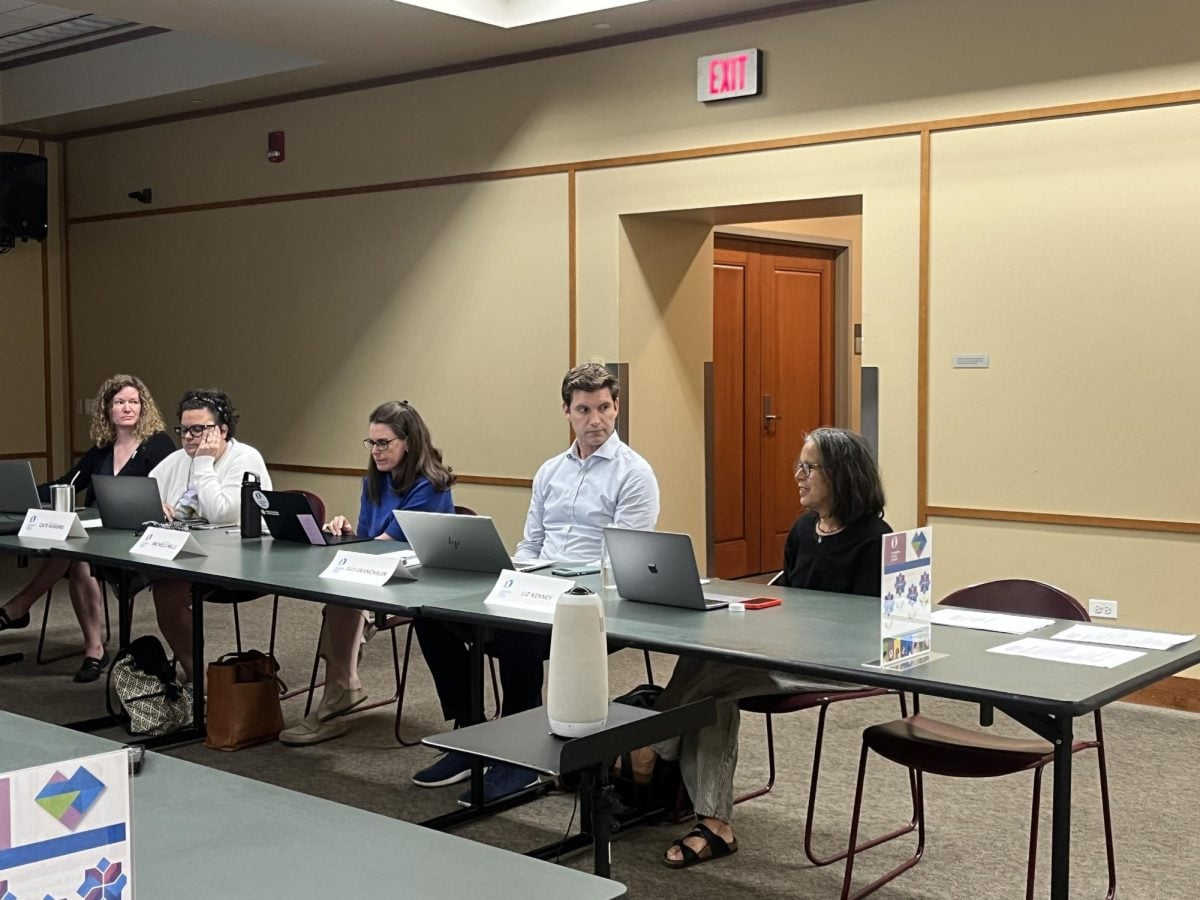
At a June board meeting, members of the Finance Committee shared that the ideal scenario is one where the district closes two to four schools, each of which costs $2 million per year in operating costs. Their work was supported by an analysis of the district’s various expenditures, including transportation.
Members of the Facilities Committee also shared their criteria to evaluate schools at the meeting.
“We considered that data through a number of lenses, meaning you had a wide variety of expertise, a very diverse set of people on that on that Facilities Committee, and we didn’t always see the data in the same way,” said Seth Weinert, a District 65 parent and committee member. “And so we learned from each other, and there was a lot of agreement, there was some conflict.”
Weinert emphasized that the Facilities Committee conducted its work — reviewing documents such as the district’s facilities plan and HVAC system costs — in “a dispassionate and data-driven way,” straying from emotions attached to any specific school.
Fellow committee member Bridget Wild said most members didn’t know what schools their colleagues represented.
Community members were given the opportunity to provide feedback on the criteria over the summer. The district scored each school on the criteria to help inform potential closure decisions.
“These criteria are agnostic of which schools will score what because they will be plugged into a different model that will push out different scenarios,” Wild said. “(For) a lot of them, as you can see in the sub-criteria, the score would fluctuate depending on which schools you would consider for consolidation.”
According to public committee meeting minutes, the Facilities Committee has evaluated different versions of about four scenarios to present to the board.
As the committee concluded its scenario work, Weinert said the conversations became “more emotional.”
“I think when you start looking at specific schools and specific programs and truly understanding the impact that the board’s decision will have on people’s lives, that has a way of making numbers on a piece of paper seem very, very real,” he said.
In a letter published in the Evanston RoundTable, District 65 Board President Sergio Hernandez and Vice President Nichole Pinkard wrote that the board is looking at the scenarios with three goals in mind: increasing building utilization from 65% to between 80 to 90%, creating a sustainable operational budget and maintaining a fund to address the capital needs of district buildings.
The board leaders emphasized that the impact of decisions goes beyond statistics on who is affected.
“School closures and consolidations affect children, families, and neighborhoods,” Hernandez and Pinkard wrote. “The board remains committed to ensuring that every decision leads toward excellence in educational opportunities and outcomes for all students.”
Through Phases 1 and 2 of the plan, the district reduced costs by about $20 million — $6.5 million in Phase 1 and $13.2 million in Phase 2. These cuts helped significantly reduce the district’s budget deficit for the 2025-26 school year, from $13.2 million to $710,000, Tamara Mitchell, the district’s chief financial officer, announced at an August board meeting.
For Orloff, the scenarios set to be presented “cast a wide net” to give the board options in its decisions, he said.
“There’s things we as a school district can’t do, like keep all the schools — unless we find a way to fund them,” Orloff said.
He said he doesn’t know what that funding would look like, but suggested a referendum as a possibility.
Student Programming Committee role to ‘audit,’ not scenario build
For many Student Programming Committee members, the committee’s work is not meant to be viewed on its own, but in the context of the other committees. The programs the committee looked at not only need financial support to exist, but must also be housed in a building. However, the work of the Finance and Facilities Committees does not explicitly inform the work of the programming committee, member Terri Shepard said.
The committee’s work instead fits the larger picture by making recommendations to improve the effectiveness of the district’s programming, committee member Matthew Roberts said.
“From my perspective, it’s almost like it feels more like an audit of existing resources to try to create some sort of coherency,” he said.
In-school programs include Two-Way Immersion, the African Centered Curriculum and early childhood education. According to public meeting minutes, the committee is now looking at out-of-school programming, like summer childcare and Books & Breakfast, a before school tutoring program.
Shepard said such evaluations are a “tremendous amount of work” because the committee only has so much time at each 90 minute to two hour meeting.
“We could spend, sometimes not more than five minutes on it, dissecting the question, discussing the answers, and on some we didn’t even feel we could start our response, because we weren’t totally in agreement or understanding of what they (were) asking for,” Shepard said.
What the committee is doing is similar to that of the district’s Student Assignment Planning committees, which help the district ensure all students have equitable access to district programming.
Student Programming Committee member Henry Wilkins has been part of SAP for two iterations of the committee, but said having the work be attached to financial implications — like the district’s SDRP — is beneficial.
“You can make grand ideas, but can it really work for the school district and what you know they’re faced with? I think (the SDRP) actually will sharpen the recommendations that come from the committee,” Wilkins said.
Like Weinert, Wilkins said the scenarios presented to the board will lead to an “emotionally charged” community depending on what gets recommended. Wilkins said he has “no clue” what the scenarios that will be presented look like.
He added that despite this, he knows the committees put “considerable thought” into being equitable in their work.
Putting the pieces together
Susan Harkin, the district’s SDRP consultant, said at a June meeting that combining the work of each committee occurs at the district level.
District 65 declined a request for an interview with district staff working with the committees.
The only time the three committees interact is during share-out sessions at the end of each meeting. The format for that time is a presentation from each committee followed by time for questions, Weinert said.
For many members of different committees, presenting at school board meetings like the one in June, was the first time they were able to speak to each other about the work they were doing, Orloff said.
Weinert emphasized that after the scenarios are presented, community members should take the time to consider them and their benefits for them as individuals, but also for their community.
The overarching goal driving the committees’ work is giving students a good education, Wild said. For her, this meant dreaming a little bigger about the kind of facilities students should get to learn in, she said.
“I do think that we owe it to our students to be a little bit aspirational and to point out that we have a very aging infrastructure. What school looked like when many of these buildings were built is very different than what happens in classrooms right now and how we use space,” Wild said. “I think that that has to be part of it, even though our purpose for coming together right now and having this big moment is really related to the structural deficit and our changing population.”
Email: [email protected]
X: @anavi_52
Related Stories:
— D65 board discusses accountability report, deficit reduction scenarios
— D65 to roll out new device policy, remove race from consolidation considerations