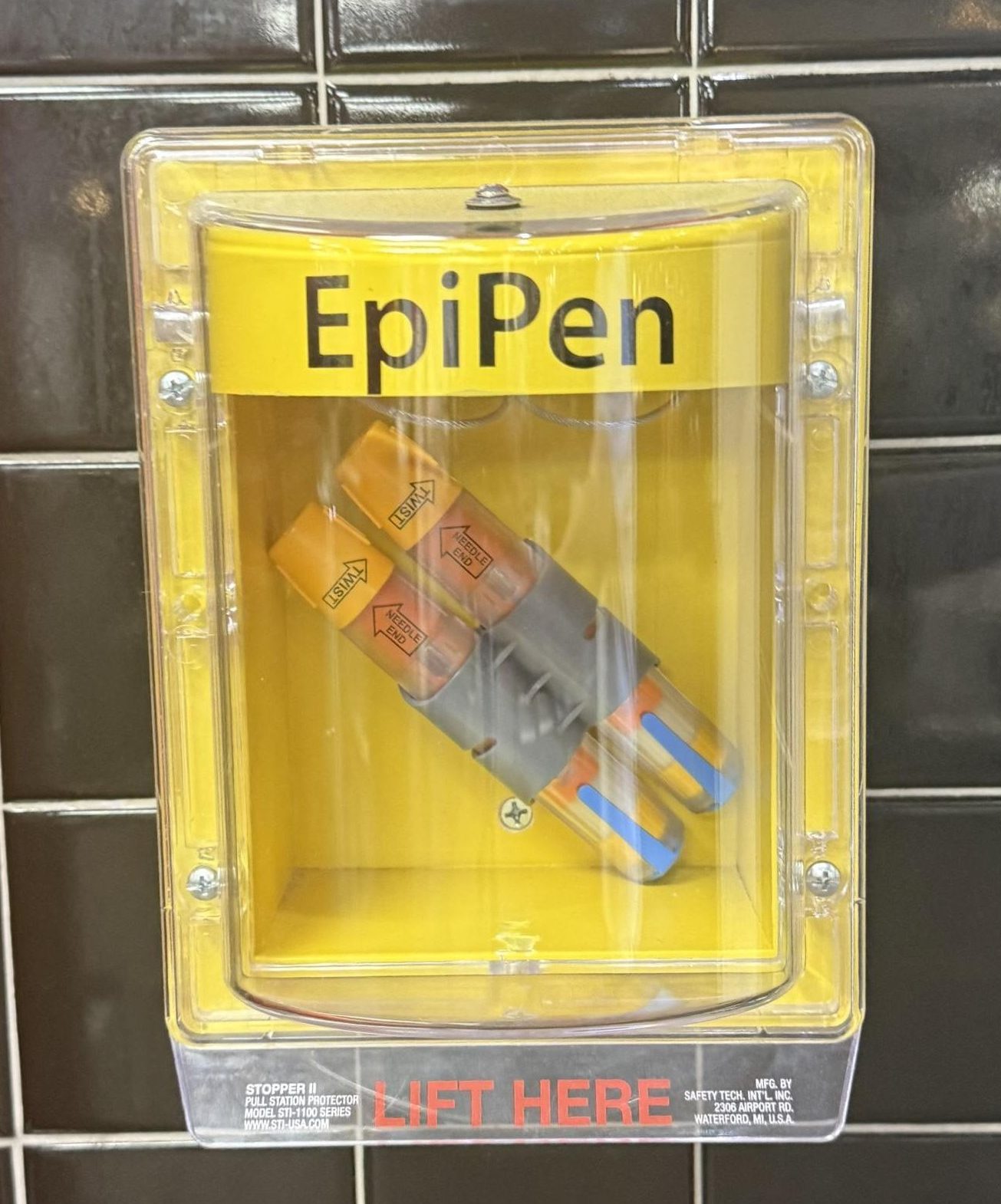
Several universities across the country keep undesignated stock epinephrine in their dining halls, providing a critical medication for students facing severe allergic reactions to food.
The University of Michigan, the University of Maryland and Illinois State University are among the few schools that have implemented the stocking of undesignated epinephrine — adrenaline prescribed for an organization, not a specific patient — such as EpiPen or AUVI-Q.
These autoinjectors provide extra time for students and staff to receive emergency care if they experience anaphylaxis, a high-risk allergic reaction that occurs within minutes or seconds of a person ingesting their allergen. Epinephrine autoinjectors are typically administered in an individual’s thigh and temporarily open up the individual’s airways.
Food allergies are not uncommon on college campuses. An ongoing study conducted by Feinberg’s Center for Food Allergy and Asthma Research found that 1 in 10 college students are clinically diagnosed with food allergies. A 2009 study found that 42% to 63% of 513 students reported having an allergic reaction while in college, with 56% of these students having anaphylaxis symptoms.
Food also often influences students’ social interactions, especially in dining halls, and social pressures can sway students’ encounters with food.
The 2009 study also reported that only 40 to 50% of college students avoid their allergens, engaging in risky behaviors, such as trying unfamiliar dishes or not inquiring about ingredients, out of fear of exclusion and embarrassment.
Yet, only 11 out of 217 universities verified by the Food Allergy Research and Education organization reported keeping undesignated stock epinephrine in their dining halls.
But the schools that do have undesignated stock epinephrine available in their dining halls say they’re thankful to have it on hand should allergic reactions occur.
Bringing epinephrine to university dining halls
For UMich, the catalyst for epinephrine availability in dining halls began in 2015, when Public Act 221 was passed in the state, allowing authorized personnel on campus, such as dining staff, to possess epinephrine. According to The Michigan Daily, students had requested epinephrine in dining halls for years, but previous legislation did not allow the school to purchase it.
The school obtained the medication through a blanket prescription with help from their UM Health team, along with a standard operating procedure outlining the proper steps to administering the epinephrine. The program was then implemented in 2019.
Michigan Dining now stocks AUVI-Q auto-injectors in all its dining halls and requires staff to complete annual anaphylaxis response training verified by FARE.
UMich nutrition and procurement supervisor Eliza Haffey explained that while having epinephrine in the dining halls is expensive, since epinephrine autoinjectors typically expire after one year and require replacement, it is “worth it” to save a life.
“No matter what we do, there’s going to be potential for allergic reactions,” Haffey said. “We can educate students to read our menu signs all we want, but we work with a very risk-taking age of individuals.”
Since its establishment, UMich’s epinephrine has been used approximately twice a year, according to Haffey, helping both students and staff members get the immediate care they need.
Haffey said that in the past, it was used to help a staff member with a shellfish allergy. The chef had been cooking shrimp when she experienced an allergic reaction. An assistant manager administered the undesignated epinephrine for her, as she had never used it before.
Navigating legal challenges
Laws allowing organizations to own and administer epinephrine differ from state to state. For UMich, policy changes made it easier to implement undesignated epinephrine programs.
But at UMD, implementing the same program required changing state laws, as previously, the state did not permit organizations to obtain epinephrine prescriptions. According to Maryland Today, the University Health Center and Dining Services Director worked with UMD’s Office of Government Relations and Del. Joseline Peña-Melnyk, who represents Prince George and Anne Arundel counties in the state.
Their collaboration led to House Bill 1473, which created the Emergency Use Auto-Injectable Epinephrine Program, allowing college campuses to stock undesignated epinephrine. The program went into effect in October 2018.
Bart Hipple, assistant director of marketing and communication for dining services at UMD, described the process as lengthy, involving multiple proposals over several months. But ultimately said it was helpful to have the medication available in all of the campus dining halls.
“Having the epinephrine keeps the students’ faith,” Hipple said. “They know they’ll be taken care of because we have this ‘insurance policy.’”
Hipple said UMD has not had to use their epinephrine more than twice a year since the program’s implementation. Even while use cases are low, several universities with the program, like ISU, still consider it necessary.
ISU placed EpiPens in some dining locations in 2019 after noticing a rise in students with food allergies on campus. ISU dietician Morgan Tarmann told The Daily that 7.6% of students on the meal plan have a food allergy and that having the epinephrine is an added measure to make dining on campus safer.
The university obtained epinephrine through a prescription via their university health center and stores it in dining halls that can only be accessed with a key or by breaking the glass.
Allergy accommodation at NU
Ruchi Gupta, founding director of CFAAR at Feinberg, said that the presence of stock epinephrine increases student comfort. Her daughter, who has food allergies, attends Duke University, another school with undesignated epinephrine in its dining halls.
“I know it just makes her feel a little bit better, that (stock epinephrine is) there, and she knows where it is if she needs it,” Gupta said.
NU does not currently have stock epinephrine in its dining halls, though Plex West is a dining hall where all the food is prepared free of the top nine allergens. In addition, all other dining halls have “Pure Eats” stations that offer food cooked separately from other dishes, free of the allergens.
Preena Shroff, president of the NU chapter of College Advocate for Food Allergy Awareness and Education, said that while these precautions are important, she believes every dining hall should also have undesignated stock epinephrine.
Shroff is a student who is allergic to 15 different food items, including chickpeas and raw carrots. She experienced an allergic reaction in a dining hall when white bean casserole, a Pure Eats staple she often ate, was replaced with chickpeas in the same section without clearly indicating the change.
Shroff emphasized that an undesignated epinephrine program would provide an extra safety net in addition to NU’s existing allergen-free food options.
“(People say) students should be carrying around their own epinephrine,” Shroff said. “And I do have my epinephrine. But some students are rolling out of bed and grabbing breakfast, and they might not.”
She has advocated for an undesignated stock epinephrine program at NU for three years. But legal and logistical barriers still exist, and progress has been slow.
At NU, Compass, the dining contractor, can approve such a program. The company has expressed hesitancy, according to Shroff, as the idea of administering a drug via injection raises liability concerns.
“It’s a massive liability for them to take on, despite the fact that epinephrine is more or less harmless, right? It’s something that’s naturally produced in your body,” Shroff said.
She added that to remedy these concerns, neffy — an epinephrine intranasal spray — has been approved by the Food and Drug Administration for use, and nasal medications are considered less of a liability.
FARE’s certified epinephrine administration training — used by institutions like UMich — is available online at no cost. However, NU Dining staff are not permitted to use mobile devices during work hours, making it difficult to complete the training onsite that creates a barrier to ensuring all dining staff are equipped to administer epinephrine.
In a statement to The Daily, Compass regional marketing director Devin Davis wrote that currently NU Dining is “not pursuing the implementation of undesignated stock epinephrine in dining halls,” adding that they are focusing on maintaining their current food allergy protocols like ingredient labeling and cross-contact prevention.
Shroff noted that epinephrine has its own limits. She said it is a temporary solution, allowing the patient extra time to get to the hospital, and that there is limited research on how to prevent anaphylaxis from occurring at all.
Despite the limits, Betsy Craig, CEO of allergen labeling company MenuTrinfo, said that stocking undesignated epinephrine is necessary to support diners who experience an unanticipated allergic reaction from eating food.
“Twenty-five percent of people have their first allergic reaction outside the home without knowing they have an allergen ahead of eating the product,” Craig said. “Sometimes people have an allergic reaction when they think they are being safe.”
Craig believes stock epinephrine will, and should, become the standard in dining spaces.
“I think the day is going to come where everybody has it,” she said. “I personally want to see that happen in this industry.”
Email: [email protected]
Related Stories:
— Mental health support site provides community for students to open up about struggles
— Students advocate for food allergy awareness and education through CAFAE
— McSA students raise concerns over halal food mislabeling in dining halls, cross-contamination