

New York Times reporter pushes for more climate change coverage
Bernard Wen/The Daily Northwestern
Justin Gillis, an environmental science reporter for The New York Times, speaks to a crowd of students, faculty and local scientists about the realities of climate change and how accurate journalism can combat public apathy on the issue.
October 17, 2012
New York Times environmental reporter Justin Gillis advocated for increased urgency in dealing with climate change during an on-campus talk Tuesday evening.
“One of the urgent tasks of our time is for people like us to find a common language to alert the public to the reality of the situation we are in,” Gillis said at the beginning of his lecture.
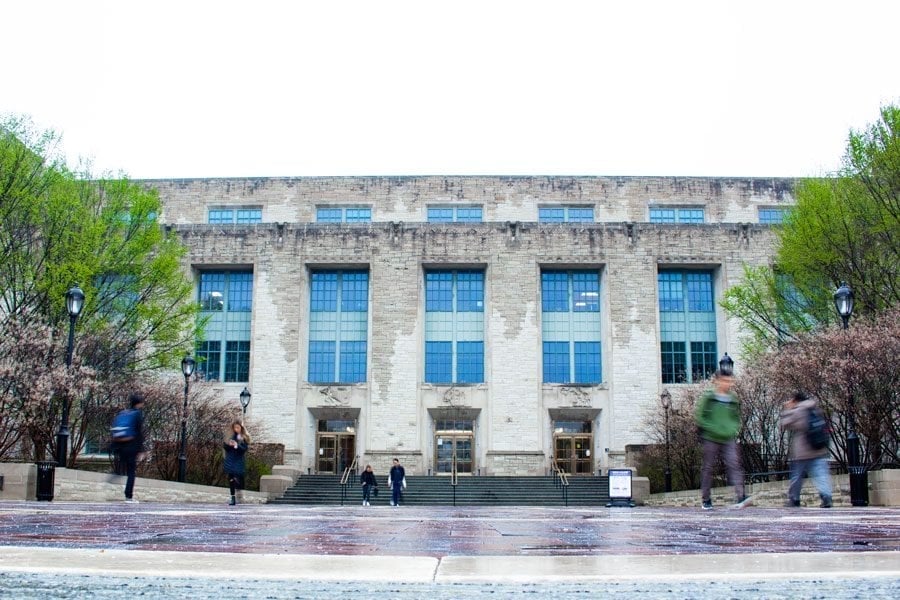
The event, hosted by the Northwestern Energy and Sustainability Consortium, brought together an audience of journalists, scientists and other interested members of the Northwestern community in the McCormick Tribune Center. Just more than 100 people attended in total.
Gillis’ recent 10-part multimedia series, “Temperature Rising,” received critical acclaim in both the environmental science and journalism fields.
David Snydacker, a graduate student representative for NESC, organized the event to emphasize the importance of the connection between science and the media when it comes to the issue of climate change.
“Climate change is a really fascinating subject, but it’s hard to get scientists who study climate change to comment on problems like communication,” the McCormick graduate student said. “Somebody like Justin, who has traveled the country and spoken to many prominent climate scientists, is particularly well situated to synthesize all the information and to make it relatable and understandable for non-climate scientists.”
The award-winning reporter pointed to polling data that shows more than 50 percent of Americans believe global warming exists but very few understand the urgency. Gillis illustrated his point by comparing photos of the Arctic ice caps taken by satellite Nimbus-7 in both 1979 and 2012, showing that more than 50 percent of the ice sheet has already melted.
“There’s a possibility of up to 250 feet of sea level rise locked up in the Arctic ice caps,” Gillis explained. “Tens of millions of people live within 100 feet of sea level, and many of the world's major cities are just a few feet above sea level."
Maninpat Naviroj, another McCormick graduate student, said he enjoyed hearing about the climate issue from a journalist as opposed to a scientist.
“He has been in the field for so long and that he feels that one of the biggest problems is conveying the issue is a new insight for me,” Naviroj said. “Because I come from an engineering background, I am used to thinking about it from the science side rather than the rhetoric side.”
Following the lecture, Gillis took questions on a variety of topics from the audience, including what scientists can do to help advocate for a response to climate change, and how much of a connection the recession had to the diminishing role of the environment in news coverage.
Gillis said he was happy to deliver the talk at “the best journalism school in the country” and “one of the best universities in the country.”
“If you look at the politics of the moment, things are just not moving,” Gillis told The Daily following the talk. “The overriding imperative here is to get accurate information over to the public and in order to do that we’ve got to go back to the basics … So I feel like if I’m going to come anywhere and make this case for upgrading our journalistic knowledge base, this is the right place to do it.”










“There’s a possibility of up to 250 feet of sea level rise locked up in the Arctic ice caps,” Gillis explained.
Gillis should either clarify what he means by "Arctic ice caps" or read a science book. The Arctic ice float on the ocean, there are no land masses beneath it. If you've ever seen a glass full of water with ice in it, you'll understand what I'm talking about. When the ice melts, the water level doesn't rise, and if the Arctic ice cap completely melts, since it floats water, the sea level will not rise. Where he comes up with this 250 foot number is beyond me, other than the obvious fear-mongering he hopes to engender among the scientific-illiterate.
[Reply]
Mark Silberg Reply:
October 17th, 2012 at 1:34 pm
http://www.skepticalscience.com/stable-greenland-ice-sheet.htm
[Reply]
David Snydacker Reply:
October 17th, 2012 at 7:29 pm
Hi Pinroot,
Justin was talking about earth's two polar ice caps - Arctic and Antarctic. When these ice caps melt, the water flows into the oceans and causes sea level rise.
Thanks for your question.
-DS
[Reply]
This is what happens when you have someone that only intends to create fear and panic rather than address facts. I don't even read Justin's columns anymore because he's an activist not an honest broker of objective evidence.
[Reply]
David Snydacker Reply:
October 17th, 2012 at 7:36 pm
Hi Sundance,
Please do take the time to read Justin's series, "Temperature Rising", because it is excellent. I think you will find a calm and rational writing style (not fearful or panicked as you say).
Thanks,
DS
[Reply]
Sundance Reply:
October 17th, 2012 at 9:30 pm
DS - Justin and you (based on your Polar melt comment above) seem to not know that Antarctic ice mass balance has been growing by 49Gt/year since 2002. The AGU has for the first time accessed the underside of Antarctic glaciers and found no melt at the glacier bottoms as was assumed. Both of these discoveries mean that the models are inaccurate. The discovery that the scientists were wrong about Antarctic ice melt is 6 months old after it was discovered that the GRACE Satellite was inaccurate and ICESAT DATA confirmed the ice growth.
If you can show me where Justin has told his readers that the Antarctic ice mass balance is growing not melting then I will reassess my view of him. Thank you for you kind comment.
[Reply]
"photos of the Arctic ice caps taken by satellite Nimbus-7 in both 1979 and 2012, showing that more than 50 percent of the ice sheet has already melted. “There’s a possibility of up to 250 feet of sea level rise locked up in the Arctic ice caps,” Gillis explained.
What a great "climate communicator" (aka "shameless propagandist") Gillis is.
Sea level has allegedly risen about 2 1/2 inches (75 mm) from 1980 to present, according to the United Nations.
http://unesdoc.unesco.org/images/0018/001893/189369e.pdf (see page 2)
If 50 percent of the ice sheet has melted since 1979, that means the remaining 50 percent will cause another 2 1/2 inches of sea level rise, a very far cry from "250 feet."
By the way, the Antarctic ice sheet is expanding, not melting.
[Reply]
Mark Silberg Reply:
October 17th, 2012 at 1:32 pm
http://www.skepticalscience.com/antarctica-gaining-ice.htm
[Reply]
Sundance Reply:
October 18th, 2012 at 6:02 pm
The article you link referrences old studies and hasn't been updated to include the GRACE data reassessment. SkepSci is an unreliable source as it is often incomplete and often excludes all research on subjects they address. You need to source your information directly from papers and climate center data if you want to know what's going on with climate.
[Reply]
David Snydacker Reply:
October 17th, 2012 at 8:03 pm
Hi Garry,
Sea ice melting does not contribute to sea level rise, because sea ice is already in the ocean. However, Arctic sea ice melting is "a harbinger" of future icesheet (land ice) melting. Justin discussed this at the event.
The concern for sea level rise is the collapse of icesheets on Greenland and Antarctica. When these icesheets melt, the water flows off the land and into the ocean, causing sea level rise. Looking at the geologic record, scientists can see that sea level has varied dramatically with global temperatures.
Thanks for your question.
-DS
[Reply]
How many of the commenters above were at the talk yesterday? I suspect none of you. If you were, you'd understand that his message is not alarmist but precautionary, and that the man is smart enough to draw a distinction between ice sheets over land and over water.
[Reply]
It is truly sad that we have Climate Change detractors at NU! Get informed on the facts and stop denying what is so plainly obvious that everyone else is doing something about it. Jamie I like your articles. They have quality to them.
[Reply]
Quantitatively ignorant journalists are the enablers of quantitatively ignorant politicians who , using the force they wield , can do great harm to our welfare .
Anyone who cites the totally irrelevant fact that 250 feet worth of ocean level of ice remain frozen from the last ice age in the thousands of feet on the Antarctic and Greenland is simply a propagandist .
If he does not discuss the fact that there has been no measured global warming in the last decade and a half despite a rise of around 4% in CO2 showing that it's effect on temperature is dominated by other factors , he is not telling the whole truth .
If he does no point out that life exists on earth only because ALL the oxygen we catabolic animals breath was locked up in CO2 until photosynthesis evolved and since then green life flourished so successfully that it drove CO2 down to the few molecules per ten thousand necessary to sustain green , and therefore all , life , he is not presenting a balanced picture of the value of this building block , along with H2O , of the biosphere .
As an undergrad and grad student at NU from about 1966-79 , It is truly sad to see future journalists being duped by such profound stupidity believing they can evaluate such propaganda without learning the quantitative science for themselves .
[Reply]